The post Fighting or Feeding Your Demons? It and Facing up to Historical and Intergenerational Trauma appeared first on Rewriting The Rules.
]]>I will be talking about the ending of the film though so have a spoiler alert for that up front. TLDR: It’s better than the giant spider in the book, but not much. However at least there was an ongoing joke though the movie about horror authors who write bad endings.
Historical and Intergenerational Trauma
When I saw the first movie of this Stephen King story I wrote this post about intergenerational trauma because the film did such an excellent job of demonstrating how we pass trauma down through the generations. While I enjoyed the sequel immensely I feel like it lost the powerful message of the first movie, as well as missing an obvious opportunity to say something helpful about how we can face demons and prevent these patterns from repeating themselves.
To recap on my first blog post, the story of the first It movie links historical and intergenerational trauma and demonstrates how these things will just continue down the generations if we don’t address them. The first film focuses on the children facing It – in the form of Pennywise the clown – in the small town of Derry 27 years ago.
In terms of historical trauma there’s a sense that the monster in It came into being around the time of settler colonialism and the genocide of indigenous Americans. In that way It can be seen as a reflection of human evil: holding up a mirror to the violence we do to each other, to other species, and to the land. The monster in It reappears every 27 years and the horrors it perpetrates relate to the human evils that are present at the time. So we see It whipping up racism and white supremacy in the 1930s and homophobic hate crimes in the latest incarnation. There are also scenes relating to violent patriarchal treatment – and sexual and physical abuse – of women. In this way there’s a clear message that historical trauma unfaced will just find new forms and continue. Some bodies and lives will always be valued less than others, subject to oppression and violence. We can see this vividly at the moment in the way that the current trans moral panic echoes the 1980s moral panic against gay men.
In relation to intergenerational trauma, each time It comes back it preys on children, and each time the parents are oblivious to what is happening. In the first movie this is clearly related to the way each generation of parents perpetuate the traumas that happened to them on their own kids: from ignoring school bullying, to physically punishing their kids, to emotional neglect, to over-protectiveness and controlling behaviour, to the sexual abuse of a bereaved father. The message is that if we don’t look at what happened to us – and do our work around it – then we won’t see what’s happening to the next generation. Even worse we may well go from victim to perpetrator: acting out the same abuses ourselves.
Confronting our Demons
In the second movie the kids who battled It in the first film are all grown up. It returns to Derry and they are called back to face it again in the hope of eradicating it entirely this time, rather than just sending it away for another 27 years.
There’s a huge potential in this film, then, to address the question of how we – as adults – might acknowledge historical and intergenerational trauma and their impact. What ways might there be to put a halt to these recurring patterns rather than continuing to act out the very violences that were done to us? The metaphor of the demon who keeps returning presents a powerful opportunity to address what we might do with our own personal and cultural demons.
What the movie does do well is to be clear that we have to go back. Choosing not to engage with the past – and to pretend the pain of the present is not happening – simply isn’t an option. Others will be hurt and – in the end – we will also be hurt a lot more than if we did face our fears. Choosing not to engage is choosing a kind of death, or at least a life of remaining asleep rather than waking up to reality and doing something about it.
The adults in the movie all have to revisit the most frightening moments of their pasts as the first step towards battling Pennywise. Again this is a great message. Unless we can fully face – and feel – the impact of these traumas upon us then we can’t acknowledge how they’ve shaped us: the survival strategies and habits they’ve left us with. Without that understanding we won’t be able to shift those patterns and we’ll simply be doomed to repeat them: hurting ourselves and others in the process.
My sister also pointed out that the movie has a smart metaphor for the mechanisms that often prevent us from facing the past and its impact on the present. The characters have all forgotten the details of what happened to them in childhood. We could see this as a metaphor for the kind of cultural and familial gaslighting which many of us experience: a strong message that it isn’t acceptable to question the power dynamics in play or their impact; that we must protect the status quo, and other people from the painful truths of the situation.
The forgetting, dissociation and confusion experienced by the characters is reminiscent of the impact of receiving that strong cultural/family message that it isn’t safe to question, and that if anybody is suffering due to social structures or family dynamics then it must be their individual fault and responsibility, not a flaw in the society or system. Hence we see Bill blaming himself for Georgie’s death, and other characters being held – and holding themselves – responsible for the bullying and abuse they received.
The Demons within Us
However, where the second film falls down – in my opinion – is that it never gets the other piece of the equation. We see how the adults have to revisit their childhood traumas and look after the victim/survivor sides of themselves back then, acknowledging the impact that it had on them. But the adults in It are all presented is pretty good people, maybe a little flawed. We never get the sense of how they – as adults – have become the generation who are now doing the damage. This was clear in the adults in the first movie, but not in the second.
Also, in the second movie, we learn that It was some kind of alien monster which arrived from another planet to wreak havoc on humans. To me this takes away from the sense of It being something caused by human evil and reflecting it back to us.
The film quickly becomes a battle between the good guys (our group of loser kids all-grown-up) and the bad guy (Pennywise). All they have to do is to face it and beat it and then all the intergenerational and historical trauma just goes away.
Fighting Our Demons
From this simple good vs. bad perspective the end of the film makes sense. The group confront Pennywise and they fight it using the Ritual of Chüd: an indigenous American ritual which Mike says was used to banish It before (the stereotypical depictions of indigenous Americans, and Black people, in Stephen King books and movies is an issue here, of course). When this doesn’t work entirely they come up with their own plan which is to shrink it down to size by making it feel small: shaming it and denying It any power by showing how they’re not scared of it. Once it has shrunk they can destroy it.
I think this gives a terrible message. It suggests that we can fight our outer or inner demons and just eradicate them. There’s no sense that the characters have to acknowledge humanity’s own role in creating this ancient evil and the damage it’s continuing to do. Nor do they have to acknowledge the demonic within themselves: their own potential for hurting others through their unacknowledged patterns and habits.
Finally – as my friend Anita who I saw the movie with pointed out – the way the Losers fight the demon is to use the very tactics that were used against them: bullying and shaming. This reminded me of this famous Audre Lorde quote :
For the master’s tools will never dismantle the master’s house. They may allow us to temporarily beat him at his own game, but they will never enable us to bring about genuine change. Racism and homophobia are real conditions of all our lives in this place and time. I urge each one of us here to reach down into that deep place of knowledge inside herself and touch that terror and loathing of any difference that lives here. See whose face it wears. Then the personal as the political can begin to illuminate all our choices.
It seems to me that exactly what the group does here is to use the master’s tools: the abuse, shame, bullying, and violence that were enacted against them, and that have been enacted against oppressed groups historically. In a way it would’ve worked well if they’d used this tactic at the end of the first movie, meaning that It inevitably came back and they had to find another tactic. But the message that this is the tactic that actually worked is a terrible one. They never do have to ‘reach down into that deep place of knowledge inside themselves and touch that terror and loathing of any difference that lives there’. They never have to acknowledge their involvement in historical and intergenerational trauma. They never really have to face their demons.
Feeding Our Demons
I found it fascinating that the ritual in It was called the Ritual of Chüd because it is such a similar name to a Tibetan Buddhist ritual which I’ve been adapting in recent years as part of my own work: Chöd practice, or feeding your demons. Intriguingly, Chöd practice explicitly offers an alternative to fighting – or using the master’s tools – which is perhaps a better way of addressing our cultural and personal demons.
Briefly what you do in Chöd practice is the following:
- Locate your demon: Tune into whatever you’re feeling, find it in your body, and visualise it.
- Visualise your demon: Take this visualisation and imagine it as a demon sitting in front of you.
- Ask your demon: What do you want? What do you need? How will you feel if you get what you need?
- Embody your demon: Move across to take the position of the demon, feel how it feels, answer the questions as the demon.
- Feed the demon: Return to your position, imagine yourself dissolving into some kind of nectar – or food – which gives the demon what it needs.
- Welcome the ally: Observe what happens to the demon. There’s a sense that – on getting what it needs – it may well become an ally to help you instead of the demon that was making things so hard for you.
So I remember one time I did this ritual I felt this horrible tight clenched feeling in my chest. When I felt into it I visualised it as old rusty metal all around my heart. When I turned it into a demon it became a terrifying huge transformer-type robot in front of me with fire burning deep in its dark eyes and massive mouth. When I inhabited it, it felt exhausted and in constant pain. I asked it the questions and the answers were that it wanted to destroy me, that it needed rest because it was so ancient and tired, and that it would feel huge relief if it got that. I imagined dissolving into lubricating oil finally easing the rusted metal. It eventually all collapsed (rather like the house at the end of It) and in its place was a pool (again rather like the lake at the end of It) and some kind of being made of water emerged: a sense of cool, calm and fluid in the place of hot, tense and brittle.
There’s a sense from this practice that our demons are the kinds of survival strategies we developed as kids. Over time they have become harmful to ourselves and others, but if we can face them and listen to them, they can morph into allies. In this way the practice is similar to embracing our inner critics, something I plan to write about here in more depth soon and touch on in my Plural Selves zine.
In the example I gave, I read this as the demon being the survival strategy of armouring over my feelings to protect myself, but there was the sense that this strategy got in the way of intimacy with myself and others, leaving me brittle and controlling in ways that risked damaging – or even destroying – myself and my relationships. The practice suggested an alternative pattern of loosening, or dismantling, the armour over time: becoming more vulnerable and fluid.
It: The Alternative Ending
So how would It have ended if the group had applied Chöd practice instead of the Ritual of Chüd: If they had fed the demon instead of fighting it?
What does It want?
It’s very clear that It wants to frighten people, that it feeds on fear.
What does It need?
But what does It actually need underneath that desire for fear? Again the answer is pretty clear in the film. Several times It – in the form of Pennywise the clown – speaks of being unseen and lonely. It tells a small child that nobody will look it in the face and expresses distress at this. If we remember that It is holding up a mirror to human evil then this makes all kinds of sense. What it wants – from creating all this fear – is for the people of Derry to look at what it’s showing them. Each time they refuse to look this hurts it terribly and it has to retreat into itself, alone, for another 27 years in the hope that the next generation might finally see.
It’s clear that the monster wants the Losers to return to Derry. It goes to great lengths to bring them back, and to scare them – without actually killing them – as children and adults. You could read this as it trying desperately, repeatedly, to get its message across. But even when kids are disappearing and bodies are turning up, nobody pays any attention.
So an alternative to fighting the demon would be for the group to finally turn towards it, looking at it directly (instead of trying never to meet its eyes), and listening to what It has to teach them. This would involve recognising the historical traumas which we’re all implicated in which just continue – and morph into new forms – through each generation instead of ever going away (colonialism, white supremacy, misogyny, homophobia, disaster capitalism, ecological crisis, etc.)
This would also involve the group seeing the perpetrators (or demons) in themselves as well as the victims/survivors. They would need to face up to their own capacity for evil and abuse, as well as being the victims of it. This would involve recognising that the only way not to reenact these abuses and traumas is to acknowledge them, and the strategies they left them with, and to continually work on shifting their patterns.
How would It feel if It got what It needed?
I would love to see an ending to the film where Pennywise could finally morph into an ally. When we face our demons and learn to work with them, instead of battling them, they can stop attacking us so violently in order to get their message across. If the group listened to Pennywise perhaps it would not have to keep retreating for 27 years and returning to cause chaos and agony. Instead perhaps it could rest, safe in the knowledge that this group would do the work of waking up Derry – and beyond – to historical and intergenerational trauma. Or perhaps it could remain within each member of the group as an ally they could keep returning to and talking with.
Interestingly there is a sense of this at the end of another horror movie, The Babadook. In this film the main characters quit trying to fight the demon – who represents grief – and instead make it a home in their cellar and feed it and care for it. They recognise that this demon will always be with them, and only by acknowledging it and looking after it can they stop hurting themselves and each other.
Of course when the first It movie came out, social media decided to ship Pennywise the clown with The Babadook to great effect, so perhaps on some level we all knew that this was the ending we needed.
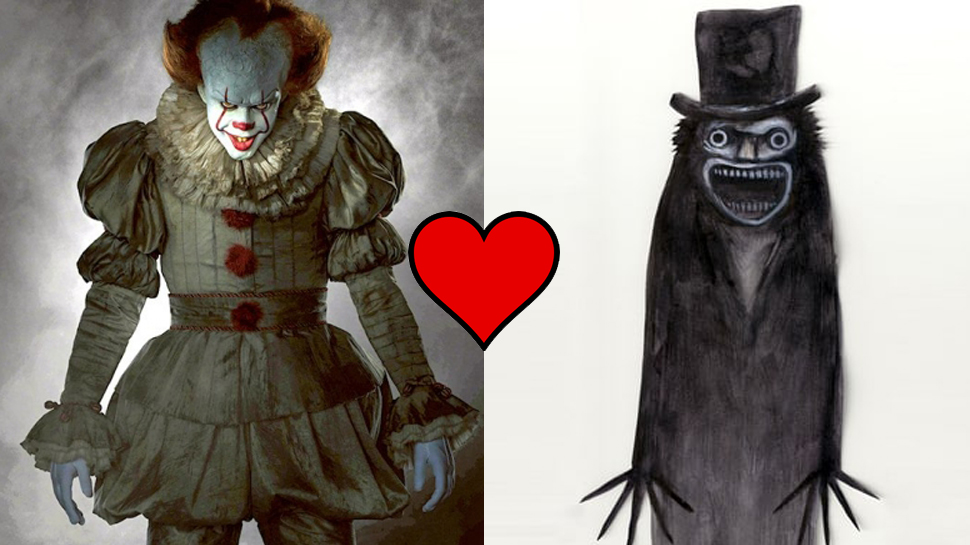
I can’t think of a better way to end this post than the way I ended the last one on this topic. We need to recognise that the ancient evil hurts us all and that we’re all implicated in it. We need to band together with all the other losers and get down into the sewers to face it. Are you with me?
The post Fighting or Feeding Your Demons? It and Facing up to Historical and Intergenerational Trauma appeared first on Rewriting The Rules.
]]>The post It and Intergenerational Trauma appeared first on Rewriting The Rules.
]]>Disclaimer 1: Obviously this is just my reading. Many other readings are possible.
Disclaimer 2: All the themes present in It are also present in this piece, so don’t read it if you don’t want to be spoilered, or find those topics too troubling right now (bullying; family physical, sexual, and emotional abuse; bereavement; violence and murder; structural and systemic oppression including racism, misogyny, and homophobia).
Disclaimer 3: There are also some images of scary clowns of course.
TLDR: I love Stephen King and I think It is about intergenerational trauma.

Horror books
Libraries were a focal point of my childhood, just as they are in It. A key moment for me was when I graduated from the kid’s corner of the library to the whole wild open expanse of the adult books. One section in particular drew me to it as surely as if it’d been marked out by the presence of a floating balloon.
I remember the thrill of browsing the covers of the horror books. Some of the images were enough to haunt my dreams without me even cracking the pages. There was a rebellion too in picking these books: disapproving glances from the librarian; bafflement from friends; a shake of the head from my English teacher when I chose to review pulp horror rather than literary fiction. I never understood why these books were somehow regarded as of lesser value. I just knew they were immensely valuable to me, although I doubt I could’ve explained why at the time.
Eventually I got a part-time job at the library. One of the perks was that I got first dibs on the books they were selling off for 10 or 20p. I soon amassed by own horror collection with laminated covers and the library pockets still stuck to their front pages. For my favourite authors I saved my pocket money for the glossy new paperbacks at the big WHSmith in town.
A non-horror fan looking at that section of the library probably wouldn’t be able to discern much difference between the books. They’d just see shelf after shelf of equivalent paperbacks with nightmare titles and dark covers embossed with gruesome images: as identical to one another as the Mills and Boons over by the door.
For me though they were very different. I knew that I was more drawn to the current authors than the classic ones, although I later developed a fondness for M. R. James. I also filtered out most of the books based on movies or supposedly true stories as not particularly inspiring. Finally I learnt to distinguish the writers whose work seemed to be about something more than simply frightening the reader with the nastiest things they could imagine. The latter books did nothing for me apart from disturbing my mind, but the former got my attention and eventually my devotion.
An enduring memory from my teenage years is of sitting on the floor of my sloping attic bedroom, my back propped against the radiator for warmth. There’s a packet of plain digestive biscuits by my side and a mug of hot chocolate. Erasure and George Michael are playing on the stereo. The walls are covered with hand-drawn pictures and posters of my favourite film and TV characters. There’s probably an incense stick burning. I’m wearing a baggy sweater and jeans. In my hand is a thick Dean R. Koontz, or a James Herbert, or a Stephen King. The spine is cracked. I’m lost in the story as the sky darkens outside. I know I won’t go to sleep till I’ve finished the book. Somehow that would be letting the characters down: letting the evil win.
Stephen King
King is the only author from that period who I still read. Returning to these authors as an adult Herbert is a bit too inconsistent: meaningful stories interspersed with just plain nasties. Koontz can get too sappy for me, although I retain my copies of Watchers and Phantoms because those are proper good.
But I’ve come back to King again and again. Certainly there are periods of his writing that don’t inspire me, and occasional books that are complete misses to my mind. But overall there’s so much to love, and his recent stuff is just as good as his early works. He’s a master of the short story, and I regularly return to those collections as well as to the handful of novels that seem to give more on each re-read.
It is one of those books for me. I remember the first version of the paperback that I got out of the library. It had a black cover with the grating of a storm drain on the front and a set of glowing eyes down there. I made it a couple of chapters in and couldn’t get any further. It was too scary.

I got it out again, a year or so later, and the same thing happened. The book called to me, but it was too much. I wasn’t ready.
Then my Dad went to the US for a conference. He brought me back a present, probably without knowing my history with the book: a copy of It. Quite the departure for my Dad who usually focused on trying to get me to crack the books that he believed everyone should read such as Moby Dick or Metals in the Service of Man! This was a more appropriate gift. The TV mini-series must’ve just come out in the States because the cover had a picture of Tim Curry’s version of Pennywise the clown on it.

My memory is that I finally managed to read the whole book when I went into hospital for one of the minor surgeries on my ears that punctuated my childhood and adolescence. That copy of It was the only book I took into hospital with me. If I wanted distracting from the scary situation I was in, that was all I had. I read it till they came to wheel me to the operating room. It was there on the bedside table when I came around from the anaesthetic. Back home it saw me through my recovery, taking me away from the pain of my sore and bleeding ears.
A couple of years back I made a decision to revisit It as I went in for surgery for the first time as an adult. It was a meaningful choice as the operation in question was top surgery to flatten my chest. Here I was in my forties making the decision to reshape my body in the way I longed for as a pre-teen. The nostalgic reading material made a lot of sense. It intrigues me now that my two main memories of reading It come from around the same ages as the child and adult versions of the characters in the novel.
During my recovery I also re-read several of King’s other novels. The main thing that struck me, which I hadn’t noticed earlier in my life, was what a legend this guy was. Right back in the 1970s and 1980s he was writing books where convincing women were the main characters, while so many male authors had no female characters, or ones that were poorly drawn and only served as victims or convenient motivations for the heroes. He was similarly awesome on class. Also the horror in these King novels frequently took the form of things like domestic violence, sexual abuse in families, marital rape, or bullying. If supernatural forces were in there at all, they only served to highlight the real human horror of such things.
The one novel that I didn’t re-read because I still can’t get past the first chapter was Carrie. That one is still too frighteningly accurate in its depiction of the horrors of girls’ bullying and what periods are like for somebody who hasn’t been prepared for them. I’m eternally grateful to King though for understanding and expressing the horror of those experiences.
It
Going back to It, somehow I didn’t put this novel in the same category as those other books (Carrie, Rose Madder, Dolores Claiborne, Gerald’s Game, etc.). Sure It had something to say about childhood and bullying, but mostly it was a more standard horror book about the ancient evil haunting the town of Derry.
I figured I was drawn to It because it told the truth that childhood is a horrifying time for many of us, and because I was wistfully drawn to its depiction of a group of loser kids who bonded together and found friendship with each other. I longed as a kid for a world where losers recognised each other and found friendship together. In my experience they either shunned each other for fear of being bullied more, or hurt each other if they did ever become close because they were too bruised or broken to handle the intimacy. I would totally have braved a sewer and an evil clown if it meant the possibility of getting a group of friends like Bill, Mike, Ben, Bev, Richie, Stan, and Eddie.

I was blown away watching the movie adaptation because it enabled me to see something in the story that I just hadn’t spotted before. I’m not sure whether it was the way this film captured the feel of the novel so perfectly, and/or the fact that I’ve finally understood these themes in my own life, but finally I got It. Several times during the film I found myself in tears. It felt like I was cracked open and someone – or something – was seeing into my soul. At the end I wandered out of the cinema in a daze. I walked along the Thames trying to make sense of it. Finally the phrase ‘intergenerational trauma’ came to mind. At that point I hopped a tube to get home quickly to my journal. I’ll try to explain what I wrote here. I’ll focus on the movie version of the story because that’s freshest in my mind right now.
Pennywise or not?
So the monster in It is an ancient evil force that lies dormant under Derry. Every 27 years it awakes and terrorises the town, taking the form of Pennywise the dancing clown. It entices kids down into the sewers and feeds on their fear. Pennywise will win as long as it keeps the kids separate and scared. If they band together and face their fears then they can beat it.

But Pennywise isn’t the real monster here. If we took Pennywise out of the picture entirely this would still be a terrifying movie. Before It even comes into their lives, the kids are already going through some deeply scary shit.
Ben is the new kid in school, alienated for his weight and his newness. He’s the target of the town bullies who threaten to ‘cut his tits off’. Mike has lost his parents in a traumatic fire. His uncle attempts to ‘make a man of him’ by teaching him how to kill farm animals, and tells him that if he doesn’t become a man he’ll end up being one of the sheep in life and get shot. Bev is living with a father who is either sexually abusing her, or is poised to start doing so, and she is shunned by all her peers who spread rumours that she’s a slut. Eddie’s mother keeps him trapped and anxious with all of the health-related fears that she projects onto him, gaslighting him into believing they’re real. Stan’s dad makes it clear how disappointed he is in a son who seems unable to follow in his footsteps. When It does come into the picture, Bill’s parents can only deal with their grief over his brother’s death by disappearing into themselves and attacking Bill when he tries to express his grief. We don’t get to see the reasons behind Richie’s ‘trashmouth’ but in the novel we find that similarly tough things are going on for him at home. Like Eddie and Bill, he’s also a target for the local bullies due to his disability.
I don’t know about you, but thinking about the kids I knew growing up I could point to at least one who was going through the equivalent of each of these things, and more. And that’s from a time when most of this stuff was kept well hidden. The childhoods that the people who I’m friends with now had make the home and school-lives of the kids in It look pretty average.
Intergenerational trauma
Let’s think about the 27 year period that It hibernates for. 27 years is about the time it would take for the children who were targeted by Pennywise in one generation to become adults and be having kids themselves. So the parents, guardians and teachers of the main characters would’ve been the children themselves 27 years ago. And their parents, guardians and teachers would be the kids of the previous 27 year Pennywise moment, going all the way back to the founding of Derry.
My theory is that Pennywise is a metaphor for intergenerational trauma. If the kids in one generation don’t face their demons, when they go on to have kids themselves those kids are doomed to be confronted by the very same demons. In this case the demons are both the evil clown who they literally have to face and fight, and the trauma, abuse and neglect that they experience at the hands of their parents, guardians and teachers, and the other children around them who’ve been damaged by their own parents, guardians and teachers. For example, we see in the movie how the main male bully, Henry, is constantly punished and put down by his father, and how one of the female bullies has a father who’s creepy around teenage girls.
So it’s the intergenerational trauma inherent in both family and school systems that’s the real monster here. Not only do parents, guardians, teachers, and other adults hurt kids with their actions and inactions, they also create the bullies who terrorise the kids. Vitally they also refuse to see the pain the kids are going through. No adult intervenes to help even when the kids are clearly distressed. The avoidance of the adults is captured in the scene where a couple drives past Ben as the bullies surround him. The couple deliberately refuse to look at Ben. Later Bev’s father can’t even see the blood all of the bathroom: adults are so oblivious to what is going on.
And of course the trauma is intergenerational because the adults only behave in these ways towards the kids because the adults in their lives behaved in similar ways towards them, right back to the start.
The legacy of survival strategies
What broke my heart watching the film is how understandable it all is. As vulnerable children we just want to put our heads down and survive the horror. If somebody else is getting targeted we’re relieved that it takes the heat off us for a while. The last thing we feel capable of doing is standing alongside that person and putting ourselves back in the line of fire.
And as adults we don’t want to confront the demons of our childhoods. In fact, as we see in the novel of It (and presumably the sequel to the movie), it becomes way more hard to confront our demons as adults than it was when we were kids. We push all the memories and feelings down and pretend that it wasn’t that bad. That often means that we’re oblivious to what the kids in our own lives are going through. This is because we’ve taught ourselves not to see those demons, because it seems normal and no worse than our own childhoods, and because it’s so intolerably hard to accept that we might be implicated in their horror ourselves.
Our short term strategies of survival (as kids) and denial (as adults) seem like the best ones to keep us alive and sane. But like so many short term strategies they’re the one that put us – and the people around us – at greater risk. If we employ these survival strategies as kids we grow up traumatised and capable of hurting others because of the patterns we develop in our attempts to avoid further trauma. If we employ these denial strategies as adults then we keep repeating the patterns, and we risk losing our connection with the next generation in one way or another. If we want to ensure that the intergenerational trauma doesn’t keep coming back we have to face our demons.
Why we love a bogeyman
It also demonstrates how we create bogeymen to help us to deny our own capacity for hurting others. We see this playing out on a cultural level all the time. We’re obsessed by extremely rare criminals like serial killers and rapists, and stranger child abusers. We consume a vast amount of fiction about such criminals as entertainment. And real stories about them are considered to be the most newsworthy, with crimes that don’t fit that preferred narrative rarely hitting the headlines. Statistically though, people are far, far more likely to be killed, raped or abused by someone they know.
The greatest risks to kids in terms of physical, sexual, and emotional abuse are within the home and the school. Way more kids die at their own hands as a result of bullying and other abuses than ever die at the hands of stranger murderers. Many more make it through to adulthood with parts of themselves deeply damaged by such experiences. People clamour for lists of paedophiles to protect their kids from, while telling them that the abuse they experience at school is just a normal part of childhood, or even a positive thing to prepare them for adult life. Interestingly the very first article I ever had published was about exactly this point!
So Pennywise can be read as a very helpful bogeyman for Derry. It keeps everyone’s attention on the evil outsider abducting their kids so they don’t have to think too carefully about what those same kids are going through in their homes or schools.
Normativity as intergenerational trauma
The role of cultural norms in all of this is also clear in It. The ‘losers’ who attract the torment of their peers – and the punishment, disapproval or smothering of their parents or guardians – are the ones who are ‘different’ or marginalised: they’re all disabled, fat, black, Jewish, or female. Tellingly they also all challenge normative cultural gender roles. The boys are frequently called ‘faggots’ for being weak or showing feelings, and punished for any perceived femininity or lack of manliness. The one girl in the group is attacked for being too sluttish and for being too boyish.
Again we’re all implicated in the intergenerational trauma of passing on the systems which oppress and marginalise ‘others’ like this: ableism, fatphobia, racism, anti-semitism, misogyny, etc. For example, there’s a huge investment in maintaining restrictive gender rules down the generations, despite it hurting both those who try to fit it and those who’re alienated by it. Many TV shows and books demonstrate the damage this does to people in general, and many statistics point to the appalling suicide rates of gender ‘non-conforming’ kids. However people still respond to attempts to loosen the rigid gender system in schools and families with cries that it constitutes ‘child abuse’ and ‘social engineering’ and goes against science (it doesn’t).
Look beneath the surface of It and it’s pretty clear that the roots of the intergenerational trauma that run through Derry lie in settler colonialism, structural racism, patriarchy, and heteronormativity. Each time It awakes, it simply whips up the human forms of hatred and fear that are most prevalent at the time. Thus the disappearance of the first white inhabitants of Derry is blamed on indigenous people. In the 1930s the Black Spot nightclub is burnt down in a racist attack by white supremacists. In the novel, the homophobia of the AIDS crisis is the form of hatred and fear that It particularly draws on during the 1980s.
It’s trying to divide us
The moment in the film which brought me to tears was the point where the kids fought over whether they were going to face Pennywise or not. Bill wanted them to follow him to confront It but many of the others were too scared, blaming Bill for the danger they’d already been placed in. Then one of them said ‘It’s trying to divide us. That’s what It wants.’
Replace ‘It’ in this sentence with any or all of the systems of power and oppression that I just listed and that statement is a punch in the gut. Over the last month I’ve seen LGBT+ activists burnt out by battles with each other, feminists physically attacking each other over divisions between them, a black woman fired for describing the realities of living under structural racism. Meanwhile… Well I don’t really need to recap what’s been happening meanwhile, suffice to say that capitalist, colonialist, white supremacist hetero-patriarchy (or whatever you want to call it) seems relatively un-dented.
Facing our demons together
So what does It teach us that we need to do if we want an end to this intergenerational trauma? We need to stop hiding behind bogeymen and actually face our demons.
We need to recognise what happened to us growing up and the impact that had instead of conveniently forgetting, denying, or glossing over it. We need to acknowledge the systems, structures, and dynamics that hurt us – and those around us – and commit to not simply reproducing them for the next generation.
We need to look at the demons we inevitably have inside ourselves as a result of being part of these systems and structures. We need to face the damage that we – and the systems we’re implicated in – have done, and commit to start doing things differently. It’s terrifying work for sure, but the alternative is that we continue to be the monster. Pennywise is just our own reflection in the mirror.
The other message of It is that we can’t do it alone. It’s too much. It’s impossible. We have to band together despite our differences. We have to resist the tendency to divide into ‘us’ and ‘them’, shunning ‘them’ until there’s only ourselves left, alone and exposed.
We need to recognise that this ancient evil hurts us all and that we’re all implicated in it. And then we need to band together with all the other losers and get down into those sewers to face it. Are you with me?

Find out more:
Read my post on the sequel here.
I’ll be writing so much more about this kind of thing in my long-term book project Everyday Horrors (a mash-up of fic, memoir, and self-help). Meanwhile here are some of my books, zines and blog posts that you might enjoy if you enjoyed this one:
- Plural selves zine: Embrace your demons by finding out about your foregrounded and disowned selves
- Staying with feelings zine: How to be with scary emotions
- Embrace your inner mutant superpower
- Inside Out: Getting in Touch with Our Emotions
- Queer: A Graphic History
- How to Understand Your Gender
Here’s Stephen King writing about why he thinks we crave horror movies.
The post It and Intergenerational Trauma appeared first on Rewriting The Rules.
]]>The post Embrace your inner mutant superpower appeared first on Rewriting The Rules.
]]>First I need to come out. Coming out is something I’ve done perhaps more than most people do in one lifetime. However this time it’s a bit different. After much reflection I need to let you know that I am a shape-shifter. Transmogrifier, lycanthrope, trickster, chameleon: call it what you will. I have the mutant superpower of magically transforming to fit my surroundings.
In the rest of this post I’ll use my own example to illustrate how you might come to identify, explore, and embrace your own inner mutant superpower.
Which mutant super hero/villain are you?
There are two ways of figuring out your own inner super hero/villain nature. You can either start by exploring which characters particularly resonate with you, or you can start by examining your own life for clues. My own realisation involved a little of both.
Read it, watch it, draw it, write it, pin it
If you want to start with fiction then the trick is to delve into genres that appeal to you where characters have magical powers. The obvious examples are the DC and Marvel comic universes (and/or the movies and TV shows based on them), particular the mutant-packed world of the X-Men, or the many and various superheroes and supervillains in the Superman/Batman/Spiderman series. If that doesn’t work so well for you then the fairy tales and myths of various cultures are packed with different kinds of monsters and magical characters, as are fantasy fiction, horror fiction, and science fiction. Check out recent shows like Lost Girl, Penny Dreadful, Being Human, or Once Upon a Time, or long term staples like Lord of the Rings, Harry Potter, Star Trek, or Dr. Who. For me the Red Dwarf and Buffy the Vampire TV series, and the books of Terry Pratchett and Neil Gaiman, are rich sources of material.
While you’re reading, listening or watching, ask yourself which characters you’re particularly drawn to. Which do you find attractive? Which scare you? Which do you relate to? Which do you fantasise about or long to ship? Check out fanfic based on the shows, books or movies you like, or write your own. Doodle and sketch the characters that you’re drawn to. Use an app like pintrest to bring together pics and clips that appeal to you.
 Dream Hunters fox fairy
For me I started connecting the dots when I remembered how much I was drawn to the fox fairy story in Neil Gaiman’s book The Dream Hunters, and to so many other stories about foxes, to the extent that I’ve planned, for years, to get a tattoo of a fox. I found myself linking that to the werewolves in Penny Dreadful and Being Human (the characters I relate to most in those shows). I also remembered how Mystique in the X-men, and the T-1000 in Terminator 2, had always held a particular horror for me. And I thought about how attractive I found Tom Hiddleston’s Loki, and the episodes of Buffy where characters cast a spell which made everybody fall for them, particularly Superstar. Perhaps this could be seen as a kind of simultaneous shapeshifting like the Camille episode of Red Dwarf where the pleasure GELF appears to each person as their object of desire.
Your actual life
The other starting point for exploration is your life. Think back to growing up: What survival strategies did you develop to get through the tough things you experienced? Were these visible or invisible to those around you (or a bit of both)? What patterns have you noticed in more recent years in the way you engage with the world or relate to other people? What makes life worth living for you? What is your worst fear? What would you like to have written in your obituary? Are there any superpower/mutant metaphors that fit these themes particularly well? Talk to friends. What do they notice about you? Which characters do they think you’re most or least like? What superpowers would they say that you have?
Or you might delve into your dreams. Do you have any recurring ones? Are there common themes in the abilities that you have, such as flying or having great strength? What are your nightmares, for example do you dream of falling or being stuck in slow motion? What do you fantasise and daydream about?
 Chameleon changing colour
For me, I remember a moment when a partner said that I was a chameleon. Thinking back to childhood I recollect how isolated and alienated I felt when I changed school: how I didn’t fit in with any of the cliques and crowds there, just as it never made sense for me that we lined up separately as ‘girls’ and ‘boys’. At first I survived this by standing apart, but eventually the pressure was too great and I learnt – clumsily and painfully slowly – how to fit in. By my next school I was drifting from group to group and finding a capacity to fit with all of them. I also notice – on an everyday level – how easily I slip into different accents and ways of talking in conversation, depending on how the other person speaks. Certainly recurring nightmares involve going back to being rejected and on the outside.
Quiz time
If you want a quick way to explore these things you could just take a bunch of these handy online quizzes (there are lots with similar titles) and see what comes out:
Exploring your hero/villain sides
Once you’ve determined your mutant superpower/s, or the heroes and villains, demons and angels that you particularly identify with (there may well be more than one), you’re ready for a bit more exploration. The way I see it, every superpower has its strengths and limitations. The hero/villain binary is not necessarily a helpful one because – as more recent movies and TV shows have showed us – it’s rarely that simple. We can understand both the X-men who want to find a way to live alongside the humans, and the ones who want a complete revolution after years of oppression. We can empathise with the dark-knight version of Batman, or the common trope of the criminal psychologist and the serial killer as flip sides of the same coin.
 Superstar episode of Buffy
In my favourite episode of Buffy, which I mentioned before, Jonathan Levinson casts a spell which makes him into a superhero, adored by everyone. However, in order to create a version of himself that is only the positive, strong, heroic parts, the other parts have to go somewhere. A shadow version is also created: in this case in the form of a real monster. You might think also Ursula Le Guin’s Wizard of Earthsea, who summons – and has to eventually face – his own shadow. Or the Confidence and Paranoia, Dimension Jump, and Demons and Angels, episodes of Red Dwarf all of which imagine the best and worst aspects of the characters being made real.
So a useful point of exploration – to consider yourself and to talk about with other people in your life – is what the hero and villain sides of your superpower look like. You can’t have one without the other: the difficult parts are so interwoven with the great parts that they can’t be teased apart. It isn’t even always obvious which aspects are ‘good’ or ‘bad’. But it is definitely worth being aware of the possibilities and pitfalls of your powers. Here are some of the positive and negative shades of shape-shifting.
Superstar
Thinking about myself as a shape-shifter, the positives for me – and I think for those around me – lie in the capacity to flexibly and fluidly adapt to situations. I notice how I can feel ‘at home’ in many different places and communities. I can often get excited by multiple projects – even those that aren’t obviously interesting to me – throwing myself in and investing in them.
 Odo: A shapeshifter who uses his powers for good
Also there is the capacity to empathise with different people. That is definitely helpful as a therapist. I find it relatively easy to pick up on how somebody is feeling, and to understand their way of seeing the world if they’re able to let me in. I also think that a strength in my writing is that capacity to hold multiple perspectives simultaneously or to see things from ‘both sides’. And I hope that I have something to offer to conflictual situations as I can often put myself in the shoes of two or more people involved. I find it hard not to.
Monster
But shape-shifters in fiction are rarely positive characters. There are, therefore, many clues to the shadow side of shape-shifting abilities.
 Mystique, T-1000, and Loki
First if we think of Mystique, T-1000, and Loki, these are all manipulators who non-consensually trick people into believing that they are other than what they are, for their own personal gain or to further wider goals. There’s very little real empathy involved here other than the small amount it takes to know what other people expect – or want – to see. So the shadow side of the trickster is to be mistrusted and treated with suspicion, to be two-faced.
I don’t experience my shape-shifting nature as deliberate. It feels much more like the werewolf who has no choice but to change every full moon, or the chameleon who can’t help but adapt their colour according to their surroundings.
 Werewolf in Being Human
Different versions of myself feel drawn out of me by different people and situations, rather than me deciding – in any conscious manner – that I want to be a certain way. However, like Mystique, T-1000 and Loki, there is often a wider goal behind it: that is the desire to be liked and approved of: to belong. And although I don’t deliberately transform my shape in order to achieve this, it can have the same effect as if I did. I know how it feels to have somebody look at you in disappointment or disgust as they see another side of you than the one they’d come to know and trust.
I mentioned the helpful side of shape-shifting as a capacity for empathy. One flip side of this is that it’s easy to get so drawn into another person’s way of being, or way of seeing the world, that I become somewhat lost myself. There’s a risk that I become very much what they want me to be, but that that is unsustainable and eventually I shift again. Perhaps helpful in the short-term, but harmful in the long-term.
What is your kryptonite? Who is your nemesis?
Of course all superheroes and villains have materials which remove their powers, which send them spiralling up to dangerous levels, or which flip them into their shadow side completely. They have nemeses who wield such weapons and who wish to destroy them. This is another thing worth exploring and remaining aware of.
 Kryptonite
As a shape-shifter there are many dangers. You can become stuck in one particular self, which eventually becomes brittle and may break under the pressure of trying to keep static what is, by its nature, fluid. And, in a world that it very invested in authentic, individuals who can ‘find themselves’ or be ‘true to themselves’, it can be scary to recognise that there is maybe no real, underlying self. It can also be easy to slip into wondering whether maybe there is a ‘real self’ and that it is something ‘bad’: This is exacerbated, for me, if I know that people have stories of me which fix me in a particular way and which I have no control over.
Shape-shifters can also struggle with situations in which they’re called upon to be multiple sides of themselves simultaneously, or in quick succession. I can feel exhausted and confused at the end of a day when I’ve been with many different people – or groups of people – all coming from such different perspectives, positions, or levels of awareness. The other day I felt overwhelemed in a situation where three people were seeing things in very different ways and I found myself flicking faster and faster between each of them. I have an image – I’m not sure whether it’s from an actual film or TV show – of a shape-shifter trying desperately to morph into one thing after another, faster and faster, in order to find the ‘right’ shape, and eventually exploding, imploding, or dissolving into nothingness.
So my kryptonite would be becoming stuck – particularly in a self that I didn’t like or respect, or being called upon to shift too much or too quickly.
Awareness of the danger of becoming stuck helps me to remember to cultivate different sides of myself, and the different relationships, places, and projects which bring them out. It’s important to me to have multiple close people in my life instead of becoming focused on one. It’s also important to move between different spaces (particularly country and city) and to take on different roles and study different areas (e.g. moving between time each week where I’m writer, activist, therapist, and academic).
Awareness of the danger of shifting too much helps me to take time alone, which enables me to find some kind of equilibrium and equanimity when I’ve been spinning too fast. It reminds me that I need grounding, and I cultivate places, practices, and relationships which help me to do that. And it helps me to see the importance of boundaries, to prevent me from getting too lost.
Of course I don’t always get this ‘right’ by any means, but I feel like with each deepening of understanding I get a bit more of a handle on it.
Letting it go and opening up
In Frozen, princess Elsa has the superpower of being able to freeze things. When this harms her little sister, Anna, her parents hide her away, wipe Anna’s memory, and keep Elsa’s powers secret until she can get them under control. After their parents die Elsa has to become queen. She emerges from her room but tries to hold back her powers in any way possible. However, she can’t repress them forever. Eventually they explode out when she’s in an emotional state. She’s exposed as monstrous and, fearing the harm that her powers might do, she retreats to a solitary ice palace. There, at least, she is able to ‘let it go’ and stop holding back this vital part of who she is.
Eventually, with Anna’s help, Elsa is able to return to the world. It seems to me that Elsa finally becomes able to channel her powers when she is open about all of who she is with others, as well as about her own vulnerabilities and fears, and the shadow side of the powers. She needs to be okay with herself and prepared to connect with others. Paradoxically the powers are most dangerous when she attempts to force control over them or hide herself.
Whether we’re a shape-shifter or an Elsa, a hulk or a dark knight, an invisible person or a firestarter, it’s important to embrace our inner hero/villain and to find ways of expressing it to others.
Many thanks to Helen Bowes-Catton who started this train of thought, to Erich and Ludi because I’d never have got here without 9 Worlds, and to Melissa for making me think more about Frozen. The cold never bothered me anyway.
If you want to read more about these kinds of ideas, check out my zine on Plural Selves.
The post Embrace your inner mutant superpower appeared first on Rewriting The Rules.
]]>