The post New book out now! How to Understand Your Relationships appeared first on Rewriting The Rules.
]]>
Like the other books in the series, this one unpacks dominant cultural ways of understanding relationships, and how those impact us, as well as the messages about relationships and ways of relating we learn growing up. It goes on to help readers locate their own ways of relating, exploring conscious, consensual relationship practices, and the kinds of support systems people might build around their relationships. Throughout the book, we also try to hold the non-binary bothness that relationships hold for pain and pleasure, trauma and healing, restriction and freedom.
Vitally, How to Understand Your Relationships is about all kinds of relationships. While it will hopefully be helpful for those focused on partnerships – of the monogamous or non-monogamous variety – it is equally applicable to friendships, family relationships and parenting, work relationships, and relationships with other humans, non-human beings, and beyond.
You can order the book via the publishers here, and it will soon also be available as an audio book. Watch this space for a video with Alex, discussing the book and what it means to us.
You might also like to check out Alex’s other book, Trans and Disabled, which also just came out, and which includes a chapter we wrote on plurality.
The post New book out now! How to Understand Your Relationships appeared first on Rewriting The Rules.
]]>The post New zine: Queer Creative Health appeared first on Rewriting The Rules.
]]>This zine was commissioned by Queer Circle to explore what queer creative health might look like, as part of their programme for developing creative health practices with queer community.
Queer people experience worse health struggles than others, and health systems are often not safe enough for queer, and other marginalised, people.
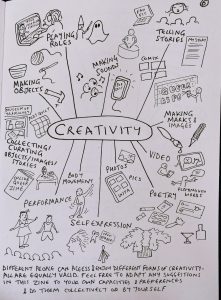
Queer people also engage with different forms of creativity, often employing creative methods to queerly create themselves and their communities, as well as exploring and communicating their experiences.
So what might queer creative health look like?
Creative health is anything that brings creativity and the arts together with health, such as art therapies, creatively expressing our health experiences, bringing music into health settings, or making health practices or understandings accessible through books or comics.
This zine explores the different meanings of queer, health, and creativity, as well as introducing a number of practices that you could try as forms of queer creative health.

The zine divides these practices into embodied, entangled, and embedded practices, to recognise that we are embodied beings (carrying all the things that have happened to us, and to previous generations), entangled beings (always in relation to other human and non-human beings and communities), and embedded beings (in the time and place we live in, and in the systems, structures and cultural norms that are present there).
The zine gives a taster of the kinds of workshops that took place at Queer Circle for anyone who couldn’t access them in person. It also explores how you might bring queer creative health practices into your own life.
Find out more:
You can download the zine here.
You can check out the Queer Circle website, and a report of the queer creative health programme here.
The post New zine: Queer Creative Health appeared first on Rewriting The Rules.
]]>The post Mental health beyond binaries appeared first on Rewriting The Rules.
]]>
I’ve experienced mental health struggles for most of my life. For me, like many of us, that means that I’ve had a high level of self-critical background noise a lot of the time: thoughts that I’ve done something terribly wrong, or that I will do, or that there’s something wrong with me. It often manifests as a low, heavy mood: a kind of grey fog over everything that makes it difficult to see things clearly, to make decisions, or to appreciate the beauty of the world around me. At its worst, it has tipped into extreme self-loathing and the urgent wish to eradicate the ‘bad’ parts of me in order to make myself acceptable.
Despite these experiences I’ve always been reluctant to label myself with the terms that might seem obvious when you read this description. I’ve probably ticked the boxes for several of the recognised ‘psychiatric disorders’ in my time, but I don’t feel comfortable identifying as a person with depression, as mentally ill, or as having a psychological problem. Equally I don’t feel comfortable identifying as sane, mentally well, or psychologically healthy. As with so much in life, I feel that the binary – in this case between ‘mad’ and ‘sane’ – is actually part of the problem.
The mad/sane binary
The mad/sane binary is present in all of the mainstream messages that we receive about mental health. For example, high profile campaigns to end mental health discrimination have often centred around one, apparently game-changing, statistic: 1 in 4 people have a mental health problem. Celebrities like Stephen Fry and Ruby Wax have used the figure to speak bravely and openly about their experience of mental ill health, but the danger of that statistic is that it suggests that 75% of the population do not experience any mental health problems at all. Rather than seeing mental health as a continuum which we might all move up and down over the course of our lives, we’re forced to stake our identity on one or other side of a strict dividing line:
‘Either … I have a mental health problem – I need help – it’s not my fault
Or … I don’t have a mental health problem – I don’t get help – it is my fault’
In this way we’re placed in a double bind, because accepting one side inevitably involves denying the other, and neither side promises a great outcome. If we’re seen as having a mental health problem we may well feel utterly disempowered, as if there’s nothing that we can do to improve our situation. If we’re seen as not having a mental health problem we might feel like we can’t admit to having any problems or get any support because we’re completely responsible for our own happiness and well being. The responsibility either rests entirely with other people, or entirely with ourselves, and either way that puts us in an untenable position.
Linked to this is the fact that both sides of the binary internalise suffering, seeing it as a purely individual thing, rather than a symptom of wider social issues. We are forced to view mental health problems as inborn, either caused by illness (perhaps a genetic vulnerability and/or brain chemistry issue) or by a personal deficiency (such as bad habits, faulty thinking, or lack of moral fibre). This can be very damaging because there’s strong evidence that all our human experiences are biopsychosocial: a complex interaction between the world around us, our personal experiences of it, and our bodies and brains, with all of those aspects influencing the others. We risk doing further damage to ourselves when we attempt to change our individual experience without recognising the role of social injustice or cultural messages in our suffering.
Social suffering
For example, it’s clear that structural oppression and social inequalities have a major role in mental health struggles because we see far higher rates of such difficulties in groups who are socially marginalised. One recent UK study found that women were 40% more likely to develop anxiety and depression than men, for example, another found that LGB people are twice as likely to be suicidal as straight people, and a further one that BAME people are six times more likely than white people to be admitted as in patients in mental health services. We need to recognise the role of intersecting marginalisations in mental health struggles, and the ways in which social experiences such as poverty, discrimination, and the experience of trauma are highly related to psychological distress.
We also live in a culture, which encourages the very kind of self-critical thinking that’s a feature of all the most common mental health problems. The French philosopher Michel Foucault famously used the analogy of the panopticon prison for our culture. In this prison there’s a single guard sitting at the top of a central tower in the middle who is able to see into all of the prison cells. Prisoners end up monitoring their own behaviour all of the time, just in case they might currently be being watched.
Foucault argued that our culture works in this way through all of the pressure we’re under to self-improve, and to present a positive, successful self to the world. We’re made to feel fear that we might be lacking or failing in some way, and we’re sold products which claim to help us to allay those fears. Makeover shows, self-help books, and beauty products are some of the more obvious examples. Social media also encourages us to maintain the illusion of perfection online, leading to endless rounds of self-evaluation and comparison.
In a world where so many of us are struggling with very real social problems, it’s vitally important to acknowledge the cultural context we’re in and to resist individualising our suffering. The mad/sane binary is very effective in preventing challenges to toxic policies and practices because people are not aware of the social context of their struggles, and because there is a fear that if you do speak out you will be dismissed as ‘insane’.
We can see this at play in the recent moves to regard unemployment as a psychological problem and the insistence that those claiming benefits undergo cognitive behavioural therapy. The responsibility is placed on the individual rather than on wider societal problems, and resources are focused on psychological change rather than addressing economic inequalities. There’s a high risk that people are left in the same damaging situation, but with an even greater tendency to blame themselves for it.
A sane response to a mad world?
The psychotherapist Winnicott famously said, of depression: “The capacity to become depressed […] is something that is not inborn nor is it an illness; it comes as an achievement of healthy emotional growth […] the fact is that life itself is difficult […] probably the greatest suffering in the human world is the suffering of normal or healthy or mature persons”. Perhaps we would do well to view the depression, anxiety, and other mental health struggles that most of us grapple with at some point as a sane response to an insane world. This would shift the emphasis for change away from the individual and towards the wider societal structures and cultural messages around us.
I know that what has helped me the most in this area has been to recognise the social and cultural aspects of my struggles. It’s a huge relief to allow the weight of total responsibility to lift, and to recognise the role of internalised self-criticism and social power dynamics in my experiences. This acknowledgement also allows me to engage critically with the mad/sane binary: resisting the sense that I’m completely responsible for my difficulties and the sense that I have no capacity at all to help myself. In this way I can cultivate a kinder relationship with myself, on the one hand, and feel more of a sense of kinship with all of the others who are in the same cultural boat. Such connections enable the possibility for collective resistance and for social activism, which feel like a much better focus for my energy than continually trying to change myself.
Find out more
My zine on social mindfulness covers these ideas in more detail. My zines on Staying With Feelings, Self-Care, and Plural Selves are also relevant to mental health.
My other blog posts on mental health include:
- Mental health: Beyond the 1 in 4
- Mental health: Beyond a health focus
- Mental health interview 1
- Mental health interview 2
- Supporting each other through mental health crises
- Mental health and relationships
For more on LGBT and GSRD mental health, check out:
- New Resource on Gender, Sexual & Relationship Diversity (GSRD) and Mental Health
- LGBT+ mental health video
- Bisexual mental health
The post Mental health beyond binaries appeared first on Rewriting The Rules.
]]>The post BDSM 101: Consent, consent, consent appeared first on Rewriting The Rules.
]]>If you like this, please do consider supporting my Patreon.
- The Psychology of Sex
- Enjoy Sex (How, When and IF You Want To)
- Make Your Own Sex Manual
- Erotic Fantasies Zine
- Dom/sub podcast
- Power and consent podcast
- Safe, Sane, and Consensual
Consent, consent, consent
Despite what you might think from Fifty Shades, consent is not just a matter of having a safeword! In fact we can see from Fifty Shades itself that safewords are not enough. The first time that Christian spanks Ana she’s really not sure if she likes it. Her feelings about it change from when it happens to later when she reflects on it. She has similar ambivalence on other occasions but clearly doesn’t feel that she can use her safeword to express that uncertainty.
There are huge cultural pressures around sex. We often feel – as Ana seems to – that we must have certain kinds of sex a certain amount in order not to lose a relationship. We feel that we should ‘perform’ certain kinds of sex in order to be a ‘real’ man/woman, or a ‘proper’ straight or queer person. We feel like if we’ve had a kind of sex before we’re obligated to have it again. We feel too embarrassed or awkward to say we’re not enjoying something. We feel that because we’ve done one thing we should automatically do others. All of these are deeply problematic ways of thinking about sex which hurt us badly, but they are also really hard to completely step away from because they’re so engrained in our culture.
So, when it comes to consent, we can’t just rely on partners to say ‘no’ or safeword if they’ve stopped enjoying it. Instead, consent should be about trying to minimise the pressures that they – and we – are under, so that we can be as confident as possible that what we’re doing is consensual. How can we do this? Well it is definitely worth talking about the messages we’ve received about sex and reassuring the other person that we really wouldn’t want them doing something they don’t enjoy. We can also deliberately avoid making any suggestion that kink or sex should involve certain things (e.g. genitals, pain, orgasms, or fancy outfits) or that certain things are more or less normal.

It’s also worth thinking about wider power dynamics that are in play between you. Is one person older than the other, or from a gender, race, or class with more social power? Does one person earn a lot more than the other (hello Christian Grey!)? Is one person much more sexually experienced or confident in their capacity to find other sexual/romantic partners? Are there differences between you in terms of mental or physical health? All of these are worth considering in relation to how the person with greater power (in these various areas) can maximise freedom of the other person to be able to say no (or yes). Of course it’s likely that you’ll each have more, or less, power in different areas.
Finally it is troubling how much we tend to assume that we’ll be able to have consensual sex – or play – when our wider relationships are not very consensual at all. The Pervocracy puts it really well:
I think part of the reason we have trouble drawing the line “it’s not okay to force someone into sexual activity” is that in many ways, forcing people to do things is part of our culture in general. Cut that shit out of your life. If someone doesn’t want to go to a party, try a new food, get up and dance, make small talk at the lunchtable–that’s their right. Stop the “aww c’mon” and “just this once” and the games where you playfully force someone to play along. Accept that no means no–all the time.
Fifty Shades is a perfect example of how to get this wrong. Christian is constantly doing things after Ana has clearly said ‘no’, such as buying her expensive gifts, following her on holiday, and getting involved in her work. How on earth is she to trust that he’d respect her ‘no’ when they’re playing? And just as Christian tries to convince Ana that she’s a submissive, Ana tries to force Christian to be the ‘hearts and flowers’ boyfriend that she’d really like. How are they to trust each other not to try to pressure, control, and manipulate when it comes to their sex life?
If you’re bringing kink into an existing relationship it’s definitely worth having a good hard look at whether you treat each other consensually around other things, such as socialising, food or finances, and how you might be more consensual in those areas. It’s also worth thinking about whether you treat yourself consensually! This is something I’ve written more about here and there is lots of useful stuff about cultivating consensual communities over on the Consent Cultures blog.
Conclusions
I hope these posts have given you a flavour of some of the things that are worth thinking – and communicating – about when exploring kink. As I said earlier, there are heaps more helpful resources out there to draw on. There’s another excellent list available from Clarisse Thorn’s website here.
It can be amazing, when you haven’t done so before, to finally give yourself permission to have the kind of sex and/or play that really excite you. Tuning into yourself, communicating with others, and cultivating consensual dynamics, are all excellent ways to start opening that door.
If you want to find out more, check out my books, zines, and podcasts which cover this topic in more depth.
If you enjoyed this, please do consider supporting my Patreon.
- The Psychology of Sex
- Enjoy Sex (How, When and IF You Want To)
- Make Your Own Sex Manual
- Erotic Fantasies Zine
- Dom/sub podcast
- Power and consent podcast
- Safe, Sane, and Consensual
The post BDSM 101: Consent, consent, consent appeared first on Rewriting The Rules.
]]>The post BDSM 101: Figuring out, and communicating, what you’re into appeared first on Rewriting The Rules.
]]>- The Psychology of Sex
- Enjoy Sex (How, When and IF You Want To)
- Make Your Own Sex Manual
- Erotic Fantasies Zine
- Dom/sub podcast
- Power and consent podcast
- Safe, Sane, and Consensual
Figuring out what you’re into
There’s a sense in Fifty Shades that the kind of ‘kinky fuckery’ that Ana finds herself enjoying is fine, but that the kind of ‘real’ BDSM that Christian is after is not okay. Please put these kinds of distinctions from your mind! People are always trying to draw lines between what kinds of play are okay and what kinds aren’t. For ages it was that missionary penis-in-vagina man/woman sex was fine and nothing else was. Then it expanded a bit to any kind of sex involving genitals was okay, but other stuff wasn’t. Now, after Fifty Shades, we’re told that a bit of light spanking and fluffy handcuffs is okay but anything ‘more than that’ isn’t. All this focus on what counts as normal, right, proper sex (and what doesn’t) takes us aware from far more important questions such as what the people involved actually enjoy, and how to do it ethically.

So the first step is to try (as much as is actually possible) to step away from all the things you’ve learnt about ‘normal sex’ and all the pressure there is right now to have ‘amazing sex’ with all kinds of toys and techniques, and just tune in to what you’d actually like to do. Importantly that might involve bringing kink into your sex life, or kink might be something you explore without linking it to sex. Many people enjoy things like role-play, sensation-play, bondage, and impact-play without necessarily involving genitals or orgasms.
Another key thing is to remember what a big umbrella kink, or BDSM, is. People are into all different kinds of things and for all different kinds of reasons. For example you might enjoy playing with power (bossing people around, or serving someone) and never go near pain or strong sensations. Or vice versa. Or you might enjoy mixing those things together. People sometimes use D/s to refer to the more power-based forms of play, and SM for the more sensation based. Even for any one activity, people get different things out of it. So, for example, if you like the idea of hitting someone with a riding crop to humiliate them you might not fit so well with someone who wants to be hit as a form of physical endurance. Again, nobody should ever tell you that your motivations or preferences are any less valid that anyone else’s.
Research suggests that around equal proportions of people prefer being the top or dominant person, the bottom or submissive person, and switching between different positions at different times. You could think which applies best to you, as well as recognising that it often changes over time.
Communicating what you’re into
Fifty Shades isn’t a great example of how to communicate about what you want. Ana is just presented with a list of Christian’s interests and told to say which she’ll consent to and which she won’t. This means that their play is entirely based on what one of them wants rather than both of them. Also it often seems like Christian telepathically knows what will give Ana multiple orgasms with no communication whatsoever. Real people don’t work like this!

If you’re not sure what you’re into it is worth you – and the person or people you’re thinking of playing with – doing a bit of self-exploration. Check out some kinky videos, erotic fiction, or books of popular fantasies and see what piques your interest. Many people in BDSM communities suggest ‘yes, no, maybe’ checklists. These are lists of all imaginable activities which you can go through saying which you’re up for and which you aren’t. There are many versions online – here’s just one of them.
Of course these are worth revisiting from time to time because our preferences and desires often change over time, and with experience. Some people write, and update, a kind of ‘user manual’ for themselves to give partners a longer explanation of how they – and their body – works. One particularly important thing to get across is any ‘hard limits’ and ‘triggers’ you’re aware of so that partners know what they really mustn’t do or say.
Sometimes people have the idea that talking about these things is unsexy or unromantic. A good rejoinder is that non-consensual play is a lot less sexy and romantic. Also, my friend Hannah gives a great analogy:
When you choose a restaurant based on the type of cuisine you like, read the menu, discuss dish choices with your companions, ask the waiter some questions about the specials, and tell him how you like your steak, does it ruin your appetite or spoil your enjoyment of the meal?
It is worth being very cautious about playing with somebody who isn’t up for some form of communication, and it can be extremely sexy and romantic to share fantasies or plan out a scene in advance. You could even put aside an evening specifically for that purpose, with all of the delayed gratification that involves. If face-to-face is hard then writing things down (online or offline) can be easier and equally exciting (although with the proviso that online communication is not completely private).
Of course Ana has a hard job telling Christian what she wants because she has zero experience of sex or kink. It can be very hard to communicate what you’re into if you haven’t actually tried things. In such cases communication might be more a matter of letting each other know how to tell if you’re enjoying something or not. For example, are you somebody who is very noisy when enjoying things or do you go quiet?
Safewords like in Fifty Shades are obviously a good idea but ideally there should be a lot more going on than that. If you’re just starting to try out some stuff it’s worth going gently and slowly, and checking in regularly with each other how it’s going (where’s this for them on a scale of one to ten, for example). Don’t assume that the way something feels for you will be the way it feels for somebody else. People are all different and what is gentle for you may be near the limit for them. You can always try out something you’re curious about in a much more light and playful experimental context before bringing it in more seriously.
Checking in is important for everybody involved. Tops and dominants can struggle just as much as bottoms and submissives, with the added pressure that they are often the one who is expected to orchestrate or control everything.
The absolutely essential thing with all of this is to create conditions under which whatever you do is most likely to be consensual for all concerned. Whether you’re playing with an existing partner, or somebody you’ve met through kink community who has good word of mouth as a trustworthy person, the next post will cover the kinds of things you really need to consider in order for play to be consensual.
Tomorrow: Consent, consent, consent.
If you want to find out more, check out my books, zines, and podcasts which cover this topic in more depth:
- The Psychology of Sex
- Enjoy Sex (How, When and IF You Want To)
- Make Your Own Sex Manual
- Erotic Fantasies Zine
- Dom/sub podcast
- Power and consent podcast
- Safe, Sane, and Consensual
The post BDSM 101: Figuring out, and communicating, what you’re into appeared first on Rewriting The Rules.
]]>The post BDSM 101: Finding out more about kink appeared first on Rewriting The Rules.
]]>- The Psychology of Sex
- Enjoy Sex (How, When and IF You Want To)
- Make Your Own Sex Manual
- Erotic Fantasies Zine
- Dom/sub podcast
- Power and consent podcast
- Safe, Sane, and Consensual
Finding out more about kink
In Fifty Shades Christian swears Ana to secrecy about their kink relationship so that she can’t talk to anybody else in her life about it. This is a terrible idea! It’s a huge warning sign in a relationship if there are areas you’re forced to keep secret. Given how common kink is there may well be people already in your life who you can chat openly about your ideas with. However there is still stigma around kink, so you might prefer to talk with people who’re already involved in BDSM.
If you’re new to kink, there is a huge wealth of information available to help you get started. It’s definitely worth checking this out and learning from people who have been there and got the Tshirt.

I wouldn’t suggest going to general sex advice books to find out about kink. Generally they are pretty poor with only brief sections that don’t cover any detail about consent or practicalities. Some of the spin-offs from Fifty Shades are equally dubious (note: cable ties are not a good idea for bondage!) Go to the community experts instead. The books by Lee (Bridget) Harrington & Mollena Williams, Tristan Taormino, and Dossie Easton and Janet Hardy are particularly helpful places to start. Many of those folk have blogs, podcasts, and video clips that you can check out as well.
Online FetLife is also a good social networking space to meet others and chat about kink-related topics or get advice from more experienced folk. There are also groups on general social networking spaces like facebook. Offline munches and fetish fairs are a great place to start meeting other people to play with and/or learn from. At these kinds of events the emphasis is just on chatting and exchanging information, rather than doing anything kinky yourself, so they can be great for the newbie. Online and offline there are loads of different groups, clubs, events, etc. for different interests, sexualities, genders, and so on, so do find ones that feel comfortable to you.
However, a word of caution about getting involved with BDSM communities: It can be easy, as someone new to kink, to assume that everybody already there knows what they are doing and has your best interests at heart. The manta of ‘safe, sane, consensual’ can leave you assuming anybody you meet would be safe to play with. As I said earlier, sadly kink groups aren’t exempt from abusive behaviour, and you should be just as cautious as you would be anywhere else. Unfortunately some people do prey on folk who are new to the scene, relying on their ignorance, and the stigma around kink, to keep their silence. Particularly it’s worth running a mile from anybody who tells you that they’re some great expert, that they know what you want, that you should do certain things to be a ‘proper’ submissive or dominant, or that you should go faster than feels comfortable to you (basically the Christian Grey vibe is one to be well cautious of!)
SexGeek has much more information on this, plus a great list of resources for people new to kink, and Erica Hanna has written an excellent, and well-researched, post about things to be cautious of when getting involved with kink communities and events.
Also, as Elizabeth Sheff and Corie Hammers found in their research, sadly most kink communities – like many other sexual communities – are not very diverse in terms of race and class. As in Fifty Shades there can be a link between BDSM, wealth and whiteness which is excluding, for example the idea that it is necessary to buy a ‘red room’ full of expensive kit in order to be ‘proper’ kinky. Another tip from Fifty Shades can help a little here: Cable ties aside, a lot of equipment can be purchased cheaply from a hardware store, or taken from a kitchen cupboard (e.g. ropes, clothes pegs, spatulas, candles). Again the books and websites mentioned can help with adapting everyday kit, and there is also some good community writing about creating more inclusive communities.
Finally, if you have any worries or anxieties about the kind of kink that you’re interested in – such as whether it is consensual or not – then it could be worth chatting with a kink-affirmative professional. Sadly we’re still not in a situation where all therapists and counsellors are knowledgeable about kink, and some are downright pathologising, so check out a site like Pink Therapy (UK) or Kink-Aware Professionals (US) to find somebody decent.
Of course you might not want to get that involved in kink community if it is more that you just want to bring some BDSM into an existing relationship. But it is well worth cracking a book or two, and checking out some informative websites, to learn the basics in terms of physical and emotional risks and establishing consent. The rest of these posts give a few suggestions to start with, but there’s plenty more information and advice out there.
Tomorrow: Figuring out, and communicating, what you’re into.
If you want to find out more, check out my books, zines and podcasts which cover this topic in more depth:
- The Psychology of Sex
- Enjoy Sex (How, When and IF You Want To)
- Make Your Own Sex Manual
- Erotic Fantasies Zine
- Dom/sub podcast
- Power and consent podcast
- Safe, Sane, and Consensual
The post BDSM 101: Finding out more about kink appeared first on Rewriting The Rules.
]]>The post BDSM 101 (or what to do and what not to do from Fifty Shades of Grey) appeared first on Rewriting The Rules.
]]>- The Consent Checklist
- The Psychology of Sex
- Enjoy Sex (How, When and IF You Want To)
- Make Your Own Sex Manual
- Erotic Fantasies Zine
- Dom/sub podcast
- Power and consent podcast
- Safe, Sane, and Consensual
So, over the next four days, I’m going to cover the following topics, including where I think Fifty Shades gets it right, and where it has a lot of room for improvement:
- Mythbusting about BDSM
- Getting informed about kink
- Figuring out, and communicating, what you’re into
- Consent, consent, consent
Before we go on it’s important to say that pretty much everything covered here is also true for any kind of sex – not just kink. It’s sad that people often don’t think about tuning into what they enjoy, or ensuring consent, until they’re considering BDSM. So you might well find it useful to read on even if kink isn’t something you’re particularly interested in.
First some myth-busting
There are a lot of myths out there about BDSM, which stands for Bondage and Discipline, Dominance and Submission, and Sadomasochism. Fifty Shades manages to challenge some of these, but also leads some of them in tact. So what do we actually know?
Well, first of all the whole Fifty Shades phenomenon demonstrates that having some kinky desires or fantasies is not abnormal. There’s no way the books would have been such bestsellers if it were. And research bears this out. Around two thirds of people have fantasies about bondage, and other common interests like spanking and roleplay are not far behind.
Research has also now clearly demonstrated that being into kink also doesn’t make you psychologically unhealthy or more likely to be injured during sex. BDSMers actually come out as higher than others on emotional well-being in some studies, and they don’t turn up in ER any more than anybody else.
However, Fifty Shades does – unfortunately – perpetuate one common myth about BDSM: that people who are into kink are more likely to have been abused themselves (as Christian Grey was as a child) or to be abusive (as the women who introduced the young Christian Grey to BDSM was, as was one of his other ex-partners).
Again the evidence shows that BDSMers have childhoods that are indistinguishable from other people’s and are no more likely to be abusive themselves. Of course, that means that there will be folk in the BDSM world who have experienced abuse (just as there are in the general population). Also, sadly we know that there are abusive people in all communities and BDSM is not exempt from this. But it’s important to remember it is no more likely here, despite how it might seem in Fifty Shades.
So it’s absolutely fine to want to be kinky. However, as with all forms of sex, it is worth thinking up front about how you’re going to do it in as consensual and enjoyable way as possible – both for yourself and for any other people involved. That’s what the rest of these posts will cover.
Next: finding out more about kink.
If you want to find out more, check out my books and zines which cover this topic in more depth. And if you enjoyed this, please do consider supporting my Patreon.
- The Psychology of Sex
- Enjoy Sex (How, When and IF You Want To)
- Make Your Own Sex Manual
- Erotic Fantasies Zine
- Dom/sub podcast
- Power and consent podcast
- Safe, Sane, and Consensual
The post BDSM 101 (or what to do and what not to do from Fifty Shades of Grey) appeared first on Rewriting The Rules.
]]>The post Consensual Relationships Revisited: Only with Consent appeared first on Rewriting The Rules.
]]>Content warning: abusive relationships and abusive sex are touched on briefly in this post.
Recently I wrote a post here about open relationships. It explored how the concept of openness might be applied to relationships more widely than just open non-monogamy – which is what people usually mean when they talk about open relationships. Whilst my research with polyamorous communities started by focusing on non-monogamy, I think that openness is a useful concept to apply to all kinds of relationships, not just non-monogamous relationships or just partner relationships.
A similar thing has happened with my research on kink, or BDSM, communities. Initially, like many of the researchers who have tried to learn from – rather than explain – kink, my focus was on the ways in which people ensured that their play was Safe, Sane and Consensual (SSC) or Risk Aware Consensual Kink (RACK). Those terms are the mantras of the kink communities. Whilst RACK recognises the problems with the idea that the things people do could ever be entirely safe, or completely sane (whatever that means), it retains the idea that consent is the vital cornerstone of BDSM sex.
However, my latest piece of research with kink communities was all about how common ideas about consent are currently being questioned, and reconsidered, by people in those communities. Online conversations over the last three or four years have radically challenged understandings of consent in ways that I think are useful for everyone, far beyond just kink communities.

The Consent Culture movement has argued that the idea of consent needs to be expanded out in a number of ways.
Consent is about:
- All sex, not just kinky sex
- Enthusiastic mutual agreement, not just the ability to say ‘no’
- The whole relationship, not just the sex parts
- All relationships, not just sexual relationships (including the relationships that we have with ourselves)
- The whole culture, not just the individuals within it
The idea is that unless we aim for consensual relationships beyond the bedroom, with all the people in our lives, and in our wider culture, it will be very hard – if not impossible – to ensure consent within sexual encounters, whether those are kinky or non-kinky. It isn’t possible to isolate just one aspect of human behaviour (sex) and ensure that it is conducted under a completely different set of rules than the ones that we use when managing the domestic chores,for example, or inviting someone out to a social occasion, or putting structures in place for how our work projects will be conducted.
I’ll take each one of these expansions in turn now, and explore how we might encourage all of our relationships, networks and communities to become more consensual.
All sex, not just kinky sex
This last few months my main research project has involved analysing sex advice media. One thing that is really noticeable in mainstream sex advice is that there is hardly any consideration of consent at all. On the few occasions when consent is mentioned, it only happens when the authors start writing about kinky sex. In all of the books listing multiple positions for sex, and all of the agony aunt musings on sexual problems, there is hardly any mention of the need for sex to be consensual, or of the role of lack of consent in sexual difficulties. But when the topic of kink comes up – as it increasingly does since the 50 Shades phenomenon – suddenly everyone is being advised to proceed very carefully and to ensure that they have a safeword.
Of course it is good to see consent being mentioned at all, but given the extent to which non-consensual sex happens in non-kinky forms of sex it is shocking that there is so little about how to engage in that kind of sex consensually. It often seems like consent is just being used, in these few kinky mentions, to remind readers that BDSM is something ‘different’ and riskier: so it is seen as requiring consent in a way that ‘normal’ sex doesn’t.
In the sex advice book that Justin Hancock and I are writing, we aim to weave consent throughout the book rather than considering it only in relation to certain kinds of activities.
Enthusiastic mutual agreement, not just the ability to say ‘no’
One of the first things that many of the BDSM blogs say is that we need to move away from the ‘no means no’ version of consent, which is the one that we generally hear about. ‘No means no’ is the idea that sex is consensual so long as the other person doesn’t refuse our sexual invitation, or actively say ‘no’ (or use a safeword) during sex.
The idea of ‘enthusiastic’ or ‘yes means yes’ consent is that ‘no means no’ is a pretty poor basis on which to proceed.

For one thing, studies have found that people very rarely use the word ‘no’ when refusing things. It can be very difficult to start using it in a sexual context given how unfamiliar it is. Researchers asked young women and men how they would tend to turn down a friend’s invitation to go to the pub if they didn’t want to go. Generally they reported that they would say something like ‘I’m sorry I’m busy tonight’, or ‘I’ve got to finish this project’. Similarly, when they were asked what they’d do if they went home with somebody but then decided that they didn’t want sex, people of all genders said that they would say something like ‘I’m so sorry I’m actually really tired’ or ‘I’ve realised I’m not ready for this’. Crucially all the participants were clear that they would recognise such statements – from another person – as meaning the exact same thing as ‘no’.
This kind of finding lies behind the enthusiastic consent idea that we should read anything other than an enthusiastic ‘yes’ as a ‘no’. As one website puts it:
- “NO” means NO.
- “Not now” means NO.
- “Maybe later” means NO.
- “I have a boy/girlfriend” means NO.
- “No thanks” means NO.
- “You’re not my type” means NO.
- “*#^+ Off!” means NO.
- “I’d rather be alone right now” means NO.
- “Don’t touch me” means NO.
- “I really like you but …” means NO.
- “Let’s just go to sleep” means NO.
- “I’m not sure” means NO.
- “You’ve/I’ve been drinking” means NO.
- SILENCE means NO.
- “__________ ” means NO.
Research suggests that the kind of ‘miscommunication’ that is often cited by perpetrators when non-consensual sex happens is generally not valid. People are mostly very capable of understanding a refusal that doesn’t include a ‘no’ in both social and sexual situations, and a direct ‘no’ is actually relatively uncommon.
However, there are certainly differences between people, particularly in terms of culture, class and neurodiversity, which meant that one person might struggle to read another’s reluctance. For this reason, enthusiastic consent can be a more helpful model than ‘no means no’ because it suggests that people only go ahead if everyone involved is enthusiastically saying – or demonstrating – that they want to do so. If you’re not receiving a clear, wholehearted, enthusiastic message to go ahead from a partner you don’t go ahead, and you check in with them (and vice versa). Also this is an ongoing process throughout the whole encounter, rather than a one-off thing that you do only at the beginning.

However, as with the capacity to decline sex, the capacity to enthusiastically consent is constrained by a number of other factors, so it is important not to leave it there. The Consent Culture bloggers suggest many things that individuals and communities can do in order to put in place the best possible conditions for people to engage with each other consensually.
The whole relationship, not just the sex parts
Here we can return to 50 Shades of Grey, as a helpful example. In the novels (and presumably the upcoming movie), it could be argued that the sex/kink was relatively consensual, at least according to the ‘no means no’ version of consent. Christian presents Ana with a list of all the things he likes and doesn’t like sexually, and she is able to remove anything that she doesn’t fancy doing. He also introduces her to the concept of a safeword so that she can stop a scene at any point.
Of course the enthusiastic consent model would prefer it if they mutually came up with a list of things that they both actually wanted to try, which they revised over time. Also it would be good if they considered how they might both check in with each other (verbally and/or non-verbally) throughout what they were doing to ensure they were still on the same page, and perhaps if they talked more together about how they both tended to express things so they would know that going in.
But the biggest problem with the consent between Ana and Christian is that it doesn’t exist in the rest of the relationship, only in relation to sex. Christian never hears Ana’s clear ‘no’ about him buying her gifts, following her on holiday, and getting involved in her work. Also both characters continually attempt to pressure, persuade or cajole the other into being what they want them to be: a submissive in Ana’s case, and a loving husband in Christian’s case. This is despite both stating very clearly that this is not what they want, several times over.
Could Ana really trust that Christian would respect her ‘no’ or safeword during sex when he had so often ignored it at other times? Could Christian really trust Ana’s consent to engage in activities when he knew that she was so desperate to convince him into the kind of relationship that she wanted with him.

So we can usefully ask ourselves how possible consent is in one aspect of a relationship (such as sex) if it is absent in other areas. If we find ourselves trying to force, control, pressure, persuade, or manipulate our partner in some areas, how easy will it be for us to adopt a different approach, or for them to be able to clearly express enthusiasm, or refusal, in others?
This is not easy stuff. We live in a wider culture of relationships where it is often deemed acceptable to try to gently – or not so gently – change a partner to be more like we want them to be: to nag them or niggle at them or pressure them to alter things because it would be better for us, or because we think it would be better for them. It can be easy, when we know someone well, to subtly manipulate them into doing what we want at the weekend, or to pressure them into going on the kind of holiday that will make us happy, or to try to convince them to dress differently or go on a diet, for example.
A particularly pervasive myth in relationships is that it isn’t acceptable to change. ‘You’ve changed’ is often deployed as an insult. This has implications for sex where people can feel huge pressure to continue the frequency and type of sex they had at the start. This can make it virtually impossible for them to feel able to refuse sex of particular kinds, or to express (or even know) what they might be enthusiastic about.
All relationships, not just sexual relationships
Several of the Consent Culture bloggers point out another difficulty in cultivating the kind of consensual relationships that are necessary in order for sex to be consensual. This is the fact that so few other relationships in our lives are consensual. As The Pervocracy puts it:
I think part of the reason we have trouble drawing the line “it’s not okay to force someone into sexual activity” is that in many ways, forcing people to do things is part of our culture in general. Cut that shit out of your life. If someone doesn’t want to go to a party, try a new food, get up and dance, make small talk at the lunchtable – that’s their right. Stop the “aww c’mon” and “just this once” and the games where you playfully force someone to play along. Accept that no means no – all the time.
Our interpersonal relationships are shot full of non-consent on this micro level. And, again, the model is often one of ‘no means no’ rather than of enthusiastic consent. Even though we know full well that somebody’s reluctance, or claim to be busy, or going quiet , or changing the subject, means that they don’t want to do what we’ve asked, it is easy to pretend that they might still be open to it because they haven’t actually said the word ‘no’.
Attempting to shift to an enthusiastic consent model in all our relationships can be very liberating. For example, after lots of conversations about this kind of thing in my friendship groups, I’ve noticed a subtle shift from a default assumption that if you’ve said you’re going to an event you ought to go. Instead now the default assumption is generally that we all have times when we get to the time of the event and –for whatever reason – we’re not in the right place for it. It is totally fine to say that we’re not up for it under those circumstances, without the need to provide any kind of explanation, and with an implicit ban on any attempts to persuade somebody further.
I’ve realised how much more enjoyable it is to have a coffee with somebody, or an evening out, when I know that the only people present are people who actively want to be there. It’s also a relief to know that it is totally fine to reschedule or to opt out when I’m not in the mood.
Enthusiastic consent in all relationships might involve things like: checking whether somebody wants physical contact rather than assuming (e.g. would you like a hug?); remembering to check in with people when there is an ongoing arrangement between you that whatever you’re doing is still something that they enjoy; assuming that the lack of an enthusiastic ‘yes’ to an invitation means the person probably doesn’t want to do what you’re suggesting, and leaving the ball in their court instead of continuing the invitations.

It’s also important to remember that different things work for different people. So in any relationship it could be valuable to initiate a conversation about how you can best communicate in order that the other person will feel able to decline, respecting that their way of communication might be different to yours. For example, they may find it easier to communicate about these things over certain media, or they could let you know that a certain response from them generally means that they are reluctant or uncomfortable.
Of course none of this is at all easy, especially when it runs so counter to the way we’ve often culturally learnt to do these things, and when we’ve often learnt to experience refusal as a personal rejection. But it is good to keep touching in with yourself about whether you are approaching people in a way that opens up, or closes down, their freedom to consent or not (e.g. to social arrangements, to work projects, or to the relationship in general).
(including the relationship that we have with ourselves)
This takes us to another major aspect of relationship consent which strangely only occurred to me very recently. I was talking about a recent interaction that I’d experienced as pushy and pressurising, suggesting that it felt non-consensual. A friend pointed out to me that I hadn’t been treating myself consensually in the situation.
I was shocked that I hadn’t noticed this given that I’m usually such a big advocate of the need for self-care and kindness as foundations for treating others compassionately. Looking back on the situation I realised that part of me felt obligated to respond in the way that I assumed the other person wanted me to. Then I felt trapped into a corner of either agreeing and feeling resentful, or refusing and feeling guilty and/or angry with them for putting me in that position. I realised that if I could treat myself consensually -really knowing that it was okay to agree or decline, and respecting my own limits in terms of what I could and couldn’t offer – then it all felt much less emotionally loaded and trapping.
Another situation which occurred to me was when I was at a social event. I didn’t want to talk with anyone because I was worried about getting pulled into a long conversation with somebody I didn’t really connect with. I realised that I was treating myself non-consensually in believing that once I’d started a conversation it wasn’t okay to move away. That meant I wasn’t engaging with anyone at all unless I could come up with a ‘good excuse’. An alternative would be to allow myself that it is fine to honestly say when I’ve got to the point that I just want to be alone, or with somebody I know well rather than in a group, or that I want to chat with a few different people over the course of the event.
Recently I had a realisation that, most evenings, I really enjoy doing something social early on (generally with one other person or with a small group), and then having some time at home before going to bed. I notice how I still don’t always feel okay just expressing that to friends who are more into late nights and who invite me along. Consensual self-relationships are definitely something that require cultivating!
Treating ourselves non-consensually can lead to us closing down because we fear the situations we might get into. For example, we might be worried that we will offer too much to somebody and have less time or energy for ourselves; that we will get into a relationships of whatever kind that doesn’t feel good for us because we think that it is what the other person wants; or that we won’t feel able to change what we have to offer as we (inevitably) change over time. This can lead to an all-or-nothing approach. On the other hand, when we are consensual with ourselves we can refuse; or offer only what we have to offer knowing that it is okay to change; or ask for time to consider things rather than responding straight away.
None of this is to say that such conversations or negotiations will be pain-free. But with a foundation of self-consent, the pain of acknowledging a discrepancy in what any two (or more) people want may become less enmeshed in a larger tangle of guilt, shame, anger, or self-recrimination. Hopefully you can stay with the loneliness that the other person doesn’t share what you want; or the sadness that you can’t reciprocate in the way that is desired; or the acknowledgement of your limitations; without criticising yourself – or the other person –for it.
The whole culture, not just individuals within it
Perhaps the main thing that the Consent Cultures movement emphasises is that individual relationships cannot easily become consensual in isolation. When we are in wider cultures where the norms are of non-consensual behaviour, it is very difficult for us to operate differently to that. There have been some really useful writings recently, for example, about how common and taken-for-granted non-consensual practices are within organisations, or within education. For example, people in positions of power over others often force them to do things; implicit rules state that people should be constantly available to their colleagues; and there are pressures to demonstrate ‘success’ in certain ways in competition with others.
Currently consent is taught very little in schools even in sex education, and this is a real problem. But people have pointed out that even if we did teach consent much more, at all levels and across different classes, it would be hard for children and young people to adopt consensual practices when they are often not treated consensually themselves in families and in schools. The idea of Consent Cultures leads us into some vital – but very challenging – conversations about how organisations, institutions, and societies operate.
As Pepper Mint points out:
we are in fact swimming in a soup of nonconsensual power dynamics, where our personal strategies are typically shaped by sets of options that can range from mildly undesirable to downright horrific.
So we need to think about all our relationships and how cultural power dynamics play out in them. For example, do differences in age, gender, cultural background, race, body type, disability, class, role, or anything else between us mean that we have different levels of power in this situation? How do these impact on the likely capacity of ourselves, and the other person, to be freely able to consent (or not) to what is being suggested? Are there pressures in play that make the other person feel that they should act enthusiastically, or say ‘yes’, even when they are not keen? And how might we decrease those pressures, or at least bring them out into the open? This is another useful set of questions to ask about the relationship between Ana and Christian in the Fifty Shades books.

Returning to the sex advice that I’ve been analysing, I feel very aware of how this kind of media often promotes a culture in which consent is difficult if not impossible. For example, there is often an implicit idea that any kind of discrepancy in what people in a relationship want sexually, or how much they want it, is bad. So there is encouragement for people to do things they don’t want to do in order to give the impression that there is no discrepancy.
Instead we could operate under the assumption that discrepancies of all kinds will be present in all our relationships: in terms of what people want to do together and how much they want to do it, as well as in relation to values, goals, and all kinds of other things.
This assumption of discrepancy means that we are less likely to fall into patterns of trying to determine who is right or wrong, or insisting that one person changes entirely to meet the other’s needs. Rather we can look at the discrepancy openly together, considering what we each have to offer, and where are limits are, and figuring out a way forward, for now.
Find out more…
Here’s some links to other posts of mine you might find helpful…
- All about BDSM?
- Getting informed about kink
- Figuring out, and communicating, what you’re into
- Consent, consent, consent
- The wheel of consent
Also check out my books, zines, and podcasts which cover this topic in more depth:
- The Psychology of Sex
- Enjoy Sex (How, When and IF You Want To)
- Make Your Own Sex Manual
- Erotic Fantasies Zine
- Dom/sub podcast
- Power and consent podcast
- Safe, Sane, and Consensual
Useful Resources:
There’s a good list of resources on the consent culture blog, and more is being written on this topic all the time if you search for the phrase ‘consent culture’.
Harriet Lerner‘s book ‘The Dance of Intimacy’ is a great reflection on the place of treating ourselves consensually in developing more consensual relationships.
The post Consensual Relationships Revisited: Only with Consent appeared first on Rewriting The Rules.
]]>The post Trigger warning: Trigger warnings (towards a different approach) appeared first on Rewriting The Rules.
]]>There has been a great deal of discussion lately on the topic of trigger warnings. First a spate of articles appeared in the press describing situations in which students had asked teachers to provide warnings about the content of materials on their courses. These warnings aimed to provide people with information about any topics that they might find personally difficult, due to connections with events that had occurred in their own lives. Many of the newspaper articles ridiculed the idea of putting warnings on great literature, for example, and portrayed such requests as entitled and over-sensitive, and as a form of censorship. Following this, a number of online authors wrote defences of trigger warnings, portraying them instead as a means for people to have some control over what they are exposed to, often in the context of wider discriminations.

I’ve been struck that most of the articles and blog posts that I have seen on this topic have taken a stance for or against trigger warnings, often presenting an impassioned argument in favour of providing trigger warnings or virulent opposition to the practice.
As readers of this blog will know, I’ve been attempting to take a different kind of approach in my thinking about this kind of thing, despite the ongoing magnetic pull towards binaries of right and wrong, good and bad. I’m trying to avoid polarisation, but instead to ask the following questions (for example, in relation to pornography, sex advice media, monogamy, or mental health diagnoses).
- One thing or many?
What are we really talking about here? Is it one unitary thing, or might it be many things collapsed together, meaning that the ‘pro’ and ‘anti’ people are often referring to slightly – or totally – different things (we see this, for example, when anti porn feminists focus on the most aggressive examples of mainstream porn, and sex positive feminists focus on alternative and/or ethical porn)
- Opening up and closing down
Given that whatever we are talking about is probably an umbrella term covering many things rather than a singular thing, and given that people seem to have such strong feelings about it in both directions, it seems unlikely that it can be determined to be either entirely positive or entirely negative. So instead it is helpful to ask ourselves what it has the potential to open up, and what it risks closing down. We might helpfully consider this question on multiple levels, i.e. what it opens up and closes down for the individuals concerned, for communities in which they are embedded, for achieving their aims, and for wider culture.
- Moving from what to how
Working through these questions often leads to different kind of conclusions. Instead of focusing on what to do (e.g. whether to use trigger warnings or not, whether to censor porn or not), we might focus instead on how we engage with whatever-it-is.
For the rest of this blog I’ll work through these points providing some of my own thoughts on trigger warnings. You might well have ideas to add in each place from your own reflections and from the other writing that already exists on the topic. Hopefully this will also provide a wider model for the way in which other topics might be engaged with from the ‘opening up/closing down’ perspective.
What are triggers?
First let’s think about what we mean by triggers. Some of the concern about trigger warnings stems from the different ways in which this term is being used. The word ‘trigger’ can be employed in a narrow sense to mean something which sparks a flashback in a person who is suffering from post-traumatic stress disorder (PTSD), or it can be used in a much wider sense to mean anything that anyone finds uncomfortable in any way. Some writers have criticised those requesting trigger warnings for claiming trauma for minor stressors in way that insults those with genuine experiences of trauma.
As with many debates around mental health diagnoses this gets us into tricky territory. What counts as ‘real’ trauma and what doesn’t? Where do we draw the line on the continuum from everyday stress to traumatic experience? And who gets to decide what counts as trauma or trigger? This line-drawing gets even more complex when we remember how dependent such things are on personal meaning: what traumatises one person is not what traumatises another.
One friend is triggered by a classroom activity involving blindfolds, decades after their experience of imprisonment as a refugee. Another is triggered when jokingly called a word that was used repeatedly against them in school to let them know that they weren’t accepted or acceptable. A third is triggered by watching a scene of conflict only a week after a painful breakup. A final friend feels triggered when told (in a debate about trigger warnings) that they don’t understand trauma, despite having undergone a life-threatening situation some months ago which is not something they feel comfortable speaking about publicly. One of these people responds angrily, using all their power to cut the offending person down to size. Another immediately leaves the situation to go home, curl up in a ball and rock themselves until the bad memories stop racing through their head. Another becomes very quiet and focuses intently on other things. The last bursts into tears and then berates themselves for getting so upset over something so trivial compared to other peoples’ struggles.
As with other such debates, those on the ‘pro’ side often focus on what seem to be incontrovertibly traumatic triggers such as sexual assault, child abuse, and violent discrimination, whilst those on the ‘anti’ side often mention seemingly trifling things like name-calling, unusual phobias, or personal slights. Perhaps it would be useful if all authors on the topic applied their argument to the entire spectrum of potential traumas to consider whether what they’re saying works across the range or is limited to a certain section. As with the wider use of a terms like ‘depression’ and ‘anxiety’, those who are pro trigger warnings might consider what it is like for somebody who struggles daily with flashbacks and panic attacks to hear others claiming trauma, whilst those who are anti trigger warnings might reflect on what they are doing when they make claims about what counts as trauma and what doesn’t.
Some have suggested the phrase ‘content warnings’ as being less loaded than ‘trigger warnings’ and this might well be a helpful move. However, the idea of being triggered is something that we can all relate to and is, I think, a useful broad concept. One of my favourite authors, Pema Chodron, uses the term to refer to those times when something happens, or somebody says something, and – due to resonances with things that have happened in our past – we find ourselves quickly responding in old habitual ways: perhaps trying to escape, or lashing out at whoever triggered us. We become very blinkered and unable to see the whole situation, and our defences go up as we try desperately to protect ourselves, feeling under threat.
In this sense, the joke that some authors have made about the trigger warning debate potentially triggering people is not far off the mark! For many on the ‘pro’ side, the ‘anti’ articles remind them of all the other times when their pain has been dismissed. Often those articles feel like yet another occasion when the particular oppressions that their group experiences are being erased or ignored by those in more privileged positions. For many on the ‘anti’ side, the ‘pro’ articles read like yet more whining from people who seem to think they deserve special treatment. Perhaps it feels like a dismissal of their own pain, which nobody has ever taken that seriously. Or, through their lens on the situation, they see a bunch of relatively privileged people asking for others to take responsibility for their emotions in an individualistic way which leaves the structural features of oppression unchallenged.
What do trigger warnings open up and close down?
Perhaps the main point of trigger warnings is to open up the possibility for people to determine what they engage with, when and how. The idea is that, if we provide people with a brief overview of the kinds of topics and issues they are going to be confronted with (in a novel, a movie, a lecture, or a workshop, for example), then they can make an informed decision about whether they wish to engage with it or not. Advocates of trigger warnings regard this as a form of consensual practice, and a good way of modelling, and enabling, a more consensual culture than we currently have. It is also a potential way of recognising the structural constraints around agency. Not all people are as free as others, and one key limit on our freedom are the scars left by experiences of discrimination and oppression. Trigger warnings are one way of giving people greater agency within the structural limits on this. Perhaps they also have the potential to somewhat flatten the hierarchy between those in a position of power (giving the message) and those in a less powerful position (receiving it). For example, a teacher providing trigger warnings to their class is potentially recognising the less privileged positions of many students (who may have experienced the kinds of things the lecture covers in ways that the teacher has not), and also flattening the hierarchy between teacher and student so that students can make choices about whether and how they engage with the materials.
However, there is also the potential – of course – for this approach to close down possibilities as well as opening them up. One risk is that, if taken too rigidly, we start to divide the world in binary ways between the powerful people who get to give trigger warnings, and the powerless victims who require them. This ‘us and them’ scenario serves nobody. The ‘powerless’ can become further disempowered by the assumption that they require looking after and can’t take responsibility for their own experience. The ‘powerful’ can find that their own vulnerabilities are dismissed or ignored by others – and by themselves if they invest in this position. This potential alerts us again to the risks in line-drawing between traumatised and non-traumatised, oppressed and non-oppressed. Perhaps instead it points us towards recognising the inevitability of traumatic experience during a person’s life, and the complex net of intersecting oppressions in which each person is located.
Critics of trigger warnings have pointed out another way in which trigger warnings can close things down for individuals. There is a risk that trigger warnings reinforce the common cultural perception that we should avoid the situations that trigger us. There is a pretty compelling consensus, amongst researchers and practitioners, that fear and anxiety are generally exacerbated by avoidance, and ameliorated by engaging with them in some way (the ‘feel the fear and do it anyway’ approach). There is certainly a real danger if we teach people that anything they find painful is to be avoided: this is a path to greater suffering, not less, as people’s worlds can end up constricting to smaller and smaller zones of perceived safety.
Advocates of trigger warnings, however, point out that the aim is not to avoid people confronting frightening or painful material, but rather to provide them with greater control over how and when they do this. No therapist I know would advocate randomly plunging a client into a situation they find highly traumatic without warning, rather most take a gradual approach, helping clients to learn to sit with their fear for brief periods at first (rather than trying to escape or avoid it) in a context where they can prepare themselves before it happens. Whilst obviously real life is sometimes going to confront us with unexpected triggers, it seems cruel to use that as justification to ignore the strong possibility of triggering somebody in the particularly exposing context of a lecture hall or other public venue if our material contains likely triggers.
Turning from the individual to wider communities, an important set of criticisms of trigger warnings in social justice movements is that they feed into a culture which is prevalent at the moment. In this there is a focus on ‘calling out’ bad behaviour within communities, often with many people jumping on the bandwagon when this happens and criticising the perceived ‘bad’ person in order to shore up their own position as a great activist or ally. Things disintegrate into a kind of ‘oppression olympics’ or ‘tragedy top-trumps’ to determine who is most marginalised and therefore has most right to call out anybody else. This often results in newer members of communities feeling unable to speak up and in people withdrawing from movements from fear of this happening to them. Critics have pointed out the risk of movements imploding or fragmenting in ways that render them impotent and which allow the systems and structures that they were attempting to change to continue. There is a danger that a focus on blaming individuals for causing personal trauma takes our attention away from social and cultural dynamics of oppression, and that our movements may be ridiculed by outsiders who observe this ‘infighting’ occurring.
There is certainly a risk that trigger warnings play into this culture if the onus is on everyone to avoid triggering anybody else, and if great shame and guilt are attached to having triggered somebody. The phrase ‘hurt people hurt people’ is a useful one for capturing the ways in which we so often bump up against each other when we ourselves are struggling, in ways that bruise others and leave them more defensive and prone to bumping into others too. Perhaps an answer here is to weave together a culture of trigger warnings with a culture of recognising the inevitability of making mistakes. We are surrounded by wider cultures in which it is not deemed acceptable to own up to having been wrong. That is a message that our communities could helpfully resist by helping people to admit to mistakes, and to acknowledge when they have hurt others, without being berated or excluded for it.
Finally it is important to think carefully about this risk of ‘fragmentation’ in communities. At the same time that there are important dialogues to be had about how to avoid communities collapsing into in-fighting, the fear of ‘fragmentation’ has historically been used to erase difference within movements in ways which privilege those who already have the most power. For example, black feminists were shouted down for ‘fragmenting’ communities when they pointed out the emphasis on issues that only impacted white women. Bisexual and trans activists are often shouted down for ‘fragmenting’ LGBT movements when pointing out their relative invisibility, or questioning whether issues like same-sex marriage should be the priority.
Moving from what we do to how we do it
I feel like I have only covered some of the many, many issues that are relevant when we start to think about trigger warnings. Perhaps this is why it has become such a hot topic of late, as it enables people to start talking about a whole load of issues that have been bubbling under the surface in many communities for a long time now, and which people have felt scared to speak out about for fear of being called-out and piled-upon for doing so. Maybe some of the rage in the anti trigger warning articles comes from a sense of having been silent for too long about something that has caused great distress. Trigger warnings are something that people can somehow legitimately target, in a similar way to the way in which it is easier to call-out an individual than it is to address the wider problematic cultures in which they are embedded. However there is a risk here that collapsing several different things together under ‘trigger warnings’ results in muddled messages which only add fuel to the fire as people polarise into ‘us and them’ positions for a pointless and exhausting battle.
As I’ve tried to suggest, an alternative approach involves not trying to determine which side you are on, or whether trigger warnings are a good or bad thing. Rather we could consider how we engage with the possibility of trigger/content warnings in ways which most enable their potential to open things up, whilst also being mindful of their potential to close things down (and also recognising that whatever we do will not be perfect, and some closing down is probably inevitable – it is an ongoing process, not a once-and-for-all choice).
Suggestions that I would make here include the following:
- Making clear that content/trigger warnings are about giving people the opportunity to consider when and how they engage with material, rather than encouraging them to avoid anything potentially painful or difficult.
- Recognising that it is impossible to predict all possible triggers and perhaps engaging groups in also thinking about what individuals and communities can do when people are triggered.
- Acknowledging both that everybody has triggers and traumas and that there are differences in experiences, particularly depending on how we are located within intersecting oppressions (not all trauma is equal)
- Making trigger/content warnings part of a wider move towards cultures of consent, and acknowledgement of imperfection and vulnerability, rather than seeing them as any kind of singular quick fix solution.
As with many such debates I think there is a good deal to be gained from listening with empathy to the other ‘side’ rather than looking for more reasons to dismiss them. As I’ve said elsewhere, in our communities we have generally all had times when we’ve been abused or oppressed by others, as well as times when we – ourselves – have been accused of abuse or oppression. It can be incredibly useful, before we engage, to remember the times we were on the other side of those dynamics, how that felt, and how we responded.
Further Reading
I explore the process I’ve applied here more in my book The Psychology of Sex, and will build on it in my forthcoming book with Alex Iantaffi for Jessica Kingsley: Life Isn’t Binary.
Julia Serano’s latest book, Excluded, is a very interesting reflection on these kinds of issues in social justice movements, particularly feminist and LGBT communities. Julia has also commented on the trigger warning debate specifically here:
A couple of thought-provoking and useful blog posts about trigger warnings, which I drew upon here, are:
Jack Halberstam: You are triggering me! The neo-Liberal rhetoric of harm, danger and trauma
and
Scott Alexander: The wonderful thing about triggers
The post Trigger warning: Trigger warnings (towards a different approach) appeared first on Rewriting The Rules.
]]>The post Review of Rewriting the Rules appeared first on Rewriting The Rules.
]]>The thing that I am most pleased with in the feedback so far is that most people are using words like friendly, kind, or compassionate. One person over email said that the fact that the book emphasises how tough relationships are, and how we all struggle and make mistakes, was refreshing and helpful compared to the usual ‘expert’ stance of self-help books. For me it was important to write something that could be useful and wouldn’t leave people feeling worse than when they started. That was a lot more vital than it being smart, radical, or rigorous (although I hope that it is those things to some extent as well).
I want to keep a note, here, of the points that people are picking up on that they wanted more on or didn’t think were covered so well. That way I can make sure that I explore more in those directions, and/or encourage other people to do so. So far these points have come up:
- How difficult it is to care for ourselves and take time for ourselves and how it would be useful to have a whole book on this material (covered in the self chapter). This is something I’m definitely planning, related to my other mindfulness projects.
- How difficult it can be for people with kids to find the time and energy needed to consider the rules, or their relationships, in this way, and how I don’t really address children or child-care much in the book. This is something I don’t feel qualified to write about in detail, but it would be wonderful if there was a book tackling parenting, and relationships where people have kids, in a similar way (rewriting the rules of deciding whether to have kids, how people go about it, what relationship styles are possible for child-rearing, and parenting, schooling, and child-development, perhaps).
- As Michael says, not taking into account that many people who get married see the vows as just part of the public ritual. This was a good point and could do with emphasising. It would be interesting to look into both how people do perceive the vows that they explicitly make, and also what implicit assumptions people have about what they are committing to at various stages of relationships and how those do, or don’t, map onto explicit promises. I’d be interested to hear of any research people are aware of in this area.
- How the book doesn’t deal much with affection or passion. This is something I definitely want to consider further. It would be interesting to write more directly about the different feelings involved in love from a Rewriting the Rules perspective, and also how shifting our perceptions and assumptions about love does, or doesn’t, involve emotional shifts.
- I’m also very aware of the minority cultural perspective that I’m writing from (albeit that the book is quite critical of mainstream minority culture). I was wary of dropping in ‘other culture’ examples in a tokenistic way, but equally didn’t want to suggest that the culture I was writing from was the only possible way of seeing these things. I’m very interested in reading more intersectional accounts of relationships and books which deal with these topics in a more diverse and global way.
The post Review of Rewriting the Rules appeared first on Rewriting The Rules.
]]>