The post TenderQueer research/practice for The Polyphony appeared first on Rewriting The Rules.
]]>Our article brings together several of the research projects carried out at QUEERCIRCLE about the kinds of creative health practices they offer there. We explore what a more intimate and expansive understanding of research might look like, than the one most of us are familiar with. We suggest it could be valuable for all of us to engage in research into ourselves (embodied), our relationships (entangled), and our communities and wider cultures (embedded).

We invite a TenderQueer approach to research and practice, recognising just how painful, vulnerable, and loving it is to stay with the trouble in ourselves, our relationships, and our world through such hard, hard times.
- You can read our Polyphony article here.
- You can read the rest of the QUEERCIRCLE takeover articles here.
- If you’re interested, you can also check out our QUEERCIRCLE zines about Queer Creative Health, and Researching Ourselves. There’s a review of these zines on The Polyphony here.
The post TenderQueer research/practice for The Polyphony appeared first on Rewriting The Rules.
]]>The post JKP Writing Prize: Everyday Disability and Chronic Illness appeared first on Rewriting The Rules.
]]>
The JKP Writing Prize is a competition for aspiring writers from underrepresented backgrounds. The theme this year is: Everyday Disability and Chronic Illness: Stories of Joy, Resistance, and Anti-Ableism.
The voices of disabled and chronically ill people remain vastly underrepresented across many sectors, including the publishing industry. JKP are looking for a short 3,000-word submission and the winners will get their work published in an anthology and receive a £150 winners fee.
Please do share on and/or consider entering. You can find all the information you need here.

The post JKP Writing Prize: Everyday Disability and Chronic Illness appeared first on Rewriting The Rules.
]]>The post Zines Forever! appeared first on Rewriting The Rules.
]]>The exhibition runs from 14th March to 14th September 2025 and looks at how zines have been used to share experiences of disability and disabled identity. The Zine Maker zine will be near the start of the exhibition, as part of an introduction to what zines are and why they are particularly relevant to themes of disability (as well as madness/trauma, queerness, and marginalisation more broadly).
The Zines Forever! exhibition is curated by Dr Lea Cooper (artist and zinemaker), and Adam Rose (Assistant Curator, Wellcome Collection).

If you can’t make the exhibition, you can access the Zine Maker zine here. It introduces zines and zine culture, and takes you through a workshop style session to make and plan your own zines.
As well as accessing our zines through this website, you can now find most of them in the Wellcome Collection, along with some of our other resources.
The post Zines Forever! appeared first on Rewriting The Rules.
]]>The post New zine: Queer Creative Health appeared first on Rewriting The Rules.
]]>This zine was commissioned by Queer Circle to explore what queer creative health might look like, as part of their programme for developing creative health practices with queer community.
Queer people experience worse health struggles than others, and health systems are often not safe enough for queer, and other marginalised, people.
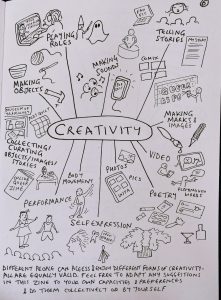
Queer people also engage with different forms of creativity, often employing creative methods to queerly create themselves and their communities, as well as exploring and communicating their experiences.
So what might queer creative health look like?
Creative health is anything that brings creativity and the arts together with health, such as art therapies, creatively expressing our health experiences, bringing music into health settings, or making health practices or understandings accessible through books or comics.
This zine explores the different meanings of queer, health, and creativity, as well as introducing a number of practices that you could try as forms of queer creative health.

The zine divides these practices into embodied, entangled, and embedded practices, to recognise that we are embodied beings (carrying all the things that have happened to us, and to previous generations), entangled beings (always in relation to other human and non-human beings and communities), and embedded beings (in the time and place we live in, and in the systems, structures and cultural norms that are present there).
The zine gives a taster of the kinds of workshops that took place at Queer Circle for anyone who couldn’t access them in person. It also explores how you might bring queer creative health practices into your own life.
Find out more:
You can download the zine here.
You can check out the Queer Circle website, and a report of the queer creative health programme here.
The post New zine: Queer Creative Health appeared first on Rewriting The Rules.
]]>The post Erotic Award 2013: Why it meant so much appeared first on Rewriting The Rules.
]]>My award was the last one of the night to be announced so I was extremely nervous by the time they got to me. Despite regularly talking to large audiences, the thought of going up on stage was absolutely terrifying. My main worry was that nobody would know why I was there: that they would see me as something of a fraud compared to all the performers, activists and practitioners who had preceded me who are so well known in these worlds.
The audience mainly consisted of members of the kink and related communities who were also staying on for the rest of the Night of the Senses ball, including those in Outsiders (the sex and disability charity which the event was fundraising for). These are very important groups for me because so much of the academic work that I’ve done has been within such communities and with the aim of increasing awareness of them beyond the stereotypes and myths that frequently circulate. I’ve always tried my hardest to make my work accountable to the people who are involved in it, and to the wider communities that they come from, but this seemed to be a real test of that. Would they see my writing as valuable? Would they even know who I was?
I needn’t have worried because the announcement of my award received a wonderful round of applause. As I made my way to the stage my legs were shaking, and I have very little recollection of what I said other than of hugging the startled compere. So I’ll use the opportunity of the rest of this post to say what I wanted say then about why this award meant so much more to me than almost any other that I could have received.
A decade ago when I started researching sexual communities, very few people in my discipline of psychology studied the kinds of groups that I was working with: the kink, bisexual and polyamorous communities. Those who did were generally seeking to conduct research which would explain why some strange people deviated from ordinary sexual behaviour: by engaging in practices other than genital sex, by falling outside the gay/straight binary, or by being in sexual relationships with more than one person.
I felt that the much more important, and less patronising, question to ask was what we could all learn from people in these communities who had – by necessity – examined issues of sexuality, gender and relationships closely and come up with many different ways of doing things. Inspired by the work of Alfred Kinsey and his colleagues, my assumption was always that there were a diversity of possible ways of being sexual and relating to others and that there would be real value in making people more aware of this. My work as a sex therapist has brought home just how much rigid ideas around sex and sexuality are responsible for all kinds of pain and suffering: from the teenage girl trying to figure out what to do sexually so as not to be labelled too tight or slutty, to the person who forces themselves to have sex for fear of losing their partner, to the people with disabilities who struggle to find any representations of themselves as sexual beings, to the many people who live in fear of their sexual desires (or lack of them) being exposed because they don’t fit into what they’ve been told counts as ‘normal’.
It hasn’t always been easy working in this area. At the start many colleagues found it embarrassing and questioned the legitimacy of what I was doing. Being open about my own involvement in the communities I was studying – so that people could evaluate my work with knowledge of my potential biases – led to exposure and judgement that was very painful at times. But over the last few years it seems that more and more academics have been taking these areas seriously and asking the same kinds of questions as me, as you can see if you check out the papers in the journal I co-edit, Psychology & Sexuality. Also colleagues in other areas have become much more interested and supportive. And public awareness has shifted such that media reports are far less likely to demonise or ridicule either the communities or the research.
Last year I published my book, Rewriting the Rules, which brings much of the work that I’ve been doing to a general audience. The response has been completely positive from academics and non-academics alike. I’m very grateful to my university – The Open University – who have been nothing but supportive, publishing The Bisexuality Report, launching my book, and publicising my Erotic Award on their website.
This year Christina Richards and I are publishing a book on sexuality and gender for therapists and health practitioners. This will hopefully make professionals more aware of the needs of people across diverse sexualities and genders, whether ‘normative’ or ‘non-normative’. I’m engaging again with kink communities to explore the sophisticated understandings of consent that are developing there which may be helpful more broadly given the current climate regarding sexual abuse. Finally, I’m starting a project with Rosalind Gill and Laura Harvey analysing sex advice in self-help books, problem pages, and TV shows. I’m hopeful that this work can lead to the publication of some more positive sex advice which is inclusive of all of our sexual practices, identities and experiences.
I’m so grateful to all of the people and communities who have supported my work over the years and who have taken part in it for little direct reward. There is no way that I could have done all this without them, and that is why this award means the world to me.
The post Erotic Award 2013: Why it meant so much appeared first on Rewriting The Rules.
]]>The post Nominated for an erotic award! appeared first on Rewriting The Rules.
]]>For those who are not familiar, the Erotic Awards (initially called the Erotic Oscars) have been running since 1994. They were founded by Tuppy Owens, who is a sex therapist who campaigns particularly on issues of disability and sexuality, and the whole event raises funds for the charity, Outsiders, for disabled people and their relationships.
Awards are presented to campaigners, films, writers, artists, publications and sex-workers, as well as to academics, like me.
The other academic finalists are Brooke Magnanti and Sue Newsome. Brooke Magnanti is a biological scientist who recently wrote the book The Sex Myth to counter prevailing myths about sex, sexuality and sex-work. Brooke also wrote the best-selling Belle de Jour series of books which were adapted for a BBC series featuring Billie Piper. I’ve met Brooke at a couple of events that I’ve been involved with and she is an extremely friendly and approachable person, as well as somebody who has done a lot of good challenging assumptions about sex and sex-work.
The other nominee, Sue Newsome, is somebody who is involved in a conference which I’m putting on for COSRT later this year. She is a sex coach, educator and therapist who is also involved with SHADA (the Sex and Disability Alliance) and does very important work in this field.
I’m guessing that my own work was nominated because, like Brooke’s, part of its aim is to challenge assumptions and myths about sex and relationships. Also, one aspect of Rewriting the Rules is to counter conventional psychological work which often tries to explain less common sexual and relationship practices by – instead – seeking to discover what can be learnt from people in diverse sexual and relationship communities. This is important to me because it moves away from the idea that there are normal ways of doing things, and that any other way is strange and problematic, towards the idea that there is a great variety of possible sexual and relationship experiences and understandings possible, and that it is worth tuning in to those which work best for us, as well as reflecting upon the ethics of different possible practices and identities.
However I’m up against two very impressive co-nominees who both certainly deserve the award. We will see what happens on the night!
The post Nominated for an erotic award! appeared first on Rewriting The Rules.
]]>The post What can we all learn about sex from The Sessions? appeared first on Rewriting The Rules.
]]>The Sessions
The film, based on an autobiographical essay On Seeing a Sex Surrogate, follows Mark O’Brien (played by John Hawkes) as he attempts to find a sexual relationship. At 38, Mark has had to spend most of his life in an iron lung since having polio as a child and is only able to be outside of the machine for two or three hours at a stretch, still lying on a gurney and reliant on his mouth for typing or making phonecalls, and on paid carers to move him around.

After being opened up to the possibilities of love, but subsequently rejected, by a potential partner, Mark decides that he wants to experience sex. A therapist refers him to a sexual surrogate: an expert practitioner who engages in sexual therapy and education through both conversation and sexual intimacy with their clients (unlike sex therapists whose professional boundaries forbid physical contact). Cheryl Cohen-Green (played by a rightly Oscar-nominated Helen Hunt) sees the highly anxious Mark for a number of sessions and helps him to explore his fears and hopes around sex, as well as experiencing various sexual practices, with the aim that he will then have sexual knowledge and skills to take into future relationships. The film takes us through both the physical and emotional aspects of the sessions and reveals the impact of these on both main characters as well as on a number of beautifully drawn additional people in Mark’s life including friends, carers and his priest (William H. Macy on cracking form).
What can we all learn from The Sessions?
The film was moving without ever straying into sentimentality, and funny whist retaining a deep commitment to the humanity of all of the characters. It contained, for me, many important messages, particularly about the value of being open to connections with others (wherever those happen) and of being able to express one’s vulnerability and uncertainty. I loved that, whilst the main character did want to have a romantic and sexual relationship, we also saw that romantic relationships are not necessarily sexual, sexual relationships are not necessarily romantic, and the other relationships in life (such as those with the priest, friend and carer) are equally valuable in their own ways.
Just as Hope Springs (which I wrote about here) does for ageing and sex, The Sessions directly challenges the common, and deeply problematic, misperception that disabled people cannot and/or should not be sexual. Clearly Mark is just as needing, and capable, of both sex and love as anybody else, and those who are able to relate with him in any kind of mutual way (rather than being unable to see past his body) are the richer for it.
The movie relays this message in a far more subtle and sophisticated manner than I could possibly do justice to so I will leave that point there. Instead, in the rest of this post, I want to ask what all of us might learn about sex from the sessions depicted in the movie. If we haven’t experienced disability it would be too easy to come out of this film assuming that what happens is only relevant to ‘other people’, or possibly to ourselves at some future time of injury, older age, or illness, but not now. Actually I think that we could gain a lot from considering the ideas around sex in this film as relevant to all kinds of people and bodies.
Sex in The Sessions
It is striking to me that the thing which makes sex with Cheryl most difficult for Mark has little to do with what his body is and is not capable of. Rather, as for so many of us, it has much more to do with his own anxieties about sex. These come from the messages which he has received about what kinds of sex are and are not okay, about what sex means, and about what it should involve.
It is extremely common for people to report sexual difficulties (more than half of people according to most surveys, as I mention in the sex chapter of my book). And even those who don’t report such problems have all kinds of ideas which get in the way of them having a pleasurable or fulfilling experience. This is a truly psychosocial issue because our psychological experience of anxiety, discomfort and self-doubt is intrinsically related to the social understandings of sex that surround us. That social stuff operates through us in the form of self-monitoring. It is like there is somebody inside observing and commenting that we might look ugly in this position; or that our partner is probably expecting us to do this now; that we’ve taken too long over something, or not long enough; or that it isn’t okay to do that because it is too dirty or weird or not ‘proper sex’. All of those kinds of internal commentaries relate to social messages about who should be having sex and in what ways.
So not only does Mark need help to believe that it is okay for somebody with his body to pursue sex at all, he also struggles with messages that sex is only acceptable in a certain kind of relationship (definitely not one with a sexual surrogate), and with ideas about what counts as sex. He has many ‘shoulds and oughts’ about sex which we will recognise from the social world that we share with him.
Cheryl challenges these perceptions well in her work with Mark. Instead of reinforcing his idea that penis-in-vagina sex is ‘proper’ sex, she introduces him to a wide range of sexual practices including those that do and do not involve the genitals, as well as the idea that certain roles or places (like motels) might be experienced sexually by people as well as certain acts. She jokes about taken-for-granted rules about sex like the idea that after fondling one breast it is ‘kindof a rule’ that you have to fondle the other one.
Whilst Mark does feel good when he meets his aim of orgasming inside a woman and her orgasming too, he later comments that it wasn’t any better than many of the other practices they engaged in, and not even as good as some. Mark also orgasms quickly on any kind of genital contact or even visual stimulation. At first he regards this as a failure but Cheryl helpfully challenges the common assumption that a (male) orgasm means the end of sex. They enjoy both sex without orgasm and sex after orgasm, and the concept that simultaneous orgasm is the epitome of good sex is challenged when it is clear that Mark can enjoy Cheryl’s orgasm more from having already had his and being able to focus on her.
What the film helpfully points out – if we are able to see it – is that we all have different kinds of bodies that work in different ways. Instead of this being a cause for shame and distress as we all try (or pretend) to meet up to some narrow, limiting standard of sex (or avoid sex entirely if we don’t), we could embrace this diversity and make it the starting point for each new sexual conversation. Rather than going in with assumptions about how our body, and our partner’s, ought to work, we could go in assuming that this will be a new and different body and being open to the inevitably new and different experience it will bring.
Our concerns could be not ‘will I get an erection?’, ‘will it last long enough?’, ‘will I be able to be penetrated?’, ‘will I come at the right time?’ but rather ‘how does this person’s body work?’, ‘what do they like having touched?’, ‘what other kinds of stimulation do they enjoy?’, ‘how do I respond to what they do?’, ‘what can I tell them about how I work with my words and with my body?’, ‘what new ways will I discover with them that I haven’t with other people?’. With such questions it ceases to matter whether or not we orgasm from penetration, or at all, or whether we get erections or can be penetrated. We can put down those anxieties and just open up to the conversation as it unfolds.
I will leave the details of how this might work in practice to future posts on sex communication and consent (and several suggestions are also already made in my book). However some ideas – many of which are touched upon in the movie – which can be helpful include:
- Exploring the whole of a partner’s body rather than focusing on assumed ‘erogenous zones’ and asking a partner to feed back to us on how each touch is for them (avoiding what they dislike in future), and doing the same thing the other way around.
- Practising mindfulness, or being in the moment. at other times in life (washing the dishes, sitting still, walking) to cultivate that capacity and bringing it to sex.
- Reflecting on our assumptions about sex, whether they are helpful, and how they can get in the way of our pleasure and ability to be in the moment.
- Communicating about what we enjoy sexually with partners outside of explicitly sexual situations (e.g. in conversation, on the phone, or online), perhaps sharing fantasies or considering all the possible sexual practices that we are aware of together.
Find out more
Since writing this blog post I’ve written a whole book, with Justin Hancock, which explores many of these ideas further: Enjoy Sex (How, When and IF You Want To). Also check out our joint website: megjohnandjustin.com.
The post What can we all learn about sex from The Sessions? appeared first on Rewriting The Rules.
]]>