The post Remembering Audrey: Another memorial appeared first on Rewriting The Rules.
]]>This time a plan took shape as I took a train past the Long Man of Wilmington last weekend. That place reminds me of my Gran – Audrey. It reminds me of the stories she used to tell of wandering the downs above Eastbourne. Last time I was there I felt strongly connected to her.
When I wrote a memorial for my other Grandmother, Leslie, I promised I would do one for Audrey too – having not had the chance to do so when she died in my teens. It’s a more complicated story to tell. But I decided to do my regret ritual today around her, and to write this story as I sit here, now, above the Long Man.

Remembering Audrey
Some of my best childhood memories involve being on a hill much like this with Audrey. She moved all the way from Sussex to Yorkshire to be close to me and my Dad – her son. She lived with my Granddad in a bungalow near the Keighley moor and I visited her there on the weekends. I thought of her as old then, but I guess she wasn’t all that much older than I am now.
Friday nights she would make me my favourite meal: roast chicken and homemade chips. We listened to singles on her record player and danced to Shakin’ Stevens. We read her grisly true crime books and gave ourselves the shivers.
Saturdays she packed a lunch and took me up the cobbled hill above the cul de sac where she lived and onto the moor. The hill seemed like a massive climb then but I guess it wouldn’t feel so far now. We always made for our spot – the red cliffs: a magic place where heather covered hillocks hid a disused quarry. Gran sat at the bottom while I clambered up over the heather and rocks, adventuring. I remember the feeling: free and wild and at the same time safe and loved, returning to Gran when I was done. We sat there watching the Worth Valley steam trains make their way along the valley far beneath us, eating chicken sandwiches and the little purple bilberries growing around us. She’d tell me how she used to climb like me – up on the Sussex downs. She said those were her happiest times too.
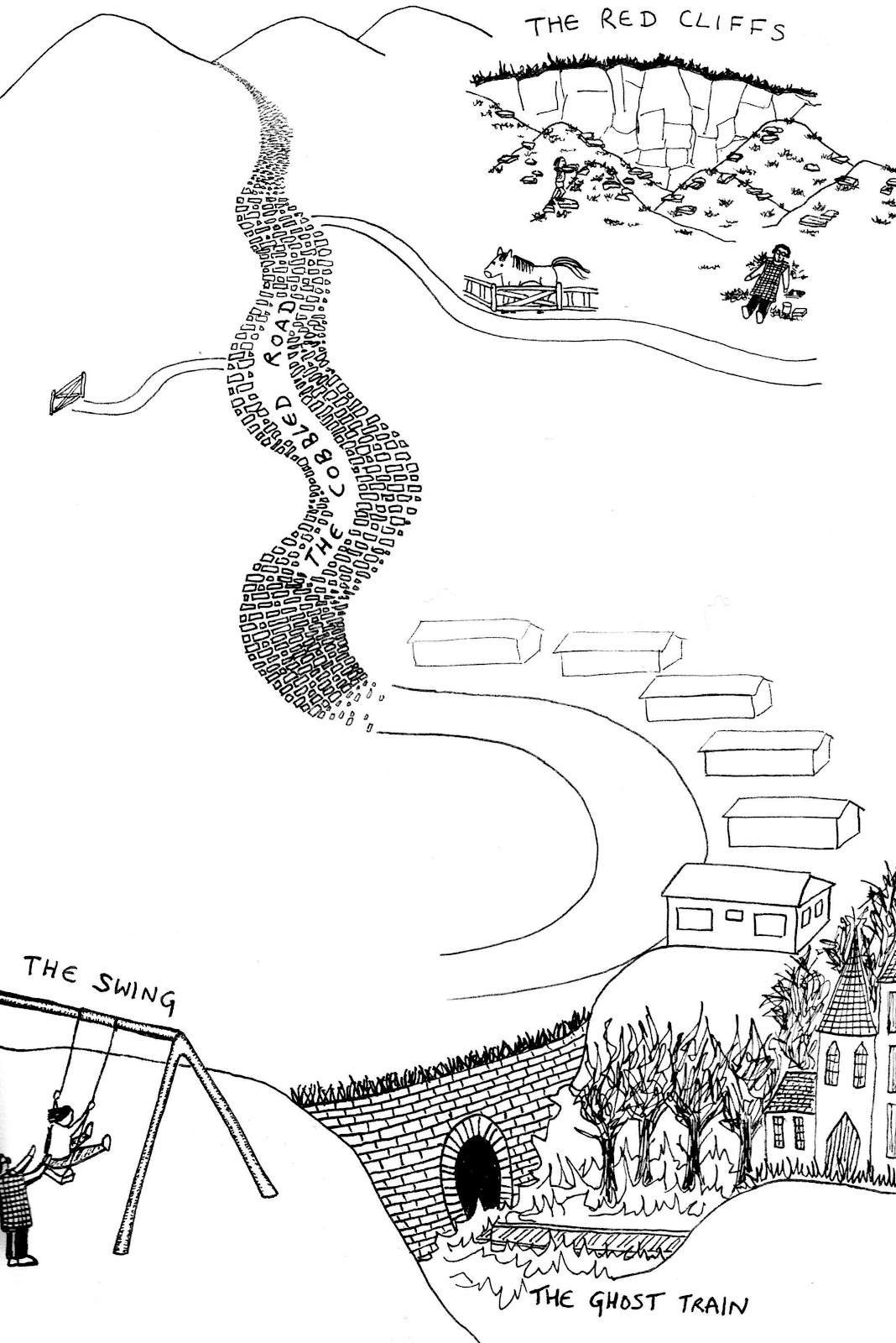
Later, after she moved to Bradford, our days together became adventures where we’d get on the first bus that came along, sit upstairs in the best spot (monarch of the bus), and go wherever it took us – Keighley and Haworth generally being the only options but I didn’t know that at the time. I remember her telling me stories about this family of kids she’d made up, and feeding me maltesers. She’d push me on the swings in the park, take me round the little shops, and get us fish and chips to eat at the bus stop before we headed home to bath and bed.
Love and Loss of Love
When I think of those times together, love is the word for it. The way Audrey delighted in me – my excitement at all that we saw and did and talked about – combined with the safety and kindness I felt from her, cuddled up in the evening watching TV after all the adventuring.
But it’s a complex story because Audrey also taught me what it is to lose love. I remember it vividly. I guess it was around the time I started adolescence. I was being bullied at school: learning that I wasn’t okay in all kinds of ways, that I’d have to hide my innocence and difference and enthusiasms if I wanted to get on. Gran had moved into sheltered housing. I think she probably struggled as much with the other people there as I did with the kids at school but I didn’t see that at the time.
I remember one evening I made a critical comment about someone on the TV who annoyed me. She became furious, saying I didn’t know what that woman had been through, what a hard life she’d had. In retrospect I think it must’ve been someone she identified with. It struck some painful chord from her own life. I remember the disappointment, disapproval, even disgust on her face as she looked at me. I linked it to the way she’d looked when I told her I’d started my period. She called that the curse.
This felt like a curse. Suddenly everything about me was wrong. And the things I was doing to survive this situation I was in made me someone my Gran couldn’t love any more. It happened a couple more times: her getting enraged like that, seemingly out of nowhere. It scared me and it confused me. I didn’t tell anyone about Gran’s anger just as I never told them about the school bullying, or my fears that there was something wrong with my body.
Gran and I became distant. She transferred her affection to my sister. Before I was out of my teens, she died. I felt guilty for betraying her, for seeing her less and less, for rarely visiting her in hospital. Her funeral was horrible: fake music and this person talking who didn’t even seem to know her.
I feel so sorry that I could never know Audrey adult-to-adult: that I could never have these conversations with her directly and also that I couldn’t find out more about her politics and activism. These were probably pretty similar to where I’ve now got to myself. She was heavily involved in the miner’s strike, for example.
Stories and Patterns
You could tell a lot of stories through what happened between me and my Gran. I later found out that this was her pattern with family and friends – to love people fiercely and fully – looking on them as golden ones – and then eventually flipping and feeling betrayed by them – hating them and often casting them out of her life, or at least her heart.
You could say it was terrible that she did that to me – a little kid. Just at the time when I needed her love to be a constant to demonstrate to me that I wasn’t all the bad things I was being told I was, instead she acted in a way which confirmed it. And she was the grown up. She should’ve known better; done better.
Or perhaps she saw what was happening to me: saw the delightful, playful kid she’d loved disappearing and this hard, unhappy, critical person taking their place; clumsily trying to be what other people wanted them to be and losing themself in the process. Maybe she couldn’t bear that: losing me that way. Maybe it was also what had happened to her once upon a time.
Or perhaps this is just what it’s like for everyone going from childhood to adolescence. Maybe I should just get over it.

But the point is I never really could get over it. My whole life I’ve longed to feel again that kind of love I felt from Gran. It’s like she passed her pattern onto me because whenever I seemed to find that kind of love I would love fiercely and fully in return, but if the person ever looked at me the way Gran did those times – with disappointment, disapproval, or even disgust – I’d find it totally unbearable. I would do anything to avoid that happening: becoming hypervigilant, trying to be whatever they would find loveable, avoiding saying or doing anything they might not like.
That kind of pressure often meant that when I couldn’t keep it up – all that work – I would become really hard to handle: desperate, flailing, unreachable, inconsolable, self-loathing. And of course that made it even more likely I’d get that look. As it happened more and more I wouldn’t be able to bear it so eventually I’d leave. Often I’d wait until another person had come along who might give me the kind of love I craved. Somehow being without it at all once more felt too hard.
Of course there’s more to my patterns than this: other stories that I have told – and will tell – in other places. There are stories about the cultural messages around love we all receive, stories about other early relationships I had and their impact, stories about capitalism and what that does to us, stories about how we all struggle to be with each other in our complexity – not grasp for the ‘good’ and hurl away the ‘bad’. There are stories about the patterns of the other people involved – which are not mine to tell – but which were part of the picture too, of course.
And there are relationships where I’ve resisted this pattern: found other ways to be, or containers for the relationship which have enabled it survive moments where I felt like my old horror was being lived out again.
But this feels like a pivotal story for me. And it’s not over yet: the pattern still happens.

Memorial
So today I decided to come here, where I imagine Gran used to come when she was a kid, maybe before all of her patterns got put in place: the ones she somehow passed on to me.
Despite being mostly veggie these days I allowed myself the happiest chicken I could find. I ate it with homemade chips last night and made sandwiches this morning. I got on the first bus that came along near my house: the Coaster that runs from Brighton to Eastbourne. I got off at Friston and walked through the forest. I saw a fawn with an adult deer in the woods: they seemed impossibly fragile to me. Lots of fragility on the walk.

I came to this spot by the Long Man, eating blackberries instead of bilberries along the way. And now I’m sitting to write this on my phone and popping maltesers. Later I’ll have my sandwiches looking down over Eastbourne, watching the trains make their way along the valley beneath me.
It strikes me that through my life I’ve taken the journey Gran took in the opposite direction: from Yorkshire to Sussex. I’ve moved down the country till I’m where she began – walking her chalk hills instead of my moors. I have to stop my progress south now. I’ve finally met the sea.
I’ve carried these patterns with me all this way, leaping from love to love with no break in the chain, trying to get back what I once had and leaving every time it looked like it was going the same way as before. I’ve tried everything to do it differently. I’ve reflected and written about it, I’ve warned people about it, I’ve shown them every part of me. But still I gave too much of myself away in an attempt to get that love and had to leave to get myself back. Still I couldn’t seem to bear it when the love dropped into that other thing – the disappointment, disapproval, disgust.
So now I’m trying the one thing I haven’t tried yet: not doing it. I’m staying with those old, old feelings of loneliness and longing for love, of yearning for somebody else to prove that I’m okay, and fearing that I’m really not. I’m trying not to push the feelings down, not to blame anyone else for them, and not to look to anybody else to make them go away. It’s really fucking hard but I think it’s the only way to change these patterns, and the pain and loss they cause to others and to me.
I’m doing rituals like this to try to find the love and kindness and safe-enough feeling that I long for within myself. I’m reaching out to all of my people, being vulnerable, and letting them into this so that I won’t be tempted to put it on one person any more. And hopefully those people will feel able to let me know if they see that happening again.
Today I do this ritual of regret for my Gran and for myself. I’m so grateful to Audrey for showing me what love can be, and I’m grateful to myself for managing to do this now. I also forgive Audrey for passing on this pattern – this curse – which has lost me so much love, home, and family along the way. Goodness knows what she went through to make her that way, or what the people went through who did that to her, or the ones who did that to them. As I forgive her I try to also forgive myself and to forgive all of us who are caught up in our own patterns, passed down through the generations, hurting each other and hurting ourselves. May we all find some kindness in this sorrow, in this regret.

The post Remembering Audrey: Another memorial appeared first on Rewriting The Rules.
]]>The post Practising regret appeared first on Rewriting The Rules.
]]>Why regret?
Intersectional feminism and other social justice movements remind us that we simply can’t help feeling and acting in racist, misogynist, classist, homo/bi/transphobic, ableist, etc. ways because we live in a society that is structurally racist, misogynist, and so on. Relatedly we’re never going to behave in a perfectly consensual way in a culture which is steeped in non-consent, based as it is on some lives, bodies, and forms of labour being valued far more highly than others: a system we’re all implicated in and can’t escape. Also – as Sarner’s article highlights with the example of a man who experienced extreme poverty going on to impoverish his own kids in a different way – we all operate under intergenerational trauma. The trauma of unjust and non-consensual culture – and the ways of treating people that engenders – has been unwittingly passed on to us and shapes our own ways of doing things, in ways that become habitual for us.
This is why the ideal of having no regrets isn’t going to work. Individualistic culture gives us the message that we – as individuals – could and should be able to choose to be good, nice, safe people who never do any harm and therefore need have no regrets, but this would be impossible. Indeed, the idea that we – as individuals – are good, nice, and safe, and are only capable of helping – never hurting – others, is one of the most dangerous ideas around. It prevents us from seeing these systems and structures of injustice and how they operate through all of us all the time. It leads to us denying and minimising the harm that we do in ways that hurt those we’ve already hurt all the more.
So it’s vital to regret on a political level: to notice where we’ve been implicated in harm, to take responsibility for the impact of our actions – however unintentional – and to keep asking the question of how we can collectively work to do things differently.
An Alternative to Blame and Shame
As Sarner suggests, regret is also vital on a personal level. Embracing the inevitability of regret – and finding ways to practise regret – offers an alternative to blame or shame, which are our go-to responses. When our actions have harmed others we either focus all our energy on blaming someone or something else for it and defending ourselves because we must be seen as a good person (by ourselves and by others). Or we go the other way and focus on shaming ourselves: holding ourselves entirely responsible, assuming this means that we’re utterly flawed as an individual, and continuing to beat ourselves up – often for years or decades. Frequently we oscillate between the false binary of blame and shame: it must be all your fault, or all my fault. Both blame and shame operate from that individualising perspective, failing to recognise the inevitability of hurting and being hurt by each other within the toxic cultures we operate in. Neither generally results in us acting any less harmfully in future.
Shame can be just as much a defence against responsibility as blame. We can give off the message to others that they must never let us know that we’ve hurt them because we can’t cope with seeing our capacity to cause harm. This kind of fragility can mean that those who are marginalised, oppressed, or harmed continually have to do the emotional labour of protecting those who have done the harm from this knowledge, shoring up their belief that they are really good people.
The culture of individualising – and of binary blame and shame – exacerbates the tendency to operate in this way. When people recognise a bad situation, the answer is often to search for one individual to hold responsible and to publicly blame, shame, and exclude, rather than to looking for the problems in the wider system and culture that enabled these dynamics. Fear of being identified and rejected in this way results in other people feeling even less able to be honest with themselves and others about their harmful actions. But as authors like Brené Brown have pointed out, we’re all going to mess up, we’re all going to get it wrong, and we’re all going to fail. Trying to avoid doing so limits our creativity, our potential, and our relationships with others. These things are inevitable and we need to cultivate a culture where it’s possible to bear this truth, and to be open about our mess, mistakes and failures.
Regret practice
Given the powerful forces pulling us to deny our harmful actions and/or to disappear into shame, how might we find another way with regret? I’m increasingly thinking that – given that these problems are always systemic, structural, and cultural – if we are to shift them then we need systems of support, structures, and micro-cultures in order to we do things differently. We can’t just rely on some kind of willpower or changing ourselves as an individual, as some forms of self-help, therapy, and mindfulness suggest.
I was re-reading Pema Chödrön’s book Start Where You Are and was struck by a ceremony she describes which is done in some Buddhist monasteries on the days of the new and full moons. I like the idea of rituals that mark specific times, like the changing seasons, or the phases of the moon. It seems like a way of connecting back to the world around us, as well as being a helpful reminder to reflect on certain things regularly: providing a structure. While I haven’t done this practice with others yet, it certainly has scope as a collective activity, and it’s possible to feel connected to others who may be doing the same – or similar practices – at the same time.
Regret ritual
The four stages of the ritual are:
- Regret – noticing what we do and putting it down
- Refraining – not doing your usual habit
- Remedial action – doing some practice to support us to do things differently
- Resolution – gently and openly committing to doing things differently
I imagine that I’ll adapt these stages differently each time I do the practice, but these are the kinds of things I’ve been playing with so far. Generally I’m taking an hour or so on the evening of the new and full moons to do this. First I set myself up with everything I need, creating a space for the ritual, maybe lighting a candle and taking a few breaths to ground myself. Then I do something like the following.
Regret
I’ve found it helpful to start by journaling about the things I regret – either everything that occurs to me or focusing on a particular theme. If you did the practice with other people you could start by telling each other these things. In between rituals you could keep a note on your phone of things that occur to you to reflect on, so you already have a list. It’s all about gently noticing the habits of thinking or behaving that we fall into which hurt ourselves, others, and the wider world. The first time I did this practice, I noticed that writing things down didn’t connect me enough with the feelings, so I also sat quietly for a while, remembered the events I regretted, and let myself feel my response in my body.
Refraining
Instead of launching into acting, we start by refraining. It’s a bit like the idea in medicine ‘first do no harm’. Often when we feel bad about something we’ve done we immediately rush to rectify it, or to get forgiveness from the person we’ve harmed, often regardless of whether that would be the best thing for them. This can end up requiring others to do even more emotional labour, or even retraumatising them. When harm has happened perhaps instead we can slow right down and refrain from acting until we can see the situation clearly, and know that we’re acting out of care for the others involved rather than trying to make ourself feel better. It can also be useful to reflect on why you did whatever you did: was there something you wanted from acting that way which you could notice if it came up again and refrain from? In the practice this phase might involve slowing down to really notice where we’re at with what happened and what we feel capable of for now.
Remedial action
This might be a practice that supports you now in doing things differently, like a compassion meditation, or putting yourself in the shoes of the other person or people involved. It could be planning what you might do to support you doing things differently in future: for example planning to explain the situation to trusted friends and get support in what you do next; or committing to learn more about an area where you’ve messed up because you didn’t know enough about it; or planning to do something you know to be helpful in a different area. Something that I’ve found supportive at this phase is to remember times in the past when I’ve felt similar confusion, guilt, shame, or whatever, and to imagine sending support back to those versions of me, as well as to other people who I know – or don’t know – who may be caught up in similarly complex situations.
Resolution
I found journaling helpful at this stage again to write down some resolutions, and to try to synthesise it into a couple of key points that I wanted to remember until the next ritual. You could also make something visual to symbolise what you want to refrain from and what you want to resolve to do differently. It could be creating drawings, or choosing objects like stones, buttons, or tarot cards that symbolise those things, which you leave somewhere you can see them every day. You could move your body in some way to represent what you want to refrain from and resolve: maybe some particular music or song to represent each one. Whatever works for you.
At the end you could take some more breaths, blow out the candle, or do some other grounding practice to mark the end of the ritual, perhaps inviting yourself to feel gratitude for the people, practices, and ideas that support you.
Cultivating the practice
I’m thinking that it might be useful, each time, to check out my notes from the previous time/s, in order to remind myself of my habits and resolutions. The ways we cause harm can be extremely hard to face so – as well as going gently and kindly with ourselves and remembering the wider situation we’re all operating within which makes this so difficult – it might be helpful to do this practice regularly in a way that builds over time: maybe not looking at everything all at once in a way that would just overwhelm us and prevent us from wanting to look at it again. Teachers, therapists, or supportive groups could be helpful if we get into territory that feels too hard to bear alone.
Find out more
I’ve written elsewhere about how it’s useful to sit with our role on all sides of the drama triangle (victim, persecutor, and rescuer) personally and politically, as well as how it can be helpful to connect with both our privilege and oppression. My social mindfulness zine also covers this in detail, and staying with feelings includes practices for how to stay with the emotions it brings up.
The post Practising regret appeared first on Rewriting The Rules.
]]>