The post Stuck in alone or together: An opportunity to address stuck patterns appeared first on Rewriting The Rules.
]]>This series of three posts work through what stuck patterns are, and the ways we can address them if we’re stuck in alone, or if we’re stuck in with others. However, all three are relevant to everyone because I’ll suggest that those of us stuck in alone could do with exploring how we might do some of this work with others, while those of us stuck in with others could do with getting plenty of solitude in order to do the parts of the work that need doing alone.
In this first post, I’ll start with a bit more of an introduction to what stuck patterns are, and why we might prioritise shifting them at this time.
Hopefully if/when this period of Covid-19 crisis is over, the ideas and practices here will still be helpful for those finding themselves alone and wanting to address their relationship patterns, and for those wanting to do so while in relationship with others. I’m also aware that not everybody will be ‘stuck in’, particularly those in the category of key-workers. Hopefully some of the ‘stuck together’ advice will also be useful for those who’re still out in the world working with others.
What are stuck patterns?
The point of the tweet I began with is that intimate relationships hold up a mirror to our habitual patterns of relating with others, and with ourselves. Most of us will have fetched up with some stuck patterns in how we relate along the way, which will have ended up being harmful – or at least not helpful – to ourselves and others.
These patterns will generally emerge in all of our relationships, given time. Often they influence how we relate to other things in our lives besides people too: work, leisure, food, exercise, technology, etc. In this post I’m focusing on how stuck patterns emerge in relationships, particularly in relationships where we are very emotionally close and/or spending a lot of time together. This is where they often come up most intensely.
Stuck patterns determine how we relate to others – and ourselves – on an everyday basis, and also when we’re triggered or activated. Different therapeutic approaches have all kinds of ways of naming these patterns and understanding where they come from. Generally they agree that stuck patterns are the strategies which we learnt when we were young – or sometimes through stress and trauma in later life – which enabled us to survive.
One useful model comes from Pete Walker’s work on cPTSD. He suggests that these strategies are often versions of the classic trauma responses of fight, flight, freeze, and fawn. Some of us learnt as kids that what worked was to battle, belittle or control those around us (fight). Others learnt that striving to perfect ourselves and do all-of-the-things was the way (flight). Others learnt to retreat into ourselves and self-soothing (freeze). Others learnt to do whatever it took to appease others and be what they wanted us to be (fawn).
Most of us have some combination of these strategies, or go to different ones at different times. Generally they have become the way we habitually relate to other people, and they come out most vividly when we’re triggered or activated: in times of crisis or conflict.
For example, my go-to patterns are mainly fawn/flight. The fawn part means I habitually try to monitor myself to ensure I’m being ‘good’ for those around me, and struggle to have boundaries if people want me to do things that don’t feel good for me. The flight part means I tend towards over- rather than under-functioning, like – I don’t know – writing a whole bunch of books, zines, and blog posts to try to figure this stuff out and communicate it to others!
When triggered, fawn/flight means that it can feel life-or-death to me to make things right with people. And I’m likely to throw everything that I have at the situation, exhausting myself in the process, rather than taking the time I need to look after myself and get some perspective.
If Pete’s model doesn’t work for you, there are many other ways of looking at stuck patterns out there. For example Jeffrey Young lists ten common problematic schemas with which we tend to approach relationships, again developed as survival strategies during our lives.
Whatever language you use for the stuck patterns, and whatever understanding you have of how they got there, we all have them and we can address them by:
- Noticing the patterns
- Doing something different
- Making that an everyday practice so that new habits can bed in over time
Why address stuck patterns?
If we decide to stay in relationship with somebody, we’ll need to address those patterns in order for that relationship to work well for everyone in it over time (if it’s not working for everyone, it’s not working for anyone). If we break-up because the patterns are hurting us too much then we’ll need to address them or we’ll likely bring them into subsequent relationships.
Better for us
Addressing our stuck patterns is better for ourselves because it will help us to discern which relationships in our lives are good for us. It will also prevent us from getting into painful dynamics with others, and enable us to notice such dynamics and shift them when we have.
Better for our close people
Addressing our stuck patterns is better for the people we’re close to because we’re less likely to hurt them, or get stuck in dynamics where we keep triggering each other with our patterns. Hopefully once we’re clearer on what our patterns are – and more able to shift from them – we’ll also have more capacity for the people in our lives and deal better when relationships do become difficult.
Better for everyone else
Addressing our stuck patterns is better for everybody because when we’re stuck in painful dynamics we have so much less to offer to the other people in our lives and to our wider communities. It’s extremely hard to be empathic and compassionate when we’re stuck in these patterns. We’re also more likely to act out of these patterns with others beyond our closest people if we haven’t addressed them: friends online, the staff in the supermarket, strangers on social media.
It might seem like addressing our relationship patterns is not the most urgent thing we could be doing while the world is literally on fire with rising fevers and global temperatures, conflagrations and conflicts. In fact I’d argue it’s one of the most vital things we can do. Why?
- On an everyday level our lives have the potential to be heaven or hell depending on how we relate to ourselves and each other. If we’re all relating to each other through our stuck patterns we’ll hurt each other and feel terrible about ourselves. If we can find ways to shift out of our stuck patterns then there’s the potential for everyday life – even a much more constrained everyday life – to be okay, perhaps even pretty good if we explicitly make this our plan and notice how we’re making progress over time.
- In relation to sickness specifically we know the toll that stress and trauma take on the immune system. If we’re putting other people – and ourselves – under stress and/or triggering them into trauma responses with our patterns then we’re making it more likely that they’ll get sick and struggle to recover quickly, not to mention the mental health crises that can result from prolonged relational stress or being frequently retraumatised.
- Just as our relationship to ourselves often mirrors the way we relate to other people, so too does the way we relate to the wider world. At a time when we urgently need to all be thinking and behaving collaboratively and collectively – and kindness, compassion and mutuality are essential – unlearning patterns which keep us locked in our own individual pain – and in stuck dynamics with close people – seems pretty urgent.
Addressing stuck patterns
In the next two blog posts I’ll cover how you might address stuck patterns if you’re stuck in alone, and if you’re stuck in with others. In some ways the challenges and opportunities of these two alternatives are opposite. Those stuck in alone may find it easier to get the space and time needed to do this slow habit-shifting work (although this will be more challenging for those who are still working full time from home and/or who struggle not to fill time with distractions). They may find it harder to get opportunities to practise shifting habits in relationship with others. Those stuck in together may find it hard to get enough space to do the inner work needed here, but they may find it easier to get practical opportunities to practice in relationship, particularly if those around them are up for this kind of work too.
A key aspect of what I’m arguing here is reframing our stuckness (alone or together) as an opportunity. Of course it’s vital to experience and express all of our feelings about the ways in which the current situation has altered our lives. This isn’t a Pollyanna approach. We need to feel our fear at what might be coming, our grief at what we’ve lost, our rage at systems which have failed to support us.
However, embracing the potential in what has happened for befriending ourselves and addressing our stuck patterns can definitely be a useful reframe. It also means that we can relate differently to the micro-moments of difficulty which come up as we spend more time alone or with close people. Instead of regarding each freak-out, plunge into loneliness, argument, or relationship tension as a failure, we can reframe these as opportunities to slow down, to turn towards what we’re finding hard, and to learn more about our patterns and how they operate in us.
To read on to the posts about how to address stuck patterns if alone or with others, follow these links:
There’s more about shifting stuck patterns when they are fleeting, entrenched, or overwhelming in this post.
Patreon link: If you liked this, feel free to support my Patreon, it will certainly help this self-employed person to maintain some income during these uncertain times.
Plural tag: This post was written by Beastie.
The post Stuck in alone or together: An opportunity to address stuck patterns appeared first on Rewriting The Rules.
]]>The post Addressing stuck patterns when stuck in alone appeared first on Rewriting The Rules.
]]>So what if you’re stuck in alone? This is the situation that I find myself in, so I’ll probably be blogging a fair amount about this in the coming weeks and months. I feel fortunate that – for me – I had already decided to live alone and to take a break from certain kinds of (romantic and erotic) relationships for a while in order to address these patterns, before social distancing/isolation hit. It must be much harder for those where this hasn’t been an intentional choice. However I think that solitude can be an opportunity for us all to do this work. Maybe reframing it in this way can be helpful for you if solitude and isolation hasn’t been something you’ve historically welcomed.
The opportunity here – if we want to take it – is to take an intentional break from any kinds of relationships where we get drawn into these patterns in a big way. For a lot of us these are partner, family, and cohabiting relationships. We get drawn into such patterns there because we’re often around each other a lot, and because – whether consciously or not – we tend to look to partners and families to provide us with the kinds of love we lacked or lost when we were younger. Our stuck patterns often emerged as an attempt to get ourselves care and protection from others and to prevent people from abandoning us or hurting us.
So here’s a great chance to go cold turkey on problematic relationship patterns! In a similar way to the way that, for some of us, the current situation enables us to have a period of not doing our job in the way we used to and perhaps addressing some of our stuck patterns around work, it also enables us to have a period away from intense relationships. Of course, just as we could fill our time with other kinds of work, we could fill solitude with online relationships, continuing to date, have online sex, speak to family every day, etc. However, I’d like to suggest the alternative of taking this time as permission to step away from being caught up in intense relationships for a while.
You won’t be surprised to hear me stress the need for gentleness around this kind of cold turkey. While I’m no fan of addiction models, there is something to the analogy between drug addiction and the kinds of compulsions we’re acting out when we long for love to heal or save us. We can expect some detox pain, withdrawal symptoms, cravings, and relapses.
For me the hardest part of this process of trying to shift old patterns of relating to myself and others has been an initial period where everything felt a whole lot more painful and difficult. It’s hard to have the faith needed to keep going when you’re not getting any rewards for the work you’re doing and when there’s a lot of uncertainty – and no guarantees – about what’s on the other side. Again a whole shedload of gentleness and kindness towards yourself is key. I’ll be blogging more about that in the coming weeks too, but it’s worth remembering that you can’t shift these kinds of patterns the same way they came into being, i.e. through treating yourself harshly.
Also this kind of work can’t be done quickly because it takes a lot of time to bed new habits into our bodies. Physiologically it’s like there was a deep channel through which the rainwater made its way off the roof and down to the ground. We need to wear a new channel deeper than that old one before the water will automatically follow the new channel.
Noticing and shifting stuck patterns by yourself
So the aim is to notice and shift these patterns in our ways of relating. Initially we won’t even notice the patterns because they come so habitually to us. Then – by bringing our attention towards them intentionally – we’ll start to notice them, but we probably won’t manage to do anything differently. This is often the hardest part: realising how much we do this stuff and feeling unable to change it. If possible at this stage it’s great if you can reward yourself for just simply noticing. That, in itself, is a huge shift. This is followed by a period where you can sometimes manage to do things differently when the old pattern kicks in, although it probably takes a lot of effort.
Eventually there will come a time when the new pattern feels as easy as the old one did. Here it’s useful to remind yourself of times you have changed other – perhaps more minor – habits in this way. You can reach that point! This is just how learning works. Portia Nelson’s poem of the hole in the road, or the visual model of unconscious incompetence to unconscious competence can be helpful reminders.

So what are we noticing if we’re alone without close people around us to keep pushing our buttons? Fortunately (!) even if we’re completely isolated our stuck patterns will kick in plenty. They’ll play out when we get a tricky email, or have a rough exchange on social media, or when a tough memory comes to mind, or a song reminds us of something hard: probably many times a day. Certainly the degree of uncertainty in the world and the frequent changes we’re having to make will probably bring out our familiar patterns.
I’ve found that increased solitude has helped me to get a way more vivid sense of what it feels like when my fawn/flight pattern kicks in. This helps me to notice it more and more – including the smaller everyday versions of it as well as the big crisis versions. For me – as for many I suspect – the underlying feeling behind my patterns is one of fear combined with shame. However, initially we may be more likely to notice the feelings that tend to get layered on top of that feeling: anger and blame if we tend to fight, busyness and speed if we tend to flight, lethargy or scatteredness if we tend to freeze, or guilt and self-criticism if we tend to fawn.
Over time I’ve found it possible to identify the earlier flicker of discomfort in my body which precede the pattern kicking in. When I turn my attention towards that, instead of trying to deny that anything is going on as I might have done in the past, I can usually now address it before the bigger pattern kicks in. I’ve started to ask myself why this particular trigger puts me in a fear/shame place, and to consider what it might be like if I looked at it differently. My process is something like this:
- Message comes in asking me to do something I don’t really want to do
- Sense of discomfort
- Turn towards sense of discomfort instead of pretending it isn’t there or acting immediately on the message
- Ask myself how this is a fear/shame thing for me
- Realise that I feel shame if I imagine saying ‘no’ to the request because someone may think badly of me, but I feel fear if I imagine saying ‘yes’ because I know that will hurt me because it involves me overriding my self-consent
- Consider other options beyond the binary of no/shame and yes/fear, such as explaining to the person why it’s tricky for me, offering something else that is a ‘yes’ for me, giving myself more time before responding, etc.
- Feel the sense of discomfort ease and a sense of peace replace it
For me personally, because I work in a plural way around everything, I found it helpful to locate the part of myself who gets stuck in the fawn place and the part who gets stuck in the flight place. I realised that my fawner is the one who is freaking out in the background trying to figure out what to do in the face of this fear/shame double bind, and this makes my flee-er jump to attention and try to do something immediately, often hurting and exhausting themself in the process. I now speak directly to my fawner when this happens – from a kind part of myself. I conceptualise this process as helping my inner fawner to step out of his prison: something I drew in comic form last year, which has been a helpful visual touchstone for me.
What I’m suggesting here is that, by slowing down and attending to these things intentionally, particularly when they kick in in small ways on a daily basis, we can get a detailed sense of the anatomy of our patterns and how they play out for us. Then we can get creative about how we shift ourselves out of them, eventually coming up with a range of tools which help us to do something – anything – differently when the patterns kick in.
Addressing blocks to this work
One thing which can really block us on doing this kind of work is fear and shame around it.
Fear: We often don’t want to go anywhere near it because it will involve confronting who-knows-what damage our patterns have caused to ourselves and others over the years. We fear what we might find if we attend to ourselves and our patterns so we don’t go near them.
Shame: In a culture which is utterly rooted in shame in order to sell projects and police our behaviour, we’re terrified of confronting anything which might validate the sneaking suspicion which has been implanted in all of us that we’re unacceptable ‘bad’ people. Certainly admitting to our stuck patterns and the damage they have done is a radical act in a world where being seen to have behaved badly can result in public call-outs and cancelling.
There will be more blog posts and podcasts from me on this topic because I think that shifting the culture of frightening and shaming (ourselves and others) is another of the urgent things we need to do right now. For now let’s focus on how we might personally lift the block of fear/shame in order to enable ourselves to do the work of noticing and shifting our patterns.
I find it useful to remind myself of the following things in order to avoid getting frozen in the fear of what I might find if I address the patterns, and to avoid defending against shame by blaming others instead of looking at my stuff.
- Everyone has stuck patterns which hurt themselves and each other, not just me. This is not something I should feel specifically bad about, but something which connects me with everyone.
- If I turn towards these patterns and the impact they have I stand a much better chance at halting my part in toxic relationships, systems, and cultures.
- If I can learn how to do this stuff maybe I can help others to do it too and that will be good work to do (getting my inner fawner and flee-er on board!)
Another useful practice which I’ve written about before are regret rituals. If we come up against painful memories where we have been hurt and hurt others then we can make deliberate space in our life to feel the grief and regret around those times. Doing this regularly can help us to feel less overwhelmed. It can help us in the hard work of forgiving ourselves and the others who have been caught up in these dynamics with us. This relates to the idea of embracing both our inner survivor/victim and our inner oppressor/abuser which many intersectional feminists suggest. We’ve all been both of these things and we need to grieve and regret them as part of addressing our patterns.
Finally I’ve recently come up with this process for thinking through any situation which comes up where we feel a lot of shame about our behaviour, often because we’ve acted out of our stuck patterns. It helps me to get my own personal role in perspective so that I can then be accountable for that without becoming so lost in shame that I can’t engage helpfully and responsibly.
I assume that the following elements will be involved in any occasion where somebody feels hurt by another’s behaviour. I work through the specific situation considering what I know each element to be in this situation – or what I can imagine they might likely be when I don’t have all the information.
How did each of these things contribute to the situation?
- Who I am, what my patterns are, and the stuff that’s happened to me to result in my patterns
- Who they are, what their patterns are, and the stuff that’s happened to them to result in their patterns
- Relational dynamics that often get acted out between people like the drama triangle or the four horsemen or the kinds of objectification of self and others that I wrote about in the Rewriting the Rules chapter on conflict
- The wider systems and culture around us
- Random chance
Then I can consider how best to address my part in it without taking too much responsibility, or too little because I can’t handle the shame.
Finding inside what you’ve looked for outside
Another useful way of addressing your patterns alone involves finding inside yourself the things that you’ve been looking for outside yourself. I mentioned earlier that when we form relationships from a place of still having these patterns we’re often trying to find – in another person or people – things that we struggle to find in ourselves, perhaps because we lacked or lost them in painful ways earlier in our lives.
For example, Pete Walker suggests that many survival strategies come into being because we’ve lacked or lost care and/or protection. This means that it’s hard to be kind towards ourselves (due to lack of good models of care) and to keep ourselves safe (due to lack of good models of protection). We could see the antidote to our shame as care, and the antidote to our fear as protection. Pete suggests ‘reparenting ourselves’ as a way of addressing this. Instead of searching for others to provide a kind of total care and protection which is probably impossible for anyone to give, we could cultivate our own capacities for self-care and self-protection.
Working as I do from a plural perspective I’ve found it useful to consider what my inner carer and protector look, sound and feel like, and to intentionally bring them into dialogue with other parts of myself so that they can become increasingly accessible in a way they certainly haven’t been for much of my life.
However you don’t have to work with it in quite this vivid a way. It could just be about talking to yourself – internally or externally – in a kind and/or protective way each time you’re struggling. If this feels impossible it can be an area where ‘acting as if’ is helpful at first. Imagine if you did have such a kind/protective inner voice. What might it say? What would it say to another person in your situation? Again even glimmers of being able to treat yourself in these ways are impressive to begin with, and can build into something much more available and constant over time.
It can be good to consider what else you may have been looking for in external relationships which you could use this opportunity to find in yourself. You could list some of the things you’ve been drawn to in the people you’ve had close relationships with and see if you can access those aspects of yourself. For example if you tend to romanticise or eroticise rescuing vulnerable people, can you find that vulnerable part of yourself to rescue? If you’re drawn to cocky confident clowns, can you find one of those in you? If you get together with people who feel a bit dark or dangerous, maybe there’s a dark, dangerous part of you who needs some love and attention. Again I hope to blog and zine more about how to do this work, but the initial plural zine gives you some tools.
I’ve been asking a lot lately what it might be like if the kind of love which I have projected out onto other people could be turned in towards myself. There’s a lot of fun, pleasure, and interest to be had in experimenting with this, and it seems to expand with practise too. I’d recommend playing with this yourself, if you can, because we need these processes to feel good in some way if we’re going to remain committed to them. Hopefully the peaceful feeling of addressing our patterns, the lifting of shame involved in regret rituals, and the joy of turning the love in, can help us to stay on this path over time. Justin and I have resources on self-love, joy, and love in the time of Covid-19 which may be helpful.
Gradual relationship practice
I’ve explored a lot of things that we can do alone to shift our patterns and to turn our solitude into something potentially immensely valuable to ourselves and others. However there’s a limit to what we can do alone.
First, it is very hard – if not impossible – to do solo work without systems and structures to support it. This is why I’m so critical of the ideas of self-help and self-improvement, and why many are shifting their language from self-care to community-care.
Secondly, the point here is to shift our relational patterns, and we do need to practice those in relation with others. Pema Chödrön gives the example of a hermit alone in a cave practising patience. Another monk visits him and starts joking that it’s all a ruse the hermit is using to look good and to get people donating things to him. Eventually the hermit explodes in anger and tells the monk to piss off, at which point the monk asks ‘where is your patience now?’
While we’re in this time of solitude it’s worth asking ourselves how we can cultivate systems and structures to support our solo work, as well as how we can engage in relationships in ways that enable us to practise what we’re learning. One bonus of this time – if we’re stuck alone – is that it can be relatively easy to ensure that we have a lot of spaciousness and slowness around all our relationships in which to process what happens and act intentionally rather than quickly from old patterns.
Relationships you might consider building in online while isolated, if you can, include:
- Peers who are also engaging in this kind of work to share how it’s going and to support each other
- Small groups where you all have time to share what’s going on for you at the moment and be heard
- More explicit forms of one-to-one peer support or therapy (Time to Think gives one useful model for this)
- Professional support if you can afford it (therapy relationships are one place where it’s explicitly intended that you notice your patterns playing out and practise different ones)
- Contact with people in your life who offer you care and/or protection (Pete calls this ‘reparenting by committee’)
- Engagements with authors and communities who are discussing how to do this kind of work – and supporting each other around it – at this time
For more about how you might go about shifting stuck patterns with others, check out my post on being stuck in together. There’s more about what the patterns are – and where they come from in this post. There’s more about shifting stuck patterns when they are fleeting, entrenched, or overwhelming in this post.
Patreon link: If you liked this, feel free to support my Patreon, it will certainly help this self-employed person to maintain some income during these uncertain times.
Plural tag: This post was written by Beastie.
The post Addressing stuck patterns when stuck in alone appeared first on Rewriting The Rules.
]]>The post Addressing stuck patterns when stuck in together appeared first on Rewriting The Rules.
]]>Perhaps addressing our stuck relationship patterns becomes a matter of greater urgency for those stuck together than those stuck alone. Being up alongside partners, family, or housemates day after day can be a hell or a heaven depending on whether we’re playing out our patterns on each other, or managing to do something different.
I’m reminded of Sartre’s No Exit ‘hell is other people’ or the Jewish parable of the long spoons, where hell is a place with a magnificent feast but everyone has spoons so long that they are unable to feed themselves and they starve. Heaven is exactly the same, but people are using the spoons to feed each other. I guess The Good Place would be ideal Netflix viewing for folk stuck in together for the duration.
Probably, inevitably, time stuck in together will sometimes be heaven, sometimes hell, and oftentimes something in between. Pema Chödrön talks about the six Buddhist heaven and hell realms as places we’re always moving between in our everyday life. In relation to our stuck patterns we could perhaps see the worst hell realm as when we’re utterly locked into our patterns with each other, retraumatising each other constantly. The hungry ghost realm is about addiction and craving. Perhaps it’s where we’re not in permanent hell, but are still filled with unfulfilled yearning and longing for the other person to save us from our pain. The animal realm is where we don’t realise that the things that bring us short term pleasure often cause us long term pain – like a moth to a flame. So perhaps in this realm we’re still employing old patterns to try to get what we want – from ourselves and others – and struggling when it means relationships flounder long term even if we do get some immediate pleasure or control.
The human realm is where we muddle along with glimpses of connection and harmony with others, and times of disconnection and pain. In the realm of the jealous gods we perhaps manage to see how our patterns hurt us all long term and manage do something different, but there’s still that sense of separation of self from other. The heaven realm could be those sacred moments when we feel our connection and oneness and the sense that what helps us helps others and vice versa. Our patterns have dropped away – at least briefly – and we know what it’s like to relate together without those patterns tugging us down into fear and shame.
As with addressing our stuck patterns when stuck in alone, two vital elements of addressing our patterns when stuck together are time alone and support from others.
The need for space
It is virtually impossible to address our stuck patterns in relationships if we have no space and solitude. We need enough slowness and spaciousness around time together to notice our patterns playing out, and to practise doing something different.
One dangerous idea about relationships is that it is better to spend all – or most – of our time together. This is likely to play out in risky ways at this time as people may be spending all their days and nights together for extended periods of time. It’s easy for us to feel shame around taking our own time and space due to a cultural assumption that we ‘should’ be together, and that being apart is a failure or a ‘bad sign’ about the relationship. This can be especially hard in relationships where one or both people’s patterns involve trying to maximise together time in order to avoid the fear and shame they have around abandonment.
It would be great to reverse this idea and to assume that everyone needs space and time alone in relationships and that it’s okay for people to have different needs and boundaries around this. It could be good, early on, for each person in a shared space under social isolation or distancing to tune into their needs and to communicate them to others. What might be possible in terms of giving people time alone where they know they’ll be uninterrupted? If it’s not possible for everyone to have their own private room, then can shared spaces be allocated on a rota, or private spaces made within shared rooms by blocking off parts of them?
Alone time becomes even more vital when one or more people are activated, triggered, or in a trauma response, as is often the case in conflict. Again, there’s a cultural norm that we must stay together at such times and sort it out to get back to good feelings as quickly as possible, often by making the other person see that we’re right and they’re wrong. Actually when we’re in such a reactive response we are way more likely to act out our stuck patterns and to hurt the other person and/or ourselves in the process. Finding ourselves in traumatic interactions regularly will likely make those patterns play out more, as well as retraumatising us so that we’re less and less able to handle the conflicts and crises that do occur. Over time it becomes increasingly hard to see each others’ perspectives and to look after ourselves and other people in our lives.
As soon as we recognise that anyone present is triggered it’s best to get some space and time so that we can soothe ourselves and/or get support from somebody who is not caught up in the dynamic with us. There’s advice about how to do this in the conflict chapter of my book Rewriting the Rules and in the literature on trauma on and offline.
I love this four elements idea that I recently heard about from Elan Shapiro. Earth stands for grounding, air for breathing, water for salivating, and fire for visualising something safe and soothing: all things that help to calm our nervous system.
Getting support
Another dangerous idea about relationships like families and partnerships is that they should be private and protected from the eyes of anybody outside of them. That means that all kinds of damaging dynamics can begin to play out without anybody spotting them and saying that something doesn’t seem right. For those within the dynamic it can often be hard to spot this happening because the dynamic has developed so gradually over time, and/or because it may be so familiar from damaging dynamics we’ve been part of in the past that we don’t realise there’s a problem.
Again there’s a risk that this ideal of privacy and protection will play out more during this time because we’re stuck with each other and it feels risky to acknowledge – to ourselves or to our friends – that there are any problems. The cultural ideals around families and romantic relationships really don’t help here because we’re bombarded with images of happy families and perfect loves which we can never live up to, but may well feel we have to pretend we’re managing in order to avoid shame.
It would be great to reverse this idea and come to a new cultural norm whereby a healthy family or relationship of any kind is one with the windows open where everyone involved is nurturing their support system and able to talk freely about what the relationship is like for them: good and bad. That means that the inevitable patterns which are present for all of us can be more easily seen and discussed openly, instead of becoming hidden and unspeakable.
It can be useful for each person in the partnership, family, or household to consider what their needs are to get support from outside, and how those supports might be put in place. Again supportive relationships that each of you might consider building in, separately, online if you can, include:
- Peers who are also engaging in this kind of work to share how it’s going and support each other
- Small groups where you all have time to share what’s going on for you at the moment and be heard
- More explicit forms of one-to-one peer support or therapy (Time to Think gives one useful model for this)
- Professional support if you can afford it (therapy relationships are one place where it’s explicitly intended that you can notice your patterns playing out and practise different ones)
- Contact with people in your life who offer you care and/or protection
- Engagements with authors and communities who are discussing how to do this kind of work – and supporting each other around it – at this time
When doing this work together it’s also useful to consider whether the relationship can be supported, as well as the individuals who make it up, whether that be a partnership, a family system, or a group of housemates. If dynamics have become stuck and/or damaging this is particularly vital. Possible forms of support for this – which can all be done online – include:
- Relationship therapy
- Systemic/family therapy
- Mediation
- Restorative and transformative justice
You might also get creative about how conversations between members of any cohabiting group might be witnessed and supported by others in your system or community, instead of doing such conversations in private. Can it become a regular practice between you that difficult conversations are carried out in front of each other, perhaps with a designated facilitator? Can you agree a structure for such conversations, such as each person getting time to speak and be heard? Can you have a process for what will happen if anyone gets triggered or activated? Such conversations can be returned to over time rather than being a one-off, and it’s useful to have aims like ‘everyone being heard’ rather than figuring out who is right and wrong.
Doing it together?
One great opportunity of being stuck together for extended periods is the potential to do this kind of work together. Very few things bring up our stuck patterns like our close relationships, especially when we’re around each other a lot. What a fabulous AFOG (as Dossie Easton and Janet Hardy call it)!
However it’s very hard to do this kind of work together unless everybody is fully on board. As I stressed when talking about doing this work alone, we’re in for a hell of a ride here. Engaging with our stuck patterns involves facing our deepest fears and shames, and may well bring up tough memories from when these patterns came into being, as well as times when they’ve been most vivid over the years. We’ll likely have to face times when we’ve hurt others badly as well as times when we’ve been hurt ourselves.
If we’re stuck in with families then we might be doing this work with the very people who we were with when the patterns developed in the first place. If we’re stuck in with partners then we may be doing this work with people who we hoped would give us the things we lost or lacked back when these patterns were put in place. Often part of what we have to face is other peoples’ inability to give us those things – at least not in any completely consistent ongoing way – as well as the impact of their patterns on us.
My own personal criteria for doing this kind of work with others are:
- Is everyone involved up for doing their own individual work?
- Is everyone involved cultivating their own support system to help them through it given that it’s hard – if not impossible – to support each other within a relationship where this is currently playing out?
- Are we broadly on the same page with this way of understanding things: acknowledging that we’re all part of these dynamics with our own stuck patterns, rather than trying to pin it on one person being the main problem?
If everyone involved is up for it then it can be a good idea to start having discussions about what the processes will be within your partnership or group, as well as how these might be supported from outside, and what support you might offer out in return. For example, you might think about making times for everyone to gather together:
- Just to share how they are doing (where each person gets allocated time to share),
- To address practical aspects of living together during this time
- To address emotional dynamics of living together during this time and what stuck patterns are playing out between people
- To deal with specific conflicts
- To relax and have fun together (because it’s hard to do this work if all your time together is focused on hard stuff)
Addressing our part when others are not on board
Whether or not the people around you are working on their stuck patterns, it’s still worth doing your work. In fact, you doing this kind of work can become a model for others which they may take up if and when they’re ready. Also when one person changes their patterns it can be that the whole system shifts to encompass that change. Harriet Lerner’s work is really helpful on how to shift our own patterns and hold firm when others try to pull us back into old dynamics or systems.
It wouldn’t be consensual to push anybody into doing this kind of work. Also it’s important to recognise what a big ask it is, and how it may well not be something people yet have capacity for.
However, it is also a hell of a lot of emotional labour for one person to work on their patterns – and to try to improve the relationship or family – when others involved are doing nothing. It is hard – if not impossible – to make these changes within a system where others are actively resisting such changes, or unable or unwilling to confront their role in it at all.
If you want to address your own stuck patterns within a relationship, family or group where others aren’t up for doing it together, then you might find my suggestions on how to do this work when stuck alone helpful. Considering how you can carve out time and space within your home to do this work, as well as how to get outside support, will be particularly important here.
Of course the most dangerous end of the spectrum of these kinds of stuck relationships patterns are abusive relationship dynamics of various kinds, including coercive control as well as physically or sexually abusive relationships. Slightly lower down the spectrum – but still concerning – are relationships where one or more people are frequently being (re)traumatised by the degree of conflict or the kinds of dynamics that are playing out.
In situations where there is abuse, damaging dynamics, and/or where other people involved are not up for addressing the dynamics, it is important to consider other options. Of course this may be far more difficult during this time of social distancing and isolation. There’s government guidance for safe accommodation provision here, a useful article about the spike in domestic abuse here, and a list of places to support you in crisis here and here.
Personally I think it’s useful for all people – whether living alone or with others during this time – to have a sense of what their contingency plan will be if their living situation becomes damaging and their mental health deteriorates because of it. Mental and physical risks need to be balanced. It may be the case that alleviating stress by moving location for a brief period of respite – or longer term – is less risky to everyone’s physical and mental health than staying put. Also remember the toll that the stress of repressing the pain you’re in – or having regular trauma times – can take on the immune system.
For more about how you might go about shifting stuck patterns, check out my post on being stuck in alone. There’s more about what the patterns are – and where they come from in this post. There’s more about shifting stuck patterns when they are fleeting, entrenched, or overwhelming in this post.
Patreon link: If you liked this, feel free to support my Patreon, it will certainly help this self-employed person to maintain some income during these uncertain times.
Plural tag: This post was written by Beastie.
The post Addressing stuck patterns when stuck in together appeared first on Rewriting The Rules.
]]>The post Remembering Audrey: Another memorial appeared first on Rewriting The Rules.
]]>This time a plan took shape as I took a train past the Long Man of Wilmington last weekend. That place reminds me of my Gran – Audrey. It reminds me of the stories she used to tell of wandering the downs above Eastbourne. Last time I was there I felt strongly connected to her.
When I wrote a memorial for my other Grandmother, Leslie, I promised I would do one for Audrey too – having not had the chance to do so when she died in my teens. It’s a more complicated story to tell. But I decided to do my regret ritual today around her, and to write this story as I sit here, now, above the Long Man.

Remembering Audrey
Some of my best childhood memories involve being on a hill much like this with Audrey. She moved all the way from Sussex to Yorkshire to be close to me and my Dad – her son. She lived with my Granddad in a bungalow near the Keighley moor and I visited her there on the weekends. I thought of her as old then, but I guess she wasn’t all that much older than I am now.
Friday nights she would make me my favourite meal: roast chicken and homemade chips. We listened to singles on her record player and danced to Shakin’ Stevens. We read her grisly true crime books and gave ourselves the shivers.
Saturdays she packed a lunch and took me up the cobbled hill above the cul de sac where she lived and onto the moor. The hill seemed like a massive climb then but I guess it wouldn’t feel so far now. We always made for our spot – the red cliffs: a magic place where heather covered hillocks hid a disused quarry. Gran sat at the bottom while I clambered up over the heather and rocks, adventuring. I remember the feeling: free and wild and at the same time safe and loved, returning to Gran when I was done. We sat there watching the Worth Valley steam trains make their way along the valley far beneath us, eating chicken sandwiches and the little purple bilberries growing around us. She’d tell me how she used to climb like me – up on the Sussex downs. She said those were her happiest times too.
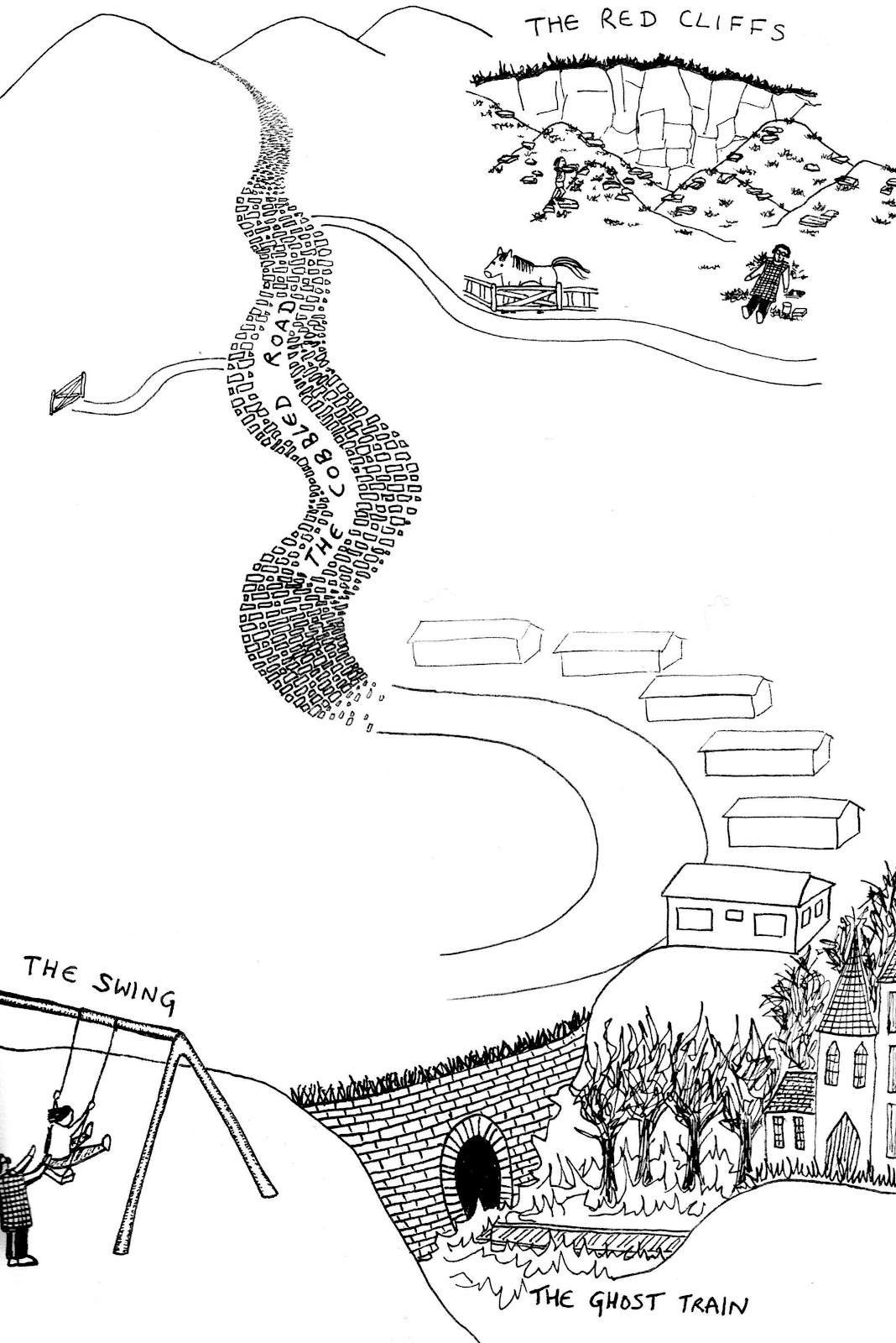
Later, after she moved to Bradford, our days together became adventures where we’d get on the first bus that came along, sit upstairs in the best spot (monarch of the bus), and go wherever it took us – Keighley and Haworth generally being the only options but I didn’t know that at the time. I remember her telling me stories about this family of kids she’d made up, and feeding me maltesers. She’d push me on the swings in the park, take me round the little shops, and get us fish and chips to eat at the bus stop before we headed home to bath and bed.
Love and Loss of Love
When I think of those times together, love is the word for it. The way Audrey delighted in me – my excitement at all that we saw and did and talked about – combined with the safety and kindness I felt from her, cuddled up in the evening watching TV after all the adventuring.
But it’s a complex story because Audrey also taught me what it is to lose love. I remember it vividly. I guess it was around the time I started adolescence. I was being bullied at school: learning that I wasn’t okay in all kinds of ways, that I’d have to hide my innocence and difference and enthusiasms if I wanted to get on. Gran had moved into sheltered housing. I think she probably struggled as much with the other people there as I did with the kids at school but I didn’t see that at the time.
I remember one evening I made a critical comment about someone on the TV who annoyed me. She became furious, saying I didn’t know what that woman had been through, what a hard life she’d had. In retrospect I think it must’ve been someone she identified with. It struck some painful chord from her own life. I remember the disappointment, disapproval, even disgust on her face as she looked at me. I linked it to the way she’d looked when I told her I’d started my period. She called that the curse.
This felt like a curse. Suddenly everything about me was wrong. And the things I was doing to survive this situation I was in made me someone my Gran couldn’t love any more. It happened a couple more times: her getting enraged like that, seemingly out of nowhere. It scared me and it confused me. I didn’t tell anyone about Gran’s anger just as I never told them about the school bullying, or my fears that there was something wrong with my body.
Gran and I became distant. She transferred her affection to my sister. Before I was out of my teens, she died. I felt guilty for betraying her, for seeing her less and less, for rarely visiting her in hospital. Her funeral was horrible: fake music and this person talking who didn’t even seem to know her.
I feel so sorry that I could never know Audrey adult-to-adult: that I could never have these conversations with her directly and also that I couldn’t find out more about her politics and activism. These were probably pretty similar to where I’ve now got to myself. She was heavily involved in the miner’s strike, for example.
Stories and Patterns
You could tell a lot of stories through what happened between me and my Gran. I later found out that this was her pattern with family and friends – to love people fiercely and fully – looking on them as golden ones – and then eventually flipping and feeling betrayed by them – hating them and often casting them out of her life, or at least her heart.
You could say it was terrible that she did that to me – a little kid. Just at the time when I needed her love to be a constant to demonstrate to me that I wasn’t all the bad things I was being told I was, instead she acted in a way which confirmed it. And she was the grown up. She should’ve known better; done better.
Or perhaps she saw what was happening to me: saw the delightful, playful kid she’d loved disappearing and this hard, unhappy, critical person taking their place; clumsily trying to be what other people wanted them to be and losing themself in the process. Maybe she couldn’t bear that: losing me that way. Maybe it was also what had happened to her once upon a time.
Or perhaps this is just what it’s like for everyone going from childhood to adolescence. Maybe I should just get over it.

But the point is I never really could get over it. My whole life I’ve longed to feel again that kind of love I felt from Gran. It’s like she passed her pattern onto me because whenever I seemed to find that kind of love I would love fiercely and fully in return, but if the person ever looked at me the way Gran did those times – with disappointment, disapproval, or even disgust – I’d find it totally unbearable. I would do anything to avoid that happening: becoming hypervigilant, trying to be whatever they would find loveable, avoiding saying or doing anything they might not like.
That kind of pressure often meant that when I couldn’t keep it up – all that work – I would become really hard to handle: desperate, flailing, unreachable, inconsolable, self-loathing. And of course that made it even more likely I’d get that look. As it happened more and more I wouldn’t be able to bear it so eventually I’d leave. Often I’d wait until another person had come along who might give me the kind of love I craved. Somehow being without it at all once more felt too hard.
Of course there’s more to my patterns than this: other stories that I have told – and will tell – in other places. There are stories about the cultural messages around love we all receive, stories about other early relationships I had and their impact, stories about capitalism and what that does to us, stories about how we all struggle to be with each other in our complexity – not grasp for the ‘good’ and hurl away the ‘bad’. There are stories about the patterns of the other people involved – which are not mine to tell – but which were part of the picture too, of course.
And there are relationships where I’ve resisted this pattern: found other ways to be, or containers for the relationship which have enabled it survive moments where I felt like my old horror was being lived out again.
But this feels like a pivotal story for me. And it’s not over yet: the pattern still happens.

Memorial
So today I decided to come here, where I imagine Gran used to come when she was a kid, maybe before all of her patterns got put in place: the ones she somehow passed on to me.
Despite being mostly veggie these days I allowed myself the happiest chicken I could find. I ate it with homemade chips last night and made sandwiches this morning. I got on the first bus that came along near my house: the Coaster that runs from Brighton to Eastbourne. I got off at Friston and walked through the forest. I saw a fawn with an adult deer in the woods: they seemed impossibly fragile to me. Lots of fragility on the walk.

I came to this spot by the Long Man, eating blackberries instead of bilberries along the way. And now I’m sitting to write this on my phone and popping maltesers. Later I’ll have my sandwiches looking down over Eastbourne, watching the trains make their way along the valley beneath me.
It strikes me that through my life I’ve taken the journey Gran took in the opposite direction: from Yorkshire to Sussex. I’ve moved down the country till I’m where she began – walking her chalk hills instead of my moors. I have to stop my progress south now. I’ve finally met the sea.
I’ve carried these patterns with me all this way, leaping from love to love with no break in the chain, trying to get back what I once had and leaving every time it looked like it was going the same way as before. I’ve tried everything to do it differently. I’ve reflected and written about it, I’ve warned people about it, I’ve shown them every part of me. But still I gave too much of myself away in an attempt to get that love and had to leave to get myself back. Still I couldn’t seem to bear it when the love dropped into that other thing – the disappointment, disapproval, disgust.
So now I’m trying the one thing I haven’t tried yet: not doing it. I’m staying with those old, old feelings of loneliness and longing for love, of yearning for somebody else to prove that I’m okay, and fearing that I’m really not. I’m trying not to push the feelings down, not to blame anyone else for them, and not to look to anybody else to make them go away. It’s really fucking hard but I think it’s the only way to change these patterns, and the pain and loss they cause to others and to me.
I’m doing rituals like this to try to find the love and kindness and safe-enough feeling that I long for within myself. I’m reaching out to all of my people, being vulnerable, and letting them into this so that I won’t be tempted to put it on one person any more. And hopefully those people will feel able to let me know if they see that happening again.
Today I do this ritual of regret for my Gran and for myself. I’m so grateful to Audrey for showing me what love can be, and I’m grateful to myself for managing to do this now. I also forgive Audrey for passing on this pattern – this curse – which has lost me so much love, home, and family along the way. Goodness knows what she went through to make her that way, or what the people went through who did that to her, or the ones who did that to them. As I forgive her I try to also forgive myself and to forgive all of us who are caught up in our own patterns, passed down through the generations, hurting each other and hurting ourselves. May we all find some kindness in this sorrow, in this regret.

The post Remembering Audrey: Another memorial appeared first on Rewriting The Rules.
]]>The post Four things I’ve learnt about relationships for Poly Dallas Millenium appeared first on Rewriting The Rules.
]]>Why this means the world to me
Hi. Thank-you so much for having me here today. When Ruby approached me last year saying she would like to subtitle the conference this time after my book Rewriting the Rules I was blown away.

Partly this was because that book has been such a labour of love for me. It was the first self-help style book I wrote and I spent a decade longing to write it but unable to believe in myself enough to do so. When I finally did manage to battle through my inner critic I had to distill years of painfully finding my own way with relationships onto the page. The second edition – which just came out – was no less difficult. It felt like I was co-authoring it with an older version of myself and that was not an easy collaboration by any means.
Also it is a huge deal – as a European writer – to be welcomed to a US conference. A bunch of us have been studying and writing about polyamory in Europe for some decades now, but it often feels like the – often more recent – work coming out of US academia and activism eclipses what we’ve done, and are still doing. Of course this is even more the case for Europeans who sometimes or always write in languages other than English.
This is particularly challenging for me now that I’m working towards making my living as a writer. It’s extraordinarily hard to make any money from that line of work, and it can feel tough knowing that I am – I think – saying something new and important, but that few folk on this side of the pond will know about it. This recognition – and potential to speak to an American audience – means the world to me.
So it was already a huge deal to be invited to speak at this conference. And then I checked out the event online. It quickly became clear that here, finally, was an intersectional non-monogamy conference. For years I’ve been frustrated by the lack of coverage of power dynamics and social structures, privilege and oppression, in polyamory communities, and now I was being invited to an event where these were foregrounded.
It also felt intensely vulnerable. The main reason by far that I wanted to write a second edition of Rewriting the Rules was because when I wrote the first edition back in 2010 I had barely engaged with intersectional feminism. This has been something I’ve done my absolute best to address since then to the point that the vast majority of the thinkers I now engage with come from this approach, but I realise I still have a hell of a lot to catch up on. As a white British author to be invited to speak at a conference alongside the likes of Kevin Patterson, Dalychia Saah, J Mase and Feminista Jones is a huge honour and one I really hope I can do justice to.
This is why I haven’t taken the easy road with this presentation. I could’ve given you my standard hot take on non-monogamy talk that I’ve been giving the last couple of years, but you deserve more than that. So I’m going to heed the words of one of my heroes – Mollena Williams-Haas – from the incredible talk she gave at the Non-Monogamies and Contemporary Intimacies conference in Vienna last year (available here if you haven’t seen it – please do check it out). She said that the gift we need to give to the world is to go into the places we are most vulnerable and to work – whatever our work is – from that place.
I’ve been holding those words close ever since then. It is why I’m finally dropping my academic and therapy work to focus on writing. It is why my writing now includes memoir and erotic fiction as well as self-help: so that I can be transparent about where these ideas come from and why they mean so much to me. I guess it’s about showing my workings instead of just the polished advice that comes out of all that painful experience.
Because if I hide that part of it away I can be just another shitty self-help author holding themselves as a point of comparison to the rest of the world as somebody who has it all together and is going to lecture you on how to get it right just like them. This is one of the things I hate most about self-help and I’m committed to doing something different. A major theme through all my work is that relationships are extremely fucking hard and we all struggle in our relationships with ourselves, with our loved ones, and with the world. I’ve heard it said that your mess is your message. Perhaps the message is stronger if you also share the mess.
So I’m going to give you a short introduction to the key ideas of Rewriting the Rules, and then spend the rest of the talk telling you about what I’ve learnt about relationships since the first edition: by going into the mess.

Rewriting the Rules
Most relationship self-help books make a lot of assumptions about what a ‘successful’ relationship looks like, and how you go about having one. They sell the reader the dream of happy-ever-after, and put the blame on them if they can’t achieve it. That’s why I called Rewriting the Rules an anti-self-help book. Instead of locating blame in the individual it starts with the shitty cultural messages we all receive about relationships, suggesting that they are primarily responsible for the difficulties we come across. Messages like the idea that you have to find The One perfect person who will complete you, that you must hide any relationship conflicts from the rest of the world and pretend like everything is awesome all of the time, that you should have hot sex with this person for the rest of time, and that that must be in a monogamous relationship.
For each theme in the book – love, sex, gender, conflict, etc. – I asked four questions:
- What are the rules that we learn about this aspect of relationships?
- Why might we question them?
- If they don’t work for us, what might we put in their place? and
- What if we went beyond rules to embrace the uncertainty of this thing?
So, for example, in the monogamy chapter I look at the rules that suggest monogamy is the one true way of doing relationships, and how we can question that by looking at the statistics on non-monogamy globally, and on secret non-monogamy in countries like the UK and US. I explore the pressures that the monogamy ideal puts on relationships, and the diversity of monogamish and non-monogamous relationship styles that now offer alternatives to this. However, I also explore the tendency we have – when stepping away from mainstream cultural rules – to put new rules in their place and hold onto them just as rigidly. I suspect we’re all very familiar with varieties of poly-normativity and polier-than-thou tendencies to put forward the one true way of polyamory – or the poly grail, as I call it. Unicorn hunting, treating ‘secondaries’ as lesser human beings, and becoming so poly-saturated that you have no time for friends or self-care are three examples that spring to mind (not that me or anyone else in this room would ever do anything like that I’m sure!)
In Rewriting the Rules I try to steer clear of suggesting that any way of doing relationships is inherently better, more normal, or morally superior. It’s more about appreciating that different things work for different people, and in different relationships. We need to start by unpacking all the cultural rules that impact us all – whether we’re inside them or outside of them.

What I’ve learn about relationships since Rewriting the Rules
So that’s where I got to in the first edition of Rewriting the Rules, and I am still proud of that book because that cultural piece is missing from so much self-help around relationships – even polyamorous relationships.
However it could be argued that I went too far the other way. Focusing on wider cultural messages is also a good way of avoiding looking too carefully at closer-to-home reasons for your own relationship struggles.
Also, while I wrote a lot about the need to look at wider culture to inform our close relationships, I didn’t make enough connections in the other direction. How can going into the mess and vulnerability of our relationships help us make a better contribution to wider society? In the last five years this seems to me the most urgent question as we all try to make sense of a world of Trump and Brexit, to deal with the vital questions raised by – for example – #BlackLivesMatter, #MeToo, and the current moral panic around trans.
Here are four key ideas that I’ve woven into the new edition of Rewriting the Rules which I want to share. Obviously there’s only time to touch on them here – what they are and the implications they have for our relationships with our close people and the wider world. Hopefully they might be a jumping off point for more conversations and reflections though. There are free zines on my website covering most of these themes in a lot more detail if you find them useful.
-
Relationship patterns and intergenerational trauma
The first thing I wanted to include way more of in the second edition was relationship patterns: how they get formed, how they impact us and the people around us, and how we might be able to shift them. That involved taking a long, hard look at my own relationship patterns which have been something like this…
Did you see this show? It was one of my favs growing up. Every week this dog finds a new person and home, he helps them with whatever they’re struggling with, but once things are sorted he can’t stay and he has to head off down the road again. He’s basically a manic-pixie dream dog.
This was what I was doing in relationships of all kinds my whole life. I tried to figure out what people wanted me to be, and then I gave it to them. Initially that resulted in huge validation – I was good, and I was good for people. Once I was polyamorous I could be good for many people. What a good Littlest Hobo! But it’s unsustainable. And it hurt people and it hurt me, a lot. I’ve lost so many homes, people, companion animals. Too much loss. While I definitely don’t think the only relationships of value are the ones that last, I wouldn’t mind the chance at a relationship, home, family, or community that lasted longer than five years.
The cultural piece was part of this of course. The promise of being – and getting – The One definitely had a role to play in my struggles, as did the Hollywood promise that true love is the path to lasting happiness – whether in its monogamous or polyamorous form.
But – as with all of us I suspect – my history was also a big part of the picture. Perhaps the major piece of work I’ve been doing the last couple of years has been on this. Interestingly #MeToo was a huge part of it. My sisters and I started by sharing our experiences of sexual assault – growing up and in more recent years, including in polyamory communities. This opening up led us to sharing stories of our upbringing and identifying the impact of intergenerational trauma and how it had left all of us feeling that we were unacceptable unless we covered over our emotions and pretended to be something we were not. We now talk on Google hangouts between San Francisco, LA, and London every few weeks, committed to building a different way of relating, at least between the three of us.
-
Self and other consent
How can I challenge this pattern – which I suspect many others share – of trying to be what others want me to be? Self-consent is the key here. One of the main books that I drew on in the second edition of Rewriting the Rules was bell hooks’s All About Love.

My main takeaway from this was that love can’t happen – isn’t even love – unless we value ourselves and each other equally. That’s where you get to if you apply the same thought processes to social justice and to interpersonal relationships.
Learning self-consent is every bit as hard as learning how to – really – treat others consensually in a world of massive power imbalances and insidious social scripts, as Zach Budd highlighted at the Poly Dallas conference. It’s still a work in progress for me: a lifelong process I suspect. But it includes noticing when I let desire for approval, fear of failure, or a deep-down belief of my unacceptability override what I really feel. It requires cultivating kindness and practicing self-care: not the neoliberal capitalist bubble-bath kind of self-care but the Audre Lorde long-hard-look-at-yourself self-care that we all need to make a daily practice if we want to stop harming ourselves and others on an interpersonal – and a global – level.
-
The drama triangle
The other idea I brought into the new edition was Stephen Karpman’s drama triangle. If you’re not familiar with it it looks like this.

The idea is that, in relationships, we often get drawn into stuck dynamics where we go round and round this triangle. For example my Littlest Hobo dynamic easily puts me in the role of rescuer – coming in and making somebody’s life all better so that maybe – in the immortal words of Julia Roberts in Pretty Woman – they will ‘rescue me right back’. The problem is if you get invested in the role of rescuer you easily put the other person in a double-bind. They must get better so that you can feel you’ve been a good rescuer. Also they mustn’t get better because then you’ll be out of a job. It’s easy then to shift from rescuer to persecutor because you’re actually treating somebody pretty badly. And easy to shift again into victim because rescuers really don’t like people pointing out that they’re actually being persecutors.
Sound familiar? I think that this triangle has so much to offer what we’re grappling with in our wider communities. When #MeToo 2.0 hit some of the polyamory communities in the UK it took a familiar form. One individual abuser was highlighted, survivors shared their stories of his behaviour, and others aligned themselves with two different forms of rescuing: either becoming saviours for the ‘victims’, or bystander-apologists for the persecutor.
If we’re going to get to grips with the abusive dynamics that inevitably show up in our relationships and communities – in a culture founded on oppression and unequal valuing of different bodies and lives – then I think we have to stay with our capacity to occupy all three positions on this triangle. We need to get to know our inner victim, our inner persecutor, and our inner rescuer. That involves a whole heap of self-kindness, as well as the intensely vulnerable self-care work of staying with feelings.
-
Staying with all the feels in all the relationships
Learning our part in drama triangles – interpersonal and social – involves staying with how it feels to be in all of those places. For example, the work that my sisters and I are doing involves going back into our intensely vulnerable victim/survivor places: recognising that the various kinds of experiences we went through at young ages was not okay, and that the strategies that we developed to survive them made all kind of sense. It also involves recognising how much of that intergenerational trauma came out of us being on the receiving end of other people’s survival strategies, and how our own survival strategies have also now hurt other people.
Staying with our persecutor potential is hard as hell of course. It involves being with the guilt and shame and fear of our potential to harm others and to harm again. It involves going beyond the temptation to focus on obvious forms of abuse and non-consent – that we may not have engaged in – to the micro level emotional gaslighting, manipulation, and non-consensual pressure that we all take part in our day-to-day relationships, and the macro level dynamics of oppression that we all benefit from and are implicated in whether we like it or not.
Staying with our rescuer involves recognising our tendency to focus on obvious abusers and villains to avoid looking at the damage we do – for example by setting ourselves up as saviours, by not addressing our privilege and power, or by failing to acknowledge our limits and taking on too much only to let people down.

It’s hard fucking work, but we have to do it. And it involves developing our capacity to stay with all of the feelings in all of our relationships. So many of our survival strategies, relationship patterns, and non-consensual tendencies comes from endeavouring to avoid feeling the feelings that scare us: shame, anger, fear, sadness, loss. And of course, like a hamster on a wheel, most of these tendencies will fetch us right back where we most wanted to avoid. As Anita Cassidy puts it: ‘Feeling shit doesn’t kill you, but the shit you do to stop feeling shit might.’
An important caveat to this is, of course, with all these things (being present, staying with feelings, being vulnerable) they have to be done in a container of huge self-kindness, self-compassion, and self-care. Those things always have to come first and foremost. It’s easy to do these things because you think you should, and for them to end up being far too much. So taking it slowly, prioritising kindness over all else, and getting support with it, are all vital.
I think we all have to do this work, and I think that doing this work will look different for all of us. For me it has included a combination of journaling about the hard stuff, sitting with my feelings by the Thames, reading people who challenge me on social media, deliberately practising showing close people my vulnerability bit-by-painful-bit, and – perhaps unexpectedly – tuning into my erotic fantasies and writing erotic fiction.
Right now it involves the painful messy work of acknowledging my relationship patterns with existing – and new – partners, and how far I may – or may not – be able to shift them given how strongly entrenched and sneaky they are. I’m convinced though that this can be a joyful process as much as it is an excruciating one – often both of those things simultaneously. And if it’s going to make any difference it’s one we have to do together in our relationships, in our families, and in our communities.
Further Resources
- Rewriting the Rules.
- My zine on self-care.
- My zine on staying with feelings.
- Meg-John and Justin podcast on staying with other people’s feelings.
- Love Uncommon posts on how to do self-consent.
The post Four things I’ve learnt about relationships for Poly Dallas Millenium appeared first on Rewriting The Rules.
]]>