The post Embracing failure in work, home, and relationships appeared first on Rewriting The Rules.
]]>This summer I left employment – and education – after over two decades, to focus on writing full time. It’s a curious way to celebrate it: writing about being a failure. But it’s been such a major theme of the past year that it feels like the best way to do so.
Over the last year I’ve failed repeatedly. My favourite author and teacher, Pema Chödrön, wrote a book called Fail, Fail Again, Fail Better which I’ve been reading a lot of late. I’m not sure that I’m failing better yet, but I’m certainly becoming very well acquainted with failure and what it has to offer us. If that sounds like a strange idea – surely failure is something to be avoided – then keep reading.
My great mate and co-author Justin Hancock says that we can generally handle it if one of three areas of our lives – work, home and relationships – is shaky, so long as the other two hold relatively steady. If two of those aren’t good then things start to feel pretty precarious. And when all three go at once…
That’s what happened for me last Summer. I was starting the process of leaving academia so work was shaky, I was moving city and it took a good while to figure out where I’d be living, plus things were rocky in my relationships. This was all against the backdrop of it finally really hitting me what it means to be a trans person at this cultural moment of moral panic; a survivor during #metoo and all the conversations that have followed, and recognising how intertwined those things are with my life and my work.
Still, I landed, I found a sense of relative safety, and I managed to keep going, albeit at a much slower pace and with a lot more emphasis on self-care than before.
But now I actually have left my employed job after a whole life spent studying or working in education. Having thought I had a handle on it, I’ve fallen back into my old relationship patterns more than once in the last year (like a hamster on a freaking wheel!) and I’ve had to painfully confront the impact that’s had on myself and others, with a whole lot of regret and loss in the process. And, just when things were at their worst, I found out that I couldn’t stay living in the place that had become home for me.
Approaching Failure
I’ve been through these kinds of failures before. I’ve lost several jobs, homes, relationships, friendship groups, and communities along the way, often under painful circumstances that have left me feeling shame at having let others – and myself – down. The shift this time – I hope – isn’t that I’m not failing, it’s that I’m trying to approach failure in a radically different way.
Authors like Pema, and Brené Brown, who write about failure point out that failure is inevitable in life. This is particularly the case if you are ‘in the arena’ – as Brene calls it. Doing what feels valuable in work, love, and community is inevitably also going to be vulnerable. And we’re inevitably going to fuck it up at times.
Because of the stigma around failure, most of us endeavour to avoid it at all costs. If it happens we respond by blaming ourselves and hiding away so we never risk failing again, or by blaming everybody else and not taking any responsibility for what we’ve done because it’s too hard to face our shortcomings and limitations – and their impact. When I failed in the past I often burned my bridges pretty fast, moved on, and worked even harder to avoid such failure in the future, without looking too carefully at what’d just happened.
What I’m doing this time is different. I’m trying to embrace the fact that these failures have happened – and that they certainly won’t be the last ones I experience (well so long as I stay alive of course). Instead of adding them to a long list of past experiences that have felt similar – and using them as proof of the story that something about me is wrong and unacceptable, or that there’s something wrong with the work, people or communities I’ve surrounded myself with – I’m trying to look at them clearly, with honesty and kindness.
When I do that I realise that there’s much to be learnt here – probably far more than we learn from experiences of ‘success’. Also, the closer I look, the more the success/failure binary is called into question. I see that these two elements are closely woven together – inseparable in fact. As Brené points out: learning, creativity and innovation aren’t possible without failure. But I think it’s more than that: failing at work is a kind of work (perhaps this kind of work that I’m doing right now!) Also, failing at love and home have both brought me as much love and home as they have lost me.
Let’s delve deeper into these three areas so you can see what I mean…
Work
I’m a failed academic. Clearly. I’m 45 and I haven’t made professor: the pinnacle of the academic ladder. This is because – despite publishing twenty books and over a hundred articles – I have never been REF-able: The Research Excellence Framework which is the way academic success is measured in the UK.
I’m not excellent. Far from it. I haven’t brought in research funding because I didn’t want to spend my time on funding bids or administrating big research projects. Also, every time I thought I’d finally written something that ‘counted’ as the right kind of academic work, I was told that it still wasn’t right: too ‘polemic’, too far out of my discipline (undisciplined), a chapter when only journal articles counted, a theory paper when only research papers counted, a co-authored paper when single author is the gold standard, single author but not in the right kind of journal, in the right kind of journal but not the right kind of research.
I tried to carve out a different path as a public engagement academic, but it’s not enough to do that alone – you do need to bring in the money and publish the papers also. When you point out that it may well not be possible to do all of those things, teach, and practise self-care – and care for the others in your life – that doesn’t tend to go down particularly well.
I could say a lot about which kinds of people academic systems and structures do – and do not – serve; about the kinds of labour, knowledge and bodies that are – and are not – valued there; and about the impact this has: the shame, imposter syndrome, and anxiety that so many academics are plagued by. I probably will say more about these things at some point. And I should also acknowledge the massive privileges I’ve been afforded by being within academia (and being privileged enough to get there in the first place): the money I’ve been able to save, the things I’ve learned, the projects it’s supported, and the ways it’s been (mostly) a safe-enough place to be my particular brand of non-normative weirdo. For now let’s agree that I’m a failed academic, by academic standards.
It’s okay though, I never actually wanted to be an academic. I only did a PhD in the first place because I was too young to do the thing I really wanted to do which was to be a therapist. And I only took an academic job post-PhD to fund my therapy training. I stayed in academia because I got passionate about teaching, and about studying the things I care about as an activist (gender, sexuality, relationships, mental health). But really I always wanted to be a therapist.
Here’s the thing: I’ve failed at that too. I worked as a therapist for over a decade – mostly in voluntary contexts because I had the academic job to pay the bills. Last year I left the voluntary therapy behind with the plan that I’d take on more private clients, so that I could afford to live once I quit the academic job to focus on writing. I didn’t take on any more clients. I realised that not being a therapist felt like a relief. My reservations about therapy in general – and about my particular capacities as a therapist – surfaced, and I realised that I needed to stop. So I did, with no idea about what I was going to do for money if I wasn’t going to do that.
It’s a good thing too because I would not have been able to hold therapy clients through the last year, given the crises I was facing in my own life. But it’s not just that. Being a therapist isn’t for me, I realise. I’m not the kind of therapist I would want to be: the kind that I’ve been lucky enough to experience a few times in my life. I don’t have that skill set: the capacity to contain people, or to work with them relationally in the ways I’d want to. I can do great one-to-one work with people, but in much more of a peer-to-peer mentorship type way. Not therapy.
But this is all okay because the whole point was that I was giving it all up to be a writer, right? So that’s what I’ll be: a writer. D’you want to know how much I wrote – for publication – between last summer and this? Zero. Nothing. Not a word! The stuff I have coming out this year was all written before then. I have written thousands and thousands of words in my journal. I have written the third book in the four-book erotic fiction project I have going on, which may never see the light of day (the prospect of putting something that vulnerable out there and failing remains too scary, but who knows?) I managed the odd blog post, but even those were few and far between.
What did I achieve – workwise – in these months of failure? A lifelong workaholic I finally learned how to underfunction instead of overfunctioning. I learnt to prioritise self-care: always putting The Work before the work. I largely undid my previous patterns of working to soothe or distract myself, or getting through the to-do list before I allow any self-care. I learnt to relate to work consensually: to feel into my body when I get a request, and to only say ‘yes’ to things that feel good immediately and still feel good 48 hours later. It’s been hard and it’s been messy, like all change. I’ve let people down. I’ve felt like the flaky colleague just when I wanted to end on a high note. I’ve taken time off sick when previously I’d have worked on through. I’ve had to go back to people when I’d said ‘yes’ to change it to a ‘no’ when I realised I’d overridden my self-consent.
It’s still a work in progress, but it is The Work: changing the habits of a lifetime of remaining in sometimes toxic and bullying work environments, forcing myself to produce the kinds of things I thought would count rather than what I valued, working through crises, sickness and struggle instead of allowing rest, recovery, recuperation. Writing is coming back now (as evidenced by the sudden explosion of blog posts and tweets about my new graphic guide). What I’ve been through is helping me to keep remembering to engage with writing more kindly, openly, mindfully, and flexibly. I’m pretty convinced that when we write in such ways it’s better quality – and connects more with others – too.
Home
To relate very differently to work – prioritising the work I find most fulfilling and feel most skilled at – requires rethinking home too. How to live in order to be a full-time writer, because sadly writing alone will never provide a liveable income for most of us? Twenty books in and only one of them brings me in more than a few hundred quid a year – and that may only be for a short time.
The main answer is, again, privilege. My whiteness, financially comfortable background, being largely non-disabled within our current society, location in the UK with English as my first language, and more, meant that I had enough privilege to access higher education. Also, remaining in higher education meant that I had the kind of job where it’s possible to be pretty crazy and pretty weird and still keep a paying job (except for that one faily, faily time when I nearly got fired after The Sun called me a bisexual boffin). So – despite a relationship pattern where I’ve given a lot of the money earned through this work to other people in order to secure love (top tip fellow people pleasers: it doesn’t work) – I managed to save up enough to live on for a while, now that I’ve downsized considerably
While I was searching for somewhere cheap to live an opportunity came up to live in the co-op my friend lived in. I’ve loved the idea of communal living since I came across Tales of the City at a formative age. I did have some assumptions and fears about what it might be like in practice, most of which were wholly inaccurate. It seemed like a financially sustainable option outside of the problematic systems of renting and buying property. I also loved the possibilities it opened up around access intimacy, care, and consent.
Living there I learnt lots about how much more possible self-care becomes when we have systems and structures which support it. I also learnt how much more possible caring for each other through physical and mental health struggles is when there are many people around and available, all of whom get it. I saw how conflict – openly addressed and held within family and community – can play out differently. I also learned some hard lessons about group dynamics. I’m sure I’ll be reflecting on this experience for many years to come.
But when the house considered whether to make me a permanent member after eight months they decided not to. Partly this was because I had been going back and forth a lot about what my ongoing living situation would be. But more than that – and this was bloody hard to hear – it was because I felt to them more like extended family than immediate family.
It would’ve been so easy to experience this as rejection, as me failing. The day it happened I was awash with memories of previous experiences that felt like this: when my university housemates threw eggs at my door because they were so sick of me having my depressed partner round at our flat all the time; when I lost most of my group of friends following one of those painful periods of ricocheting break-ups that can happen in queer community.
Partly thanks to the work the house has done in holding people through conflict and crisis – and perhaps also thanks to The Work that I’ve done over the years – this played out very differently. I was able to feel the feels and to express them – quite vividly – to everyone, and to feel heard and seen and understood. And I was able to hear them too. They were right that I felt more like extended family: I felt that too. And while it was terrifying to have this final rug pulled out from under me at this exquisitely vulnerable time, there was a sense of possibility in it too: things that might open up as well as close down.
Interestingly, since that time and in the conversations we’ve continued to have, I’ve actually felt closer to my friends from the house – not further away. There’s been a lot more openness. And I’ve been able to put more time and energy into nurturing other friendships where I have deep connections, including sharing my new home space with them in ways I never did before. I’m able to hold the possibility that, in losing a home and family, I may paradoxically have gained one.
Feeling Failure
I realise at this point that I’ve been talking about failure in quite a prettied up way: the way it can look in the fuzzy glow of hindsight. You could go away with the impression that it’s this okay thing – not that bad – quite beautiful in fact if looked at from the right perspective. Let’s talk about what failure actually looks like. Let’s talk about what it feels like.
Brené likens it to stepping out into the arena and falling on your face, eating dirt in front of everyone. It is like that. Except imagine that you’re naked. Not noble Cersei Lannister kind of naked but crying, begging, and scrabbling at the door you’ve just been pushed through to get the hell out of there kind of naked. There are tears and snot, there is rage and terror. It’s not a pretty sight. And scrutinising your every move are all your closest friends and family, plus everyone who has ever bullied you or criticised your work, definitely all your exes and your scariest school teachers. And every single one of their faces is filled with disgust. And they are just about to release the terrible monster that you have to fight. And when they do there is every fucking chance that you will crap yourself from fear in front of everyone. That, my friends, is what failure feels like.
That’s how it felt when those eggs hit my door, when I saw that headline in The Sun and had to face my managers afterwards, when I felt rejected from my community and slunk away, when I tried to bring my soft consent-y activism into my workplace and everybody looked at me like I was completely crazy, when the house gave me my notice. And that is precisely how it’s felt every time I’ve tried and failed at love, especially during the period where I’m desperately flinging everything that I have at it, trying to pretend that I’m not doing the same old thing again like the aforementioned hamster.
Relationships
I’ve already said most of what I need to say about my relationship patterns in the second edition of Rewriting the Rules, and in these blogposts. Sadly that hasn’t stopped me from finding thrilling new ways of acting out the same old patterns: struggling to be honest with myself and others, striving to meet others’ expectations, or assuming they will be on the same page as me. This was a big part of the dynamics that brought three of the relationships – with individuals and groups – that were most important to me to breaking point in the last year.
Understandably, failure cuts deepest for me when I’m failing in this particular arena. Being somebody who has written several self-help style books on relationships really doesn’t help with that. At least I make it very clear in my writing that this stuff is bloody hard for all of us – so-called relationship ‘experts’ included. Perhaps I should insist on being billed as a relationship failure from now on.
However, I’ve noticed that, as with work and home, there is a lot of love to be found in failing at love. These days my go-to response to a life crisis is to book in time with close people each day until I’m steadier – online calls or in-person walks and talks – in addition to ongoing message exchanges. During these conversations it’s been reaffirmed for me that intimacy deepens with vulnerability. I’ve shown my feelings, my insecurities, more openly than ever before and I’ve felt how much closer that’s brought me to my people. Also most people have shared their struggles right back.
I feel more able to be real with my people – instead of monitoring myself and keeping up a facade – and I feel more able to connect with them too. How paradoxical and wonderful that mulling over the potential impossibility of love has resulted in such strong feelings – and actions – of love.
The other thing that I’ve made into a daily practice of late is explicit internal conversations. Anyone familiar with my work knows that I’m big into the idea of plural selves, and I often experience myself as more of a team – or a system – than an individual. So most days start and end with a check-in between the members of this team – written in my journal – with the explicit intention that the parts of me who are struggling will support the parts that aren’t so much on that particular day.
In Rewriting the Rules I suggested that experiencing ourselves as plural could make it easier to love ourself than it is when we imagine that we’re this singular, static individual who can be judged as good or bad. That’s certainly been my experience of late. There’s a lot of love within for the vulnerable parts, the parts who fought so damned hard and still managed to fail, the parts who took the risk and now find themselves exposed in the arena.
Embracing and Learning from Failure
This blog post is already over 3000 words long: another failure. I rarely manage the SEO-pleasing 500 word shorties that experts recommend. WordPress will doubtless give me a bunch of angry red emoticons for this latest opus and for my continued use of the passive voice.
So what are my quick take-aways about failure then, other than what doesn’t kill you makes you stranger?
- Failure is an inevitable part of being human, get used to it, and go gently because our whole culture tells us that it’s not okay, that we’re to blame for it, and that we should punish ourselves for it.
- A sense of failure may be more about you not fitting the particular system or situation you’ve tried to succeed in. Moving into a different system or situation – perhaps one with values more aligned with your own – might be something to explore.
- Feeling you’ve failed at something can give you an opportunity to stop doing that thing. The space that opens up may bring something different that you end up finding more fulfilling and feeling more competent at (like me replacing therapy with writing mentorship).
- Failure shows us where we’re stuck, where we’re hooked, where we’re messy. Learning these things is super helpful because then we can work to shift our patterns (again, gently please).
- Failing in different arenas can actually bring us the very things we thought we were losing from failing. Failing at work can become a big part of our work (emotional, creative, and otherwise – like all the people who make their work out of helping people who are struggling in the same ways that they have). Failing at home or family can bring us other forms of community and kinship. Failing at relationships – and sharing our experiences around this openly – can bring us love and connection.
- If you can stay with the fact that you’ve failed – and the impact of this on you and others – it can make you a lot more humble and compassionate for others caught in the same kinds of situations and dynamics.
- As Brené Brown points out, remaining in the arena even when we know the risks of failure – and what it feels like to fail – is pretty badass. Think Captain Marvel standing up again each time she gets knocked down in the movie.
- As Pema Chödrön suggests, having the rug pulled out from under us completely can be just what we need in order to stop looking for babysitters to look after us, and to start opening up to what life has to teach us.
- As queer theorist like Jack Halberstam and Sara Ahmed point out, what is considered successful in our culture is often determined by those with the most power. The more non-normative we are, the more likely we are to fail according to the normative standards of what counts as success. So failing can be seen as a radical part of resisting these norms. And we can rightly get pretty pissed off at how we’re set up to fail by norms which require us to pass exams, make lots of money, own property, ascend various professional ladders, stay in particular kinds of relationships, look attractive according to western beauty ideals, have kids who also meet these criteria for success, etc. etc. etc.
Okay that wasn’t so quick. Let’s try again. What can you do if you’re struggling with failing and failing again. I’d say the important things are to:
- Practice self-care around it. If it feels overwhelming then first focus on getting yourself back to a safe-enough state to look at it. Refrain from doing anything till you’re in a good-enough place to deal. There’s no rush.
- Stay with the feelings.
- Try to see the failure clearly, honestly – and above all – kindly.
- Consider what it would be like if we could see the faily parts of us as the most precious, tender, and loveable parts of us. Wow right?
- Focus on addressing your part in what happened – it’s up to others whether or not they want to address their’s. Also recognise the wider dynamics, systems, and structures that are in play which mean it’s not all on you. Try not to be drawn into blame and shame, and go easy on yourself when you’re inevitably drawn into blame and shame.
- Question the success/failure binary and who this serves.
- Recognise that habits take time to shift and require repeated failure in order to do so – check out this poem by Portia Nelson to help with this. It’s okay that you fell into that hole again.
- Don’t listen to criticism from people in the cheap seats. They aren’t in the arena, as Brené says. But do welcome generous feedback and support from people who have your back and are up for facing their own failure. This is not something we can do alone.
- Let failure crack you open, soften you up, connect you with others who’re going through similar stuff, and fuel your creativity.
- Try not to be part of cultures which shame people for failing, making it even more difficult for all of us to accept our inevitable failures, to take responsibility for their impact, and to fail better.
I’ll leave the last word to Thor’s mum, Frigga, in Avengers Endgame because I liked this thought on failure: ‘Everyone fails at who they’re supposed to be. The measure of a person, of a hero, is how well they succeed at being who they are.’
The post Embracing failure in work, home, and relationships appeared first on Rewriting The Rules.
]]>The post Showing Your Working: On Writing Vulnerable appeared first on Rewriting The Rules.
]]>Writing is a vulnerable act. This is one of the many things that it has in common with sex (which needs to be the topic of a whole further blog post). When you write, you’re putting yourself out there – exposed. Even people who are doing pretty safe forms of writing – where there’s nothing personal in there and where every statement is backed up with facts and figures or references to other peoples’ work – still feel massively vulnerable. We’re scared of getting it wrong, we can easily imagine every possible critical comment, we fear being ‘found out’ in relation to how little we know and/or how poorly we write, we compare ourselves to other writers who we admire and we can’t possibly measure up because our voice is not their voice.
Writing about vulnerable stuff
How much more vulnerable then when we’re writing about things that we, ourselves, feel vulnerable about. I felt that heavily last year when I was finishing the writing for my new graphic guide on gender. It struck me just how much of what I was writing about was deeply personal and painful: Writing about trans during the trans moral panic; about #MeToo as a survivor; and about intersectional feminism when I’m so aware that I’ll inevitably perpetuate the very systems I’m challenging at times, because of the things that I don’t see in the areas where I’m privileged.
And then there’s writing more directly about our personal lives. This has come up with several clients lately. One worries that describing his daily moments will be read as egocentric – that it’s not doing anything for anybody else – even though it’s the writing he feels so passionately drawn to. Another fears what limits may be put on their activism, or their future career, if they write as openly about their own experience as they’d like to. I’m surprised when another client doesn’t see the link between the memoir-style posts that they write, and the writing that I do. I feel like my own vulnerabilities are starkly apparent in much of what I write, but perhaps the critical self-help style that I generally use obscures them somewhat.
The challenge from that client spurred me on to publish a few of the more vulnerable blog posts that I’ve been holding back on: ones that are more directly related to my own life and my own struggles. I put one out there last week. The feelings on publishing a more personal post always follow a familiar path. First a fizzy nervous feeling: ‘did I really do that?’ Then a fear of negative repercussions. Then a few comments come back: people saying that they connected with what I wrote, that it was just what they’d needed to read on that particular day, that they share that experience and it left them feeling less alone, that it helped them to reflect on their own lives. Those comments help me feel less alone and more connected right back. And I’m reminded that it’s nearly always the more vulnerable things that I write that get that kind of response.
I’m reminded of something Mollena Williams-Haas said in this talk: How creating from our most vulnerable places often leads to the best work we can do – for ourselves and for each other. It’s often higher quality, connecting creator and audience on a more visceral level, and it’s one of the best ways in which we can be of service to our communities. I love the way that Mollena links submission to vulnerability to activism in this way, it’s something that resonates deeply for me too. In fact that talk is an excellent example of what I’m talking to because she went for the vulnerable, open approach – weaving together the erotic and the creative – and it spoke to me so much that I remember it to this day.
Showing and telling
One of the classic pieces of advice to aspiring fiction writers is ‘show, don’t tell.’ Readers don’t want to be told the main character is a cocky piece of work who hides an inner vulnerability, they want to see that from the way he strides across the bar in the first scene, oh-so-casually glancing around to check that everyone is clocking him.
So is there a value to showing rather than telling in non-fiction too? I guess the writing that I do which I experience as most vulnerable is the stuff where I show my workings, rather than just telling the reader that this is something I struggle with too.
When I first wrote Rewriting the Rules the main place that I did this was the conflict chapter. I illustrated that with a detailed description of the kind of excruciating conflicts that I’ve had in partner relationships. In the second edition I added much more detail about my own relationship patterns in the love chapter, in order to demonstrate how these come from a combination of wider cultural messages, and our own lived experiences growing up with these messages all around us.
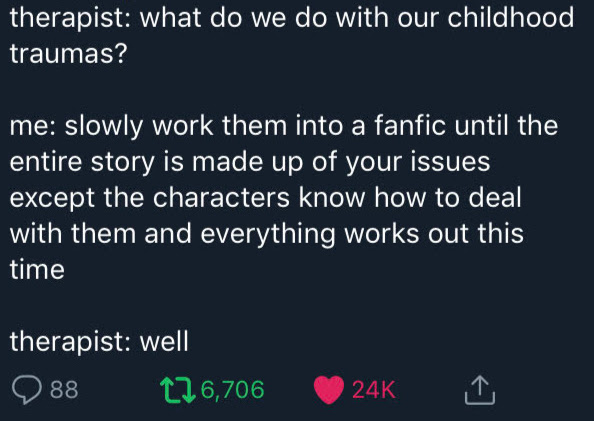
Nowadays I do a few kinds of vulnerable writing. I write more memoir-style pieces where I reflect on something I’ve been through, or am personally struggling with, or attempting to put into practice at the moment. I write fiction which is well summed up by this person on twitter.
I also create comics and zines about aspects of my experiences.
Generally I use the personal sharing I do in such writing as an example: this is how you could do this kind of work, this is how you could understand how our experiences shape our habits, here’s a practice you might try. But sometimes I let the showing stand alone. Perhaps there’s not always the need to tell as well as show.
When is vulnerable too vulnerable?
This is complicated territory because writing from the vulnerable place is also risky. You could end up hurting yourself by trying to write about something which is still too raw and painful. The writing could stray into something over-sharing or self-focused in a way that doesn’t really connect with others. This is particularly likely if you’re still very caught up in the details of what happened in that particular situation. It could feel too vulnerable if people respond critically to it once you’ve put it out there.
There’s some kind of balance to be struck between the value of writing about what’s live when it’s live – the authenticity and sense of aliveness that kind of writing can have – and the wisdom of knowing when something needs more time before you approach it creatively – either in order to be safe enough for yourself, or for it to take a form that others can connect with.
On our podcast Justin and I often come up with ideas we’d love to cover but they feel too live for us – or for others in our lives – at the moment. We keep a list on our phones of topics that would be great to cover, but we want to come back to them when it feels like we have a bit more distance from them ourselves.
Another thing I do is to journal about the things that are really live initially in a format which is not for public consumption. I’ve filled hundreds of pages in the last year, going through major transitions in work, home, and relationships. Many of the ideas and practices that have come out of this writing will likely eventually find their way into my non-fiction and fiction writing, but it’s probably best that the writing I do for the initial processing is for my eyes only.
There’s an inner sense of ‘not ready’ and ‘ready’ which I’m beginning to trust in this – and other – aspects of life. For example, there will hopefully eventually be seven comics in this series, but this is the only one that’s felt complete enough to get down so far.
If something starts to take shape as a piece of writing for a reader beyond yourself you can always write it when live and return to it later. It’s a great idea anyway to separate the writing process and the editing process. This means that in the first drafting you can really sink into the flow and write it however it comes, knowing that you’ll be coming back to it before it goes out anywhere, so you can free yourself up to make mistakes and be imperfect. This is what Anne Lammot calls the ‘shitty first draft’ – something we’re allowed to do in writing and in life.
Personally I find it helpful to have a notepad or extra document open alongside my writing, where I write down the worried or critical thoughts I have about while I’m doing it: from information I need to check to issues around diverse representation. Then I know I can go back to those concerns during the editing process, but can park them and keep writing for now.
When I’ve written something and it has that feeling of potentially being too raw, or too vulnerable, to put out there at present, I leave it and return to it later: a month, a year, whatever.
I also have a sense of who my crew are for reading things that I’ve written which I’m not sure about sharing. If you know that the future version of yourself, plus several friends, will be reading the writing and feeding back about it before it sees the light of day, that can also help you to feel more free to write now.
Over time you can get a feel for what is just the right amount of vulnerable and what is over the line. Like if the exposure scale goes from 0-10 perhaps 5-6 is that sweet spot for things that are real and vulnerable in ways that stretch you a useful amount, and will likely connect with other people. But over a 7 is into the too-vulnerable zone and worth leaving till it feels less live. I’ve adapted this from an idea I got from Love Uncommon, that when our feelings are 0-7 the thing to do is to stay with them, but over 7 has tipped us into trauma/overwhelm and the thing to do there is to get back to a sense of being safe-enough before we try to stay with the feelings.
What if…
Here’s a few things people often worry about when writing about vulnerable stuff, plus my thoughts on them:
What if…people hate it?
I figure for everything I write there’s going to be a few folks who’ll really love it – the ones for whom it hits just the right point on the right day. Now that I have quite a lot of people who regularly engage with my stuff, there’ll probably be quite a few others who like it, which is great. Then there will be the vast, vast, vast majority of the world who have no idea who I am, no wish to read my stuff, and would feel pretty meh about it if they ever did. Then there’ll be a few people who – if they did read it – would totally hate it, either because they hate me – or people like me – or because it’s the opposite of what they think, or because they’re just having a bad day – or whatever.
In my case I’m generally writing for the people who find my stuff interesting, useful, or entertaining. Nobody else has to read it. If they do, and they don’t like it then that’s okay, they don’t have to read my stuff again.
What if…people are mean about me?
I think that people imagine that this will happen a lot if they put stuff out there, but it’s actually pretty rare. I write on some fairly controversial topics and I’ve very rarely have someone attack me or criticise my writing. It has happened, but to be honest it’s usually been something out of left field that I could never have predicted. I wouldn’t have avoided the experience by deciding not to write about the vulnerable stuff.
It’s definitely worth having some plans in place – if you write publicly – about what you’ll do if you do find yourself being criticised or attacked in a big way. Is there somebody who can take over your inbox and social media during the time it’s going on? Could you get away and do self-care till it’s died down a bit? Is there a holding message you can prepare in advance to put out while you take your time responding – if a response is required? Can you think advance of some kinds of filters to decide which kinds of critical feedback you’d like to take seriously and which you wouldn’t (around who gives it, in what form, what kind of issue it raises, etc.)?
What if…I change my mind later?
People worry that once you’ve written something it’s somehow set in stone and you could be judged for it FOREVER. I think it would be great if we could make a habit of returning to things we’ve written in the past and say how our views have shifted, or what we know now that we didn’t know then. We’re all in an ongoing process, and it’s not fair to judge a person now by who they were or what they knew 5, 10 or 20 years ago. Also culture is moving on and this makes it more possible to do better on many issues today than we might’ve done in the past. We could reflect on this process of change in our writing in useful ways – being accountable for the impact of our work – instead of being defensive and insisting that every word we’ve ever written was perfect.
What if…it’s vulnerable for other people I’m writing about?
This is where consent comes in (I said writing was like sex in more ways than one). If you’re writing about other people then it’s not okay to put something out there that could leave them vulnerable without their consent. There are several options here:
- Only write your story, not those of other people who might struggle to read themselves depicted, or to have themselves read about by others. Having had the experience of being reported about in the press twice without my consent I know very well how utterly traumatic, confusing, and powerless this experience can feel. I wouldn’t wish it on anybody.
- Keep things general rather than specific.
- Anonymise people (like I did when mentioning my clients earlier).
- Have consent conversations with people you would like to write about. Remember to acknowledge the power you have in the situation and any pressure they might feel under to agree to it: Ideally give them several options rather than just ‘go ahead’ or ‘don’t do it’. Take anything other than a definite ‘yes’ as a ‘no’. Remind them it’s fine to change their mind at any time (ongoing consent).
- Write collaboratively with the other people concerned so that you all have control over it together – this could be a useful process anyway.
- Write it as fiction rather than non-fiction, changing all identifying features, combining people together, or completely making up characters but keeping features of the experience true to life. This is what a lot of therapists do when they want to write about client work without breaking confidentiality. It’s what Alex and I do when we want to write a bunch of diverse experiences around an issue in our collaborative books.
There are complexities around all this of course when it comes to memoir writing particularly: what constitutes writing about somebody else versus telling your story? Again it can be useful to give yourself complete freedom to write what comes in the first draft, and then decide which strategies – or combinations of strategies – you’ll use to keep it ethical when you’re editing.
What if…I get something wrong?
You can go gradual. It’s not a binary of keeping something to yourself or putting it out there for all to see. You can have trusted friends read it first to give you a sense if it’s something worth sharing more widely. You can have sensitivity readers who you offer something to in return for reading it with an eye to particular aspects you want to be sure you’ve got right (e.g. axes of oppression you’re not personally familiar with but have written about, or science or history parts). If you have a publisher then you’ll have at least one editor who will read it before it goes out there. If it’s a blog then you can always share it only with a certain group of people, or put it out publicly but only share it with your social media friends or followers initially. And if you do get something wrong you can acknowledge that and change it immediately if it’s online, or in a later edition if it’s in print.
Writing vulnerable
Why would we write vulnerable stuff given all of these fears and potential pitfalls? I think that it does something very important for us personally, and for others reading our work.
Personally there is what Patrick Califia calls an antidote to shame in writing vulnerable stuff. This is often the stuff that we fear – deep down – might not be okay about us. Writing it and putting it out there is a way of saying ‘this is me, with all my inevitable frailties and failings and flaws, and I’m still okay.’ Under capitalism it could also be seen as a political act to challenge the success/failure and good/bad person binaries by speaking openly about our struggles, our mistakes, and our messes.
Related to this, writing vulnerable goes against the current pressure to curate and present a perfect image on social media and beyond (which brings with it a horror of being revealed as imperfect, which we inevitably are).
For me it’s always been about resisting the common depiction of the ‘self-help author’ or ‘expert’ who has it all together and doesn’t struggle in the way that ‘regular people’ do. Fuck that noise quite frankly. We hardly need another point of comparison to judge ourselves against and find ourselves wanting in the current climate. If we only put out our successes and triumphs and never our struggles and tragedies we’re feeding that culture of comparison. So we’d better get vulnerable.
Or we can sidestep the whole thing entirely as I do on Instagram and only share images of lovely nature/animals and food I’ve cooked (yes I am quite a good cook, but I’m rubbish at loads of other things I promise).
The post Showing Your Working: On Writing Vulnerable appeared first on Rewriting The Rules.
]]>The post Open Relationships Revisited appeared first on Rewriting The Rules.
]]>Content warning: relationship conflict and abusive relationships are touched on briefly in this post.
A decade ago I started studying three topics that have pretty much defined my career: open non-monogamy, BDSM, and bisexuality. I just checked my CV and found that my first academic publication in these areas came out in 2004: an interview with the ever-fabulous Jen Yockney of Bi Community News for the Lesbian and Gay Psychology Review (now appropriately renamed the Psychology of Sexualities Review). That was quickly followed by an interview, in the same publication, with the equally wonderful Dossie Easton, about her writing on kink and polyamory.

Me and Jen Yockney more recently
It’d taken me six years since finishing my PhD to start researching these topics. My first paper based on my PhD (on a different topic) had been rejected with cruel comments from one reviewer. So I decided that academic research wasn’t for me and to focus on teaching, which I really enjoyed. I still have major issues with that side of academia. But then I started to read about gender and sexuality for my teaching, and to attend more interdisciplinary conferences. I realised that it was possible – perhaps even beneficial – to research topics that were personally relevant.
Although I can’t say that this guiding principle has made for a completely easy ride (to say the least!), I have learnt a huge amount from researching polyamorous, BDSM, and bi communities. My work has always been led by the question of what we (i.e. everybody) can learn from such communities, rather than the more traditional psychological question of how they can be explained. The answers I’ve explored have focused on the benefits of more open approaches to relationships rules around monogamy, the consensual arrangements that kinky folk use in their sexual activities, and non-binary understandings of sexual attraction (i.e. not just attraction to either ‘the same’ or ‘the opposite’ gender).
Recently I’ve been reflecting on the directions that my thinking about relationships has taken in the last few years. I realised that these themes of openness, consent, and non-binary are still very present, but in different forms. Previously I’d just thought of openness in the context of non-monogamy, consent in the context of (kinky) sex, and non-binary in the context of sexuality.
I thought I’d write a couple of blog posts to explain the ways in which my thinking has expanded out lately, considering the benefits of applying openness and consent to our relationships in a much broader way. Regarding non-binary I have a much longer piece of writing bubbling away about what happens when we apply this concept beyond sexuality and gender to our ways of relating, feeling, and thinking.
I’ll spend the rest of this post on openness.
Open non-monogamous relationships
Probably the first revelation in my explorations of open non-monogamy was the fact that it was possible at all. Wider culture presents long term monogamy as the only way of doing relationships, with non-monogamy only being possible in the form of cheating, which will inevitably mean the end of the relationship.
I found that various forms of swinging and open relationships offer the possibility of couples having additional sexual relationships in an honest and open way. Primary/secondary polyamorous couples show that it is also possible to have love relationships outside a primary couple.
I also found that polyamory opens up the possibility of relationships beyond this conventional couple-based model. There are Vs, triads and quads, poly families and networks, and all kinds of other ways of managing multiple love relationships. This offers an alternative to the conventional model of putting The One partner or spouse way at the top of a hierarchy of important relationships, with all of the high expectations this places on that relationship.

The diversity of love relationship concepts, by Kirstin Rohwer
However, as I explored these things myself and talked with colleagues about it, one thing that became apparent was that many of these models still generally place romantic, or sexual, partnerships as more important than other kinds of relationships. In fact there can be a risk that the division between partners and friends becomes even larger when we have more partners, and perhaps even less time or energy for friends, or for other kinds of relationships including our relationship with ourselves.
Another thing which I recognised in myself and others was that it becomes possible in open non-monogamy to replace a search for The One perfect partner with a search for the perfect relationship style which will solve all the problems inherent in close relationships and/or mean that you are constantly bathed in the reassurance and validation of multiple adoring gazes.
Neither of these issues is a reason to reject open non-monogamy in favour of a return to monogamy. It’s not an all-or-nothing situation where we can find one universally ‘right’ way of doing relationships and dismiss all the others. Rather I concluded that we need to embrace the diversity of possible relationship structures: versions of singledom, coupledom and polyamory; monogamies and non-monogamies and all the possibilities in between; friends-based, family-based, and partner-based models; and anything else that people are doing. Along with this it’s important to recognise that different things work for different people and at different times in their lives.
It ain’t what you do it’s the way that you do it
So that is probably about where I got to in the monogamy chapter of Rewriting the Rules and the other writing I was doing about open non-monogamy around that time.
Since then I’ve increasingly recognised how – in many areas – it seems like we get so focused on what people do that we pay much less attention to how they are doing it. I’ve started to wonder if the latter question might actually be the more useful one.
For example, this year I’ve been analysing sex advice books (more blog posts on that topic will doubtless be arriving soon!) It took me a while to realise one of the major problems with them: they were all about what people do sexually rather than how they do it. So all the advice was about trying different positions or ‘spicing things up’ with toys or techniques. There was much less on what I would see as the more important matters of how you figure out what you like, how you communicate that to others, how you ensure consent, how you learn about different bodies, and lots of other kinds of how. In the book that Justin Hancock and I are writing on this topic one thing that we’ve already decided is that the focus will be much more on the how.
Going back to relationships I think a lot can be gained from a more how-based approach. As I said I’m increasingly convinced that issues of what people do, in terms of structuring their relationships, is rather less important than how they relate within them. Both academic research and media on these topics often gets obsessed with the what: Look at those crazy polyamorists, or swingers, or whatever! Instead perhaps it’d be more valuable to look across all different kinds of relationships to explore how people do their relationships in ways that work well, or not so well, for them.
This brings me back to openness because I think that is a key part of this how. I’m going to touch on three ways in which we might consider the openness of our relationships which go beyond whether they are monogamous or not, and could apply just as much to monogamous as non-monogamous relationships. These are:
• Being open to vulnerability,
• Opening the windows on our relationships, and
• Opening up our possibilities.
Open to vulnerability
The research on conflict suggests that we tend to respond in two ways when there is conflict in our relationships. We tend to withdraw, or we tend to attack. Withdrawing includes all of the different ways of putting up defences to protect ourselves. Attacking includes all of the different ways of projecting the conflict outwards, onto the other person, instead of accepting any responsibility ourselves.
Strong versions of withdrawal would include things like storming out, or completely shutting down. Weaker versions would include shifting the conversation to avoid the topic, subtly putting up our defences so the other person can’t get in, or distancing from a relationship without letting the other person know there’s a problem.
Strong version of attacking would include hurling abuse and insults, or physical attack. Weaker versions would include sharply dismissing another point of view, niggling and nagging at the other person to let them know about aspects of them that we don’t think are okay, jokey putdowns, or complaining about them to other people.
Both of these strategies of withdrawal and attack are ways of protecting ourselves where we’re vulnerable. Think about conflicts you’ve had. They only tend to happen when someone has triggered something you feel vulnerable about –whether you’re consciously aware of that at the time or not. If that triggering doesn’t happen then it isn’t really a conflict. It’s just one person having a go and another person finding it easy to empathise with them and/or to step away kindly.
A – very challenging – alternative to withdrawal or attack in situations where we’ve been triggered is openness. This involves staying open to the vulnerability that we are feeling rather than putting up our defences, or attacking or projecting blame.
Another part of this is being open to the vulnerability in others: recognising that their withdrawal and/or attack likely stems from their own vulnerability. This is perhaps an even greater challenge as it involves being open and compassionate to others at the very moment that they are being the most difficult, threatening, and hard to empathise with.
Whether with ourselves or with others, such openness involves staying with the situation rather than attempting to shut it down; taking the the time to notice what is going on (which will likely involve taking some time out before returning to it); recognising that there is a sensible reason for the seemingly inexplicable behaviour of the other person or ourselves; and going slowly and gently enough to find it (or trusting that it is there if it doesn’t easily reveal itself). It also involves the openness to let the other person know about our vulnerability, or to listen to theirs in the vulnerable situation of realising that we are the one who triggered it.
This form of openness is clearly applicable to all relationships, not just partner ones. Although it may be the relationships that we spend most time in, and that we are most highly invested in, that challenge us the most because it is much less easy to simply withdraw from them.
Opening the windows on our relationships
One question that you might well have had reading the previous section is about abusive dynamics. The idea of being open to our vulnerability, and to the vulnerability of others, is certainly a challenging one to apply to situations when one person is consistently physically or emotionally attacking the other. This is something I’ll return to in the next post on consent.
Another important aspect of openness occurs to me when thinking about abusive relationships. Something that we know from the research on domestic abuse is that abusers tend to isolate their partners from friends and family, pressurising them into keeping aspects of the relationship secret. A particularly worrying thing about the popular Fifty Shades of Grey series is that Christian doesn’t allow Ana to talk about the kinky side of their relationship with anybody in her life.

Fifty Shades of Grey: Not the most open relationship
So another important aspect of openness in relationships could be how open they are to other people beyond the relationship itself. Perhaps it could be a warning bell in any relationship if we’re feeling that we have to keep elements of it private or secret, or that we are unable to talk about the difficult parts of the relationship with other people.
Recently I was in a pub conversation with somebody who was complaining about how badly her housemates were at doing the chores. She was in the process of moving out and her partner, who she was moving in with, nervously said that he hoped that she would be able to talk about the issue directly with him if it became a problem, rather than discussing it with friends in the pub!
I take the partner’s point of course. Part of openness to vulnerability would, I hope, be that we could try to talk with each other directly when there is a problem. But I also found myself thinking that I would like it if my partner (or any other person in a relationship with me) felt able to chat to other close people about our issues. Of course it would feel vulnerable for me to know that this was happening, but actually I would prefer the safety of feeling that vulnerability whilst knowing that our relationship was getting fresh air through it in this way, to the more questionable safety of keeping our ‘dirty laundry’ to ourselves.
Abusive dynamics are not specific to physical violence. Nor are they specific to situations where just one person abuses another: it can be a lot more even between the people concerned. And nor are they specific to partner relationships, as anybody who has ever been in an abusive friendship or a bullying situation at work will confirm.
Openness in the form of transparency, or letting others in, is therefore another aspect of open relationships that is well worth exploring for ourselves, and with the people we’re in relationships with, no matter what kind of relationship it is.
As I explored in the conflict chapter of Rewriting the Rules, the current cultural pressure is to present our relationships as perfect, and to never admit to any struggles. Bringing this kind of air and spaciousness to our relationships could be beneficial not only to us, but also to the people we open up to because they won’t be able to use our supposedly ‘perfect’ relationship as an unrealistic point of comparison any more. Such openness more widely could also help us, as a culture, to recognise that relationships of all kinds can be tough, rather than suggesting that any one kind of relationship structure will really lead to ‘happy-ever-after’.
Opening up our possibilities?
So we’ve considered openness in the form of being open to vulnerability (our own, and other people’s), and in the form of transparency in relationships. A final form that I thought of is whether any particular relationships opens up, or closes down, the possibilities of the people in it.
When I wrote the break-up chapter of Rewriting the Rules I realised that most of the chapter failed to address the most urgent question that people tend to have around break-up, which is how to know when they should break-up with someone. I struggled with providing advice about this because, of course, it is so specific to that person and their situation. One suggestion I did come up with was to think about whether it felt like the relationship was more opening up the possibilities of the people in it or more closing them down.
I still don’t want to do much more than put that idea out there as one to think about, perhaps not just at the end of the relationship but all the way through it, and in all kinds of relationships: parent/child, friends, siblings, colleagues, and neighbours, as well as partners.
Of course it is likely that there are all kinds of openings up and closings down going on constantly, but the different ways in which this is happening, and how that feels for us, seem like useful things to reflect upon, ourselves and with the other person or people. This is another thing that will come up again in the next post on consent because it is definitely interwoven with treating people consensually.
Concluding thoughts
Now that I come to the end of this long post (thank-you if you’ve made it all the way through) I realise that this whole series could be titled ‘rewriting rewriting the rules’!
I guess it’s also part of this way of seeing these things to acknowledge the inevitable imperfection of any one thing that I write, and to try to be open and transparent about that. While I’m alive everything is a process: a work in progress. An ongoing blog is a good way of capturing that.
Find out more
For more on non-monogamous or polyamorous relationships, check out these blog posts:
- Consensual relationships revisited
- Non-monogamy
- What is non-monogamy?
- Is non-monogamy for you?
- Polyamory and wonder women
- Polyamory books
- Monogamy
- Infidelity
You can find my books and zines about relationships here:
- Make Your Own Relationship User Guide
- Queer relationships zine
- Rewriting the Rules
- The Secrets of Enduring Love
- Enjoy Sex (How, When and IF You Want To)
The post Open Relationships Revisited appeared first on Rewriting The Rules.
]]>The post Collaborative approaches to relationship conflict appeared first on Rewriting The Rules.
]]>Collaborative relationship therapy
The approach is the ‘collaborative couple therapy’ of Daniel B. Wile, a US therapist. You can read all about it on Dan’s website here. Personally I prefer the term ‘relationship therapy’ to ‘couple therapy’ as it recognises that not all relationships are couple relationships.
Dan’s first idea is that the aim, in relationship therapy, should be to ‘solve the moment, not the problem’. This takes the pressure off trying to fix the whole – often seemingly overwhelming – difficulty that people are having. Instead, the emphasis is placed on addressing each interaction that comes up as something that can be ‘solved’, or engaged with more helpfully. Dan shares my view that conflict isn’t a problem in relationships: it is inevitable, and it can be helpful depending on how we engage with it.
Practicing this ‘solving the moment’ approach again and again means that another way of addressing issues becomes more and more available to the people in the relationship. They will also come to understand each other better in ways that will no doubt be helpful in addressing whatever they are struggling with.
The ‘moment’ is solved in the following ways:
- The therapist regains empathy
- The relationship regains connection
- The individuals in the relationship regain their voices
Dan’s idea is that, when we have a conflict, we generally do not voice our real feelings about the matter. These often feel too vulnerable and exposing to express; and perhaps they are too difficult to identify in the heat of the moment; and we have deeply embedded habits which lead us to respond in ways other than opening up.
Instead we retreat to fallback measures which save us from voicing our feelings. The two most common are blame and withdrawal. Either we lash out and attack the other person for causing the problem, or we withdraw into ourselves and close off. Dan lists a further fallback measure where people rush to fix the situation in ways that don’t address the feelings involved.
So, for example, if we’re having an argument with a partner or housemate about who does the washing up, our underlying feeling might be of being taken for granted and devalued each time they ignore the pile of washing up: maybe they really don’t care about us. However, rather than voicing this we are likely either to blame them (lashing out at them for being lazy), to withdraw (retreating from the painful conversation and just not saying anything in future despite being upset about it), and/or rush to fix (apologising for arguing with them and suggesting we watch a movie together or something). Similarly they may well not voice the feeling they have of guilt and embarrassment at being called on their, rather entitled, behaviour. Instead they respond with blame (attacking us for making a big deal out of something so trivial), withdrawal (going quiet or leaving the room), and/or rushing to fix (giving us a bunch of flowers the next day).
In these ways we tend to get into adversarial cycles (where we blame each other, and this escalates), or withdrawn cycles (where we avoid conflicts and resentment festers). Dan’s idea is to shift such cycles into collaborative cycles through enabling people to recover from fallback measures and voice their real feelings: confiding in each other.
This is the point at which I think it gets profound. Dan notices that, as a therapist, his empathy for one or other person tends to drop when they retreat into fallback measures. At the moment when somebody starts blaming, going quiet, or trying to placate their partner, for example, he often finds himself judging them for how stupid or unhelpful they’re being. His experience as a relationship therapist has taught him that it is in those very moments that he needs to find his empathy for that person – by recognising that they are falling back on those measures in order to defend their vulnerability. His method then is to go alongside the partner for whom he has lost empathy and to voice his hunch about what their real feeling might be, to help them to voice it themselves.
Once such feelings are voiced, the other person often softens and as able to connect with them better, and perhaps to voice their own feelings. However, as we all know, the exchange easily drops back into fallback measures of blame or withdrawal. This is where Dan returns to the idea of ‘solving the moment’. One moment has been solved, now we’re onto the next moment and a new challenge to solve.
Implications
For me there is so much of use in this approach, not only as a therapist but in my own conflicts in all kinds of relationships, and in the wider conflicts that often bubble up in groups or communities.
First the idea of aiming to ‘solve the moment’ rather than ‘solving the problem’ is useful. We can get so tangled up and overwhelmed by all of the history and complexity in play when we conflict, especially with people or groups which we have had long relationships with. The idea that each moment ‘solved’ has cultivated our capacity to engage with each other a little more helpfully next time is a good way of taking the pressure off. Also I like the redefining of the word ‘solved’ as meaning finding a connection and hearing each other, rather than resolving our differences or getting rid of the conflict. That seems a lot more respectful of the inevitable differences and tensions that exist between people and groups.
Secondly, the idea that we fall back into patterns of blame and/or withdrawal when we feel vulnerable resonates with me. So many times a day I notice that I start to become bothered and my reflex reaction is to find someone or something to pin it on, or to find ways to avoid the difficult feelings (for example, by trying to distract myself or by rushing to some kind of quick fix). Dan’s approach reminds me of how useful it can be to notice those patterns kicking in and, instead, to try to stay with the difficult feeling. I can aim to refrain from acting, or withdrawing, until I have a better understanding, and then to try to voice that understanding (to myself and/or to others concerned). Obviously this is extremely difficult and we are likely to fall back into habitual measures time and time again, but we can try not to beat ourselves up for this, and to regard each time that we manage the different approach as cultivating it in a way which will make it slightly easier the next time.
Finally, Dan’s approach alerts me to the possibility that the very moments when I find it hardest to empathise with others are the very moments in which empathy is most required, and most helpful. When somebody attacks me, or withdraws from me, I generally want to blame them or to withdraw from them myself. And such responses are easy because I have good justification. Everyone agrees with me that the other person was out of line, so I am supported in lashing out or complaining about them, or in deciding to cease engaging with somebody so painful, or in trying to insist on that the situation which is hurting me so badly gets fixed immediately.
But all those responses exacerbate the situation, hurting both me and them in the process. As Dan so wisely puts it ‘if you can’t turn your partner into an ally, you are stuck with turning your partner into an enemy or a stranger’. The approaches of blame and withdrawal just leave us – and them – with more and more enemies and strangers in our lives.
So perhaps – again probably only occasionally at first – we can start to notice those moments when somebody attacks us or withdraws from us as moments requiring of empathy, assuming that it has tapped into something so vulnerable for that person that they’ve had to reach for a fallback measure. Dan repeats the famous quote from Philo of Alexandria here: ‘be kind, for everyone you meet is fighting a great battle’.
Instead of rushing to defend ourselves, perhaps we can attempt to at least imagine what might have been triggered in the other person, using our own desire to defend, withdraw, or fix, as a way into connecting with them rather than disconnecting. Again the aim here is not to smooth over conflict, to deny difference, or to get rid of difficult feelings that may be present. Rather it is to ‘solve the moment’ by turning it into a moment of potential connection and empathy where we have voiced our own vulnerability, and have opened up space – if possible – for the other to voice their’s (if they are in a place where it is possible for them to do so).
The post Collaborative approaches to relationship conflict appeared first on Rewriting The Rules.
]]>The post Shame and vulnerability appeared first on Rewriting The Rules.
]]>In Rewriting the Rules I explore the ways in which we look to partners to validate the sides of ourselves we are happy with, and the struggles that we face when they see sides of ourselves that we are ashamed of.
Like John Welwood, who has written about this extensively, I think one important answer lies in openness (to ourselves and partners) about our vulnerability and shame. If we can see what vulnerability a particular argument has tapped into, or admit that we’re trying desperately to stop them from seeing us in a way that shames us, then we can respond less defensively and find it easier to listen to them in return.
The post Shame and vulnerability appeared first on Rewriting The Rules.
]]>