The post Love isn’t binary appeared first on Rewriting The Rules.
]]>The post Love isn’t binary appeared first on Rewriting The Rules.
]]>The post Showing Your Working: On Writing Vulnerable appeared first on Rewriting The Rules.
]]>Writing is a vulnerable act. This is one of the many things that it has in common with sex (which needs to be the topic of a whole further blog post). When you write, you’re putting yourself out there – exposed. Even people who are doing pretty safe forms of writing – where there’s nothing personal in there and where every statement is backed up with facts and figures or references to other peoples’ work – still feel massively vulnerable. We’re scared of getting it wrong, we can easily imagine every possible critical comment, we fear being ‘found out’ in relation to how little we know and/or how poorly we write, we compare ourselves to other writers who we admire and we can’t possibly measure up because our voice is not their voice.
Writing about vulnerable stuff
How much more vulnerable then when we’re writing about things that we, ourselves, feel vulnerable about. I felt that heavily last year when I was finishing the writing for my new graphic guide on gender. It struck me just how much of what I was writing about was deeply personal and painful: Writing about trans during the trans moral panic; about #MeToo as a survivor; and about intersectional feminism when I’m so aware that I’ll inevitably perpetuate the very systems I’m challenging at times, because of the things that I don’t see in the areas where I’m privileged.
And then there’s writing more directly about our personal lives. This has come up with several clients lately. One worries that describing his daily moments will be read as egocentric – that it’s not doing anything for anybody else – even though it’s the writing he feels so passionately drawn to. Another fears what limits may be put on their activism, or their future career, if they write as openly about their own experience as they’d like to. I’m surprised when another client doesn’t see the link between the memoir-style posts that they write, and the writing that I do. I feel like my own vulnerabilities are starkly apparent in much of what I write, but perhaps the critical self-help style that I generally use obscures them somewhat.
The challenge from that client spurred me on to publish a few of the more vulnerable blog posts that I’ve been holding back on: ones that are more directly related to my own life and my own struggles. I put one out there last week. The feelings on publishing a more personal post always follow a familiar path. First a fizzy nervous feeling: ‘did I really do that?’ Then a fear of negative repercussions. Then a few comments come back: people saying that they connected with what I wrote, that it was just what they’d needed to read on that particular day, that they share that experience and it left them feeling less alone, that it helped them to reflect on their own lives. Those comments help me feel less alone and more connected right back. And I’m reminded that it’s nearly always the more vulnerable things that I write that get that kind of response.
I’m reminded of something Mollena Williams-Haas said in this talk: How creating from our most vulnerable places often leads to the best work we can do – for ourselves and for each other. It’s often higher quality, connecting creator and audience on a more visceral level, and it’s one of the best ways in which we can be of service to our communities. I love the way that Mollena links submission to vulnerability to activism in this way, it’s something that resonates deeply for me too. In fact that talk is an excellent example of what I’m talking to because she went for the vulnerable, open approach – weaving together the erotic and the creative – and it spoke to me so much that I remember it to this day.
Showing and telling
One of the classic pieces of advice to aspiring fiction writers is ‘show, don’t tell.’ Readers don’t want to be told the main character is a cocky piece of work who hides an inner vulnerability, they want to see that from the way he strides across the bar in the first scene, oh-so-casually glancing around to check that everyone is clocking him.
So is there a value to showing rather than telling in non-fiction too? I guess the writing that I do which I experience as most vulnerable is the stuff where I show my workings, rather than just telling the reader that this is something I struggle with too.
When I first wrote Rewriting the Rules the main place that I did this was the conflict chapter. I illustrated that with a detailed description of the kind of excruciating conflicts that I’ve had in partner relationships. In the second edition I added much more detail about my own relationship patterns in the love chapter, in order to demonstrate how these come from a combination of wider cultural messages, and our own lived experiences growing up with these messages all around us.
Nowadays I do a few kinds of vulnerable writing. I write more memoir-style pieces where I reflect on something I’ve been through, or am personally struggling with, or attempting to put into practice at the moment. I write fiction which is well summed up by this person on twitter.
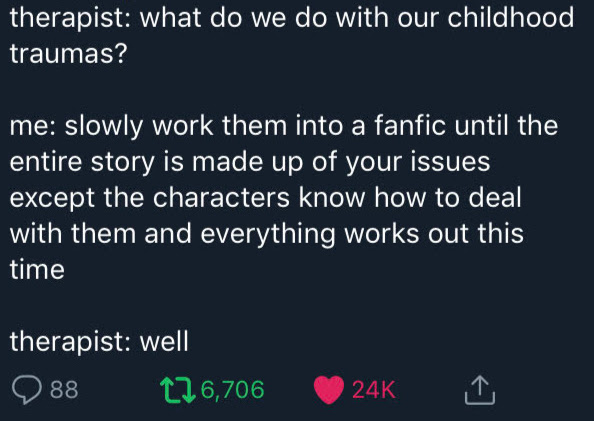
I also create comics and zines about aspects of my experiences.
Generally I use the personal sharing I do in such writing as an example: this is how you could do this kind of work, this is how you could understand how our experiences shape our habits, here’s a practice you might try. But sometimes I let the showing stand alone. Perhaps there’s not always the need to tell as well as show.
When is vulnerable too vulnerable?
This is complicated territory because writing from the vulnerable place is also risky. You could end up hurting yourself by trying to write about something which is still too raw and painful. The writing could stray into something over-sharing or self-focused in a way that doesn’t really connect with others. This is particularly likely if you’re still very caught up in the details of what happened in that particular situation. It could feel too vulnerable if people respond critically to it once you’ve put it out there.
There’s some kind of balance to be struck between the value of writing about what’s live when it’s live – the authenticity and sense of aliveness that kind of writing can have – and the wisdom of knowing when something needs more time before you approach it creatively – either in order to be safe enough for yourself, or for it to take a form that others can connect with.
On our podcast Justin and I often come up with ideas we’d love to cover but they feel too live for us – or for others in our lives – at the moment. We keep a list on our phones of topics that would be great to cover, but we want to come back to them when it feels like we have a bit more distance from them ourselves.
Another thing I do is to journal about the things that are really live initially in a format which is not for public consumption. I’ve filled hundreds of pages in the last year, going through major transitions in work, home, and relationships. Many of the ideas and practices that have come out of this writing will likely eventually find their way into my non-fiction and fiction writing, but it’s probably best that the writing I do for the initial processing is for my eyes only.
There’s an inner sense of ‘not ready’ and ‘ready’ which I’m beginning to trust in this – and other – aspects of life. For example, there will hopefully eventually be seven comics in this series, but this is the only one that’s felt complete enough to get down so far.
If something starts to take shape as a piece of writing for a reader beyond yourself you can always write it when live and return to it later. It’s a great idea anyway to separate the writing process and the editing process. This means that in the first drafting you can really sink into the flow and write it however it comes, knowing that you’ll be coming back to it before it goes out anywhere, so you can free yourself up to make mistakes and be imperfect. This is what Anne Lammot calls the ‘shitty first draft’ – something we’re allowed to do in writing and in life.
Personally I find it helpful to have a notepad or extra document open alongside my writing, where I write down the worried or critical thoughts I have about while I’m doing it: from information I need to check to issues around diverse representation. Then I know I can go back to those concerns during the editing process, but can park them and keep writing for now.
When I’ve written something and it has that feeling of potentially being too raw, or too vulnerable, to put out there at present, I leave it and return to it later: a month, a year, whatever.
I also have a sense of who my crew are for reading things that I’ve written which I’m not sure about sharing. If you know that the future version of yourself, plus several friends, will be reading the writing and feeding back about it before it sees the light of day, that can also help you to feel more free to write now.
Over time you can get a feel for what is just the right amount of vulnerable and what is over the line. Like if the exposure scale goes from 0-10 perhaps 5-6 is that sweet spot for things that are real and vulnerable in ways that stretch you a useful amount, and will likely connect with other people. But over a 7 is into the too-vulnerable zone and worth leaving till it feels less live. I’ve adapted this from an idea I got from Love Uncommon, that when our feelings are 0-7 the thing to do is to stay with them, but over 7 has tipped us into trauma/overwhelm and the thing to do there is to get back to a sense of being safe-enough before we try to stay with the feelings.
What if…
Here’s a few things people often worry about when writing about vulnerable stuff, plus my thoughts on them:
What if…people hate it?
I figure for everything I write there’s going to be a few folks who’ll really love it – the ones for whom it hits just the right point on the right day. Now that I have quite a lot of people who regularly engage with my stuff, there’ll probably be quite a few others who like it, which is great. Then there will be the vast, vast, vast majority of the world who have no idea who I am, no wish to read my stuff, and would feel pretty meh about it if they ever did. Then there’ll be a few people who – if they did read it – would totally hate it, either because they hate me – or people like me – or because it’s the opposite of what they think, or because they’re just having a bad day – or whatever.
In my case I’m generally writing for the people who find my stuff interesting, useful, or entertaining. Nobody else has to read it. If they do, and they don’t like it then that’s okay, they don’t have to read my stuff again.
What if…people are mean about me?
I think that people imagine that this will happen a lot if they put stuff out there, but it’s actually pretty rare. I write on some fairly controversial topics and I’ve very rarely have someone attack me or criticise my writing. It has happened, but to be honest it’s usually been something out of left field that I could never have predicted. I wouldn’t have avoided the experience by deciding not to write about the vulnerable stuff.
It’s definitely worth having some plans in place – if you write publicly – about what you’ll do if you do find yourself being criticised or attacked in a big way. Is there somebody who can take over your inbox and social media during the time it’s going on? Could you get away and do self-care till it’s died down a bit? Is there a holding message you can prepare in advance to put out while you take your time responding – if a response is required? Can you think advance of some kinds of filters to decide which kinds of critical feedback you’d like to take seriously and which you wouldn’t (around who gives it, in what form, what kind of issue it raises, etc.)?
What if…I change my mind later?
People worry that once you’ve written something it’s somehow set in stone and you could be judged for it FOREVER. I think it would be great if we could make a habit of returning to things we’ve written in the past and say how our views have shifted, or what we know now that we didn’t know then. We’re all in an ongoing process, and it’s not fair to judge a person now by who they were or what they knew 5, 10 or 20 years ago. Also culture is moving on and this makes it more possible to do better on many issues today than we might’ve done in the past. We could reflect on this process of change in our writing in useful ways – being accountable for the impact of our work – instead of being defensive and insisting that every word we’ve ever written was perfect.
What if…it’s vulnerable for other people I’m writing about?
This is where consent comes in (I said writing was like sex in more ways than one). If you’re writing about other people then it’s not okay to put something out there that could leave them vulnerable without their consent. There are several options here:
- Only write your story, not those of other people who might struggle to read themselves depicted, or to have themselves read about by others. Having had the experience of being reported about in the press twice without my consent I know very well how utterly traumatic, confusing, and powerless this experience can feel. I wouldn’t wish it on anybody.
- Keep things general rather than specific.
- Anonymise people (like I did when mentioning my clients earlier).
- Have consent conversations with people you would like to write about. Remember to acknowledge the power you have in the situation and any pressure they might feel under to agree to it: Ideally give them several options rather than just ‘go ahead’ or ‘don’t do it’. Take anything other than a definite ‘yes’ as a ‘no’. Remind them it’s fine to change their mind at any time (ongoing consent).
- Write collaboratively with the other people concerned so that you all have control over it together – this could be a useful process anyway.
- Write it as fiction rather than non-fiction, changing all identifying features, combining people together, or completely making up characters but keeping features of the experience true to life. This is what a lot of therapists do when they want to write about client work without breaking confidentiality. It’s what Alex and I do when we want to write a bunch of diverse experiences around an issue in our collaborative books.
There are complexities around all this of course when it comes to memoir writing particularly: what constitutes writing about somebody else versus telling your story? Again it can be useful to give yourself complete freedom to write what comes in the first draft, and then decide which strategies – or combinations of strategies – you’ll use to keep it ethical when you’re editing.
What if…I get something wrong?
You can go gradual. It’s not a binary of keeping something to yourself or putting it out there for all to see. You can have trusted friends read it first to give you a sense if it’s something worth sharing more widely. You can have sensitivity readers who you offer something to in return for reading it with an eye to particular aspects you want to be sure you’ve got right (e.g. axes of oppression you’re not personally familiar with but have written about, or science or history parts). If you have a publisher then you’ll have at least one editor who will read it before it goes out there. If it’s a blog then you can always share it only with a certain group of people, or put it out publicly but only share it with your social media friends or followers initially. And if you do get something wrong you can acknowledge that and change it immediately if it’s online, or in a later edition if it’s in print.
Writing vulnerable
Why would we write vulnerable stuff given all of these fears and potential pitfalls? I think that it does something very important for us personally, and for others reading our work.
Personally there is what Patrick Califia calls an antidote to shame in writing vulnerable stuff. This is often the stuff that we fear – deep down – might not be okay about us. Writing it and putting it out there is a way of saying ‘this is me, with all my inevitable frailties and failings and flaws, and I’m still okay.’ Under capitalism it could also be seen as a political act to challenge the success/failure and good/bad person binaries by speaking openly about our struggles, our mistakes, and our messes.
Related to this, writing vulnerable goes against the current pressure to curate and present a perfect image on social media and beyond (which brings with it a horror of being revealed as imperfect, which we inevitably are).
For me it’s always been about resisting the common depiction of the ‘self-help author’ or ‘expert’ who has it all together and doesn’t struggle in the way that ‘regular people’ do. Fuck that noise quite frankly. We hardly need another point of comparison to judge ourselves against and find ourselves wanting in the current climate. If we only put out our successes and triumphs and never our struggles and tragedies we’re feeding that culture of comparison. So we’d better get vulnerable.
Or we can sidestep the whole thing entirely as I do on Instagram and only share images of lovely nature/animals and food I’ve cooked (yes I am quite a good cook, but I’m rubbish at loads of other things I promise).
The post Showing Your Working: On Writing Vulnerable appeared first on Rewriting The Rules.
]]>The post Remembering Audrey: Another memorial appeared first on Rewriting The Rules.
]]>This time a plan took shape as I took a train past the Long Man of Wilmington last weekend. That place reminds me of my Gran – Audrey. It reminds me of the stories she used to tell of wandering the downs above Eastbourne. Last time I was there I felt strongly connected to her.
When I wrote a memorial for my other Grandmother, Leslie, I promised I would do one for Audrey too – having not had the chance to do so when she died in my teens. It’s a more complicated story to tell. But I decided to do my regret ritual today around her, and to write this story as I sit here, now, above the Long Man.

Remembering Audrey
Some of my best childhood memories involve being on a hill much like this with Audrey. She moved all the way from Sussex to Yorkshire to be close to me and my Dad – her son. She lived with my Granddad in a bungalow near the Keighley moor and I visited her there on the weekends. I thought of her as old then, but I guess she wasn’t all that much older than I am now.
Friday nights she would make me my favourite meal: roast chicken and homemade chips. We listened to singles on her record player and danced to Shakin’ Stevens. We read her grisly true crime books and gave ourselves the shivers.
Saturdays she packed a lunch and took me up the cobbled hill above the cul de sac where she lived and onto the moor. The hill seemed like a massive climb then but I guess it wouldn’t feel so far now. We always made for our spot – the red cliffs: a magic place where heather covered hillocks hid a disused quarry. Gran sat at the bottom while I clambered up over the heather and rocks, adventuring. I remember the feeling: free and wild and at the same time safe and loved, returning to Gran when I was done. We sat there watching the Worth Valley steam trains make their way along the valley far beneath us, eating chicken sandwiches and the little purple bilberries growing around us. She’d tell me how she used to climb like me – up on the Sussex downs. She said those were her happiest times too.
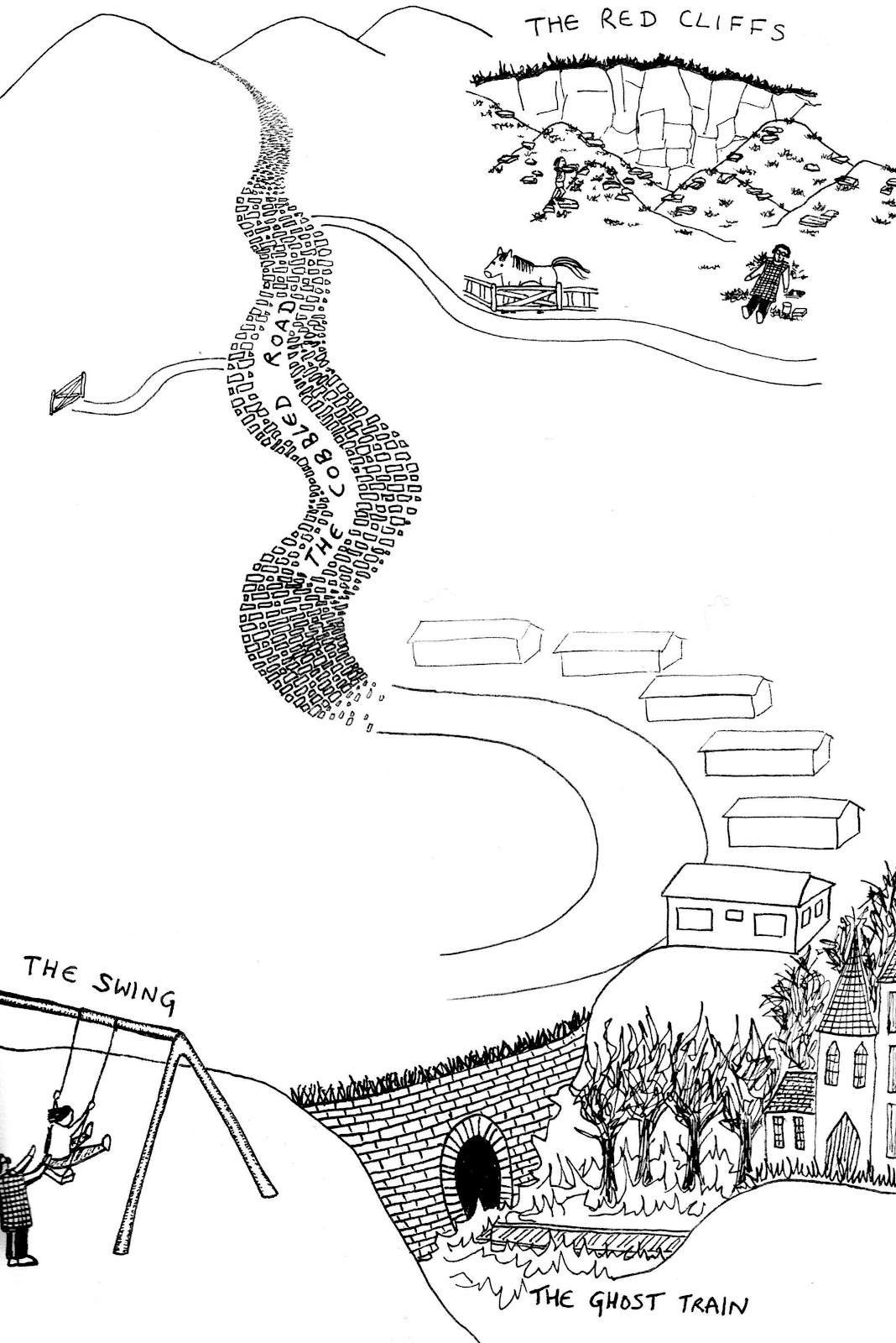
Later, after she moved to Bradford, our days together became adventures where we’d get on the first bus that came along, sit upstairs in the best spot (monarch of the bus), and go wherever it took us – Keighley and Haworth generally being the only options but I didn’t know that at the time. I remember her telling me stories about this family of kids she’d made up, and feeding me maltesers. She’d push me on the swings in the park, take me round the little shops, and get us fish and chips to eat at the bus stop before we headed home to bath and bed.
Love and Loss of Love
When I think of those times together, love is the word for it. The way Audrey delighted in me – my excitement at all that we saw and did and talked about – combined with the safety and kindness I felt from her, cuddled up in the evening watching TV after all the adventuring.
But it’s a complex story because Audrey also taught me what it is to lose love. I remember it vividly. I guess it was around the time I started adolescence. I was being bullied at school: learning that I wasn’t okay in all kinds of ways, that I’d have to hide my innocence and difference and enthusiasms if I wanted to get on. Gran had moved into sheltered housing. I think she probably struggled as much with the other people there as I did with the kids at school but I didn’t see that at the time.
I remember one evening I made a critical comment about someone on the TV who annoyed me. She became furious, saying I didn’t know what that woman had been through, what a hard life she’d had. In retrospect I think it must’ve been someone she identified with. It struck some painful chord from her own life. I remember the disappointment, disapproval, even disgust on her face as she looked at me. I linked it to the way she’d looked when I told her I’d started my period. She called that the curse.
This felt like a curse. Suddenly everything about me was wrong. And the things I was doing to survive this situation I was in made me someone my Gran couldn’t love any more. It happened a couple more times: her getting enraged like that, seemingly out of nowhere. It scared me and it confused me. I didn’t tell anyone about Gran’s anger just as I never told them about the school bullying, or my fears that there was something wrong with my body.
Gran and I became distant. She transferred her affection to my sister. Before I was out of my teens, she died. I felt guilty for betraying her, for seeing her less and less, for rarely visiting her in hospital. Her funeral was horrible: fake music and this person talking who didn’t even seem to know her.
I feel so sorry that I could never know Audrey adult-to-adult: that I could never have these conversations with her directly and also that I couldn’t find out more about her politics and activism. These were probably pretty similar to where I’ve now got to myself. She was heavily involved in the miner’s strike, for example.
Stories and Patterns
You could tell a lot of stories through what happened between me and my Gran. I later found out that this was her pattern with family and friends – to love people fiercely and fully – looking on them as golden ones – and then eventually flipping and feeling betrayed by them – hating them and often casting them out of her life, or at least her heart.
You could say it was terrible that she did that to me – a little kid. Just at the time when I needed her love to be a constant to demonstrate to me that I wasn’t all the bad things I was being told I was, instead she acted in a way which confirmed it. And she was the grown up. She should’ve known better; done better.
Or perhaps she saw what was happening to me: saw the delightful, playful kid she’d loved disappearing and this hard, unhappy, critical person taking their place; clumsily trying to be what other people wanted them to be and losing themself in the process. Maybe she couldn’t bear that: losing me that way. Maybe it was also what had happened to her once upon a time.
Or perhaps this is just what it’s like for everyone going from childhood to adolescence. Maybe I should just get over it.

But the point is I never really could get over it. My whole life I’ve longed to feel again that kind of love I felt from Gran. It’s like she passed her pattern onto me because whenever I seemed to find that kind of love I would love fiercely and fully in return, but if the person ever looked at me the way Gran did those times – with disappointment, disapproval, or even disgust – I’d find it totally unbearable. I would do anything to avoid that happening: becoming hypervigilant, trying to be whatever they would find loveable, avoiding saying or doing anything they might not like.
That kind of pressure often meant that when I couldn’t keep it up – all that work – I would become really hard to handle: desperate, flailing, unreachable, inconsolable, self-loathing. And of course that made it even more likely I’d get that look. As it happened more and more I wouldn’t be able to bear it so eventually I’d leave. Often I’d wait until another person had come along who might give me the kind of love I craved. Somehow being without it at all once more felt too hard.
Of course there’s more to my patterns than this: other stories that I have told – and will tell – in other places. There are stories about the cultural messages around love we all receive, stories about other early relationships I had and their impact, stories about capitalism and what that does to us, stories about how we all struggle to be with each other in our complexity – not grasp for the ‘good’ and hurl away the ‘bad’. There are stories about the patterns of the other people involved – which are not mine to tell – but which were part of the picture too, of course.
And there are relationships where I’ve resisted this pattern: found other ways to be, or containers for the relationship which have enabled it survive moments where I felt like my old horror was being lived out again.
But this feels like a pivotal story for me. And it’s not over yet: the pattern still happens.

Memorial
So today I decided to come here, where I imagine Gran used to come when she was a kid, maybe before all of her patterns got put in place: the ones she somehow passed on to me.
Despite being mostly veggie these days I allowed myself the happiest chicken I could find. I ate it with homemade chips last night and made sandwiches this morning. I got on the first bus that came along near my house: the Coaster that runs from Brighton to Eastbourne. I got off at Friston and walked through the forest. I saw a fawn with an adult deer in the woods: they seemed impossibly fragile to me. Lots of fragility on the walk.

I came to this spot by the Long Man, eating blackberries instead of bilberries along the way. And now I’m sitting to write this on my phone and popping maltesers. Later I’ll have my sandwiches looking down over Eastbourne, watching the trains make their way along the valley beneath me.
It strikes me that through my life I’ve taken the journey Gran took in the opposite direction: from Yorkshire to Sussex. I’ve moved down the country till I’m where she began – walking her chalk hills instead of my moors. I have to stop my progress south now. I’ve finally met the sea.
I’ve carried these patterns with me all this way, leaping from love to love with no break in the chain, trying to get back what I once had and leaving every time it looked like it was going the same way as before. I’ve tried everything to do it differently. I’ve reflected and written about it, I’ve warned people about it, I’ve shown them every part of me. But still I gave too much of myself away in an attempt to get that love and had to leave to get myself back. Still I couldn’t seem to bear it when the love dropped into that other thing – the disappointment, disapproval, disgust.
So now I’m trying the one thing I haven’t tried yet: not doing it. I’m staying with those old, old feelings of loneliness and longing for love, of yearning for somebody else to prove that I’m okay, and fearing that I’m really not. I’m trying not to push the feelings down, not to blame anyone else for them, and not to look to anybody else to make them go away. It’s really fucking hard but I think it’s the only way to change these patterns, and the pain and loss they cause to others and to me.
I’m doing rituals like this to try to find the love and kindness and safe-enough feeling that I long for within myself. I’m reaching out to all of my people, being vulnerable, and letting them into this so that I won’t be tempted to put it on one person any more. And hopefully those people will feel able to let me know if they see that happening again.
Today I do this ritual of regret for my Gran and for myself. I’m so grateful to Audrey for showing me what love can be, and I’m grateful to myself for managing to do this now. I also forgive Audrey for passing on this pattern – this curse – which has lost me so much love, home, and family along the way. Goodness knows what she went through to make her that way, or what the people went through who did that to her, or the ones who did that to them. As I forgive her I try to also forgive myself and to forgive all of us who are caught up in our own patterns, passed down through the generations, hurting each other and hurting ourselves. May we all find some kindness in this sorrow, in this regret.

The post Remembering Audrey: Another memorial appeared first on Rewriting The Rules.
]]>The post Straight people going to gay events and venues appeared first on Rewriting The Rules.
]]>How can straight, cis people be respectful in LGBTQ+ spaces?
This is a topic that comes up a lot around Pride season. Some of the bigger prides becomes so inundated with straight, cis people who want to enjoy the parade and festivities that it stops feeling like a proud – or safe enough – space for the LGBTQ+ people it was designed for. This also often elevates the prices making them increasingly inaccessible for more marginalised LGBTQ+ people.
Similarly LGBTQ+ friendly areas like Brighton, London Soho, or Canal Street in Manchester have become go-to places for stag-dos, hen-dos, and other straight, cis celebrations, perhaps seen as appropriate places for people to experience one final ‘walk on the wild side’ before tying the knot.
Why are queer events and spaces important?
It’s worth remembering the roots of queer venues and celebrations like Pride. Back in the late 1960s in the US gay, queer, and trans folks had to fight not to be ejected from venues like the Compton Cafeteria in San Francisco, or raided by the police in pubs like the Stonewall Inn in New York. The first Pride marches had their foundations in the riots that took place to protect these queer spaces, often led by those who were also working class, sex workers, and/or people of colour.
It’s easy to imagine that things are far better now than then, but rates of homophobic, biphobic, and transphobic hate crimes and discrimination have all gone up markedly since the Brexit vote, and we’re in the midst of a huge moral panic against trans people, as well as ongoing battles around how sex, gender and sexuality are taught in schools. Globally there’s still the need for a trans day of remembrance every year to mourn the frightening numbers of trans people – mostly trans women of colour – who are murdered annually. Related to all of this, mental health and suicide rates among – particularly young – LGBTQ+ people remains a big concern.
In many places LGBTQ+ people still don’t feel safe enough to express themselves – or their relationships – openly. Even where they do the backdrop is of heteronormativity: the assumption that people are straight and cis unless they ‘come out’ otherwise, and that being LGBTQ+ means being different from the norm in ways that we need to explain and justify in some way, with pressure to prove that we’re ‘normal’ in every other respect. Many LGBTQ+ people have strained or non-existent relationships with previous friends and family, so building their own friendships, support networks, and social spaces is important.
LGBTQ+ people often become used to having to come out repeatedly, to being asked intrusive questions about their bodies and sex lives, and to being treated as an object for people (the weird one in the office, or the gay best friend, for example). They have to be part of everyday workplace and family conversations which assume that everybody wants – for example – to find a partner, get married, and have (and gender) kids, and that those things require celebrating in ways that transitioning, finding a community, or coming out, do not. It’s understandable that they might want some spaces where they don’t have to worry about that stuff or self-monitor constantly: where they can assume that everyone will ‘get it’, relax, and breathe easy.
Think about your motivations
So if you are straight and cis and thinking of attending an LGBTQ+ space or event, think about your motivations. Generally speaking it’s probably a bad idea if you’re looking for the following:
- To share your opinions about LGBTQ+ people or get into arguments or debates
- To see something strange, exotic, or titillating
- To flirt or get off with somebody LGBTQ+ because you’re curious or want to have a story to tell – this involves treating people as objects for your pleasure, not full human beings
- To have a laugh by doing something a bit crazy and out-there
- To exploit or appropriate the coolness of LGBTQ+ culture in some way
These are better reasons:
- You want to support your LGBTQ+ friends who are keen for you to go along
- It’s an event or space that’s particularly looking for allies to support it – and the people going
- You’re genuinely questioning whether you might be LGBTQ+ yourself
- It’s an educative space and you want to learn something
What not to do
- Go with your straight, cis partner and get off together very publicly in the space – remember that everyday spaces are safe for you to do that in a way they aren’t for the rest of the people there
- Go with your straight, cis mates and take up a lot of room in the venue with your bodies or your noise – many people will feel less safe if you’re doing that
- Go to places with a maximum capacity which are already pretty full – better to let LGBTQ+ people be the people who get to use the space
- Ask intrusive questions of anybody there or touch anybody without consent
- Get super drunk or high so others have to look after you
What to do
- Check beforehand whether you will be welcome there – with staff or others attending
- Be friendly and treat people as full human beings, not just their sexuality or gender
- Do your homework if it’s an unfamiliar community for you – there are plenty of vids out there about things LGBTQ+ people are sick of hearing, or what not to ask them, as well as easy 101 introductions to language
- Be kind, consensual and unobtrusive – it’s not your space and you’re privileged to be welcomed here
And LGBTQ+ people need to remember…
Not everybody who appears to be straight and cis in an LGBTQ+ space actually will be. There are plenty of people who, for whatever reason, are not safe to be out as LGBTQ+, or don’t identify with that terminology, but are still attracted to the same gender or more than one gender, or living in a different gender to the one they were assigned at birth. There are also lots of people who don’t look like the common image of an LGBTQ+ person (which is so often white, young, slim, non-disabled, and middle class). There are many who aren’t into the LGBTQ+ ‘scene’ but are still LGBTQ+. This is often an issue particularly for bi people. Remember that just because somebody is with a different gender partner, or hooking up in that way, doesn’t mean they are straight. And even if they are straight, they may not be cis. They may be there because they are trans. Also femme women can feel very invisible in LGBTQ+ spaces.
Many people may access LGBTQ+ spaces because they’re questioning their gender and/or sexuality and that’s a really good reason. Insisting that they make definite decisions, identify or express themselves in certain ways is not okay. Also remember the + on LGBTQ+. There are good reasons to consider including asexual, intersex, kinky, and/or non-monogamous people, as well as sex workers, under the broad umbrella of people who are excluded from heteronormativity and discriminated against by virtue of their gender and/or sexuality. There are legitimate conversations to be had about who should and shouldn’t be included, and in what contexts – for example, not all intersex folk want to be added to the LGBTQ+ acronym and it’s very important to respect that – but generally it’s worth being as careful when making assumptions about somebody who doesn’t appear LGBTQ+ as we’d want people to be when coming into contact with somebody who does.
The post Straight people going to gay events and venues appeared first on Rewriting The Rules.
]]>The post Queer comics appeared first on Rewriting The Rules.
]]>
What was your relationship to comics as a child? Right now?
As a kid comics were where I escaped. I spent all my pocket money every Saturday on Beano and Topper and a bag of sherbet lemons. Later I was bought girl’s comics specifically which were full of stories of brave orphans and best friendships. While kid’s comics all had boys as the title characters, the girls in those comics like Minnie the Minx and Beryl the Peril were at least naughty like the boys. Girls comics were basically a tutorial in normative femininity – being for others and self sacrificing if you wanted to be popular and, later, to get a boyfriend. Luckily I also got into horror comics which offered something different, with ones like Misty particularly aimed at girls.
Needless to say there were no queer or non-binary characters in those kinds of comics back then. Although check out No Straight Lines to read about the underground queer comics that were happening in the 1970s and 80s when I was sadly too young to know about them.
Now my relationship to other people’s comics is mostly re-reading my favourites when I’m looking for comfort, so I was keen to hear more about newer queer comics at the event (more on that at the end of this post).
I’m also creating comics a lot myself as a way of figuring my own stuff out and communicating ideas simply to others. For example, my experience of trans is one of plurality so I’ve created a comic zine about how people can explore that idea as well as the first of a series of comics where I imagine my team of selves helping each other where they’re stuck. It’s great to be able to create basic comics myself, and to illustrate my books with these, as well as working with a proper illustrator – Jules Scheele – on our Icon graphic guides: Queer and Gender.
Are there characters or story arcs about queer characters or issues that stand out to you? Influences on your work?
I got into more indie comics when I was at university. Alison Bechdel’s Dykes to Watch Out For, Terry Moore’s Strangers in Paradise and Tim Barela’s Leonard and Larry were important ones – dealing with lesbian, bi, and gay people respectively. I love how Bechdel’s particularly moved with the times incorporating more trans characters and other kinds of diversity as the series progressed.
Bechdel went on to focus on memoir of course with Fun Home and Are You My Mother. That’s always really spoken to me, and is the kind of comic I make myself. Most queer graphic memoirs also explore therapeutic or mental health themes – Marbles and Calling Dr Laura – are other good examples. I also love Lynda Barry who mixes graphic memoir with guides to writing comics and weaves race and class into her work more explicitly than many.
What are your thoughts about queer representation in the indie versus big comics houses like DC, Marvel?
I haven’t read the DC or Marvel comics but I watch most of the movies – which are probably behind the comics in representation I know. To be honest they’re still pretty disappointing on inclusion of women (the first female titular heroes being so recent) and really poor on queerness, race, and disability. The X Men particularly disappoints me given that the whole thing is a meditation on the civil rights and gay rights movements: violent vs peaceful protest, radical vs assimilationist approaches, etc. Mutants clearly have much in common with queers in terms of how they are treated, so why don’t the creators learn from this?
I do find X Men and superheroes and villains useful for my writing on gender though. Lately I’ve been thinking about trans and queer people as time travellers, shapeshifters and shifters of space, holding super powers which could help save the world, which is a pretty useful approach at a time when there is such a rise in queerphobia and transphobia.
I’d recommend my co-author Alex Iantaffi’s podcast Gender Stories where they interview their daughter on gender representation in superhero movies and comics.
Since comics tend to be thought of as an American form what would you want people to know about UK comics?
That they exist. Particularly that we’re maybe at the forefront in creating critical comics about sex, gender and mental health.
The non fiction stuff out of the US and other countries is often fairly accepting of normative understandings of these topics whereas many UK creators are writing on madness in ways that critique cultural messages and mental health systems, as a few of us explored in some special issues of Asylum magazine a few years back. Jules and I are trying to write in similar ways on sex and gender.
What is distinctive about the medium in portraying queerness?
There’s something about the way comics communicate feeling – in a way that words alone can struggle to convey. Reading – and creating – them can be a very embodied experience forging a sense of connection between creator and reader through the experience described. I’m thinking of Hyperbole and a Half and how well that gets across the experience of depression for example.
There’s also something about the history of humour and lightness in comics which can make them a particularly engaging way to take in information. Readers certainly comment that Queer made queer activism and theory accessible and enjoyable to people who had struggled to wrap their heads around it in the past.
What issues are raised about how queerness is made visible (limits of racial representation, femme invisibility) and how have you seen comics engage or perpetrate these issues?
I think a long running series like Dykes to Watch Out For (as with its non-comic counterpart Tales of the City) can address these kinds of issues in a way that doesn’t happen in one-off comics. It’s still wearying that mainstream comic producers baulk at altering main characters to get a better spread of representation.
With Queer and Gender Jules and I had sensitivity readers check out the books particularly for areas we had less expertise or lived experience of ourselves. I also tried to ensure that I spent some time addressing the invisibility of race and class in queer theory and feminism, and bringing in the voices of queer people of colour and women of colour specifically, as well as representing diversity in the imagined readers of the books (who we follow through each book). We were able to tackle femmephobia specifically in the content of both books, and the graphic nature of the medium helped us to visualise this in ways words alone would have struggled to capture.
What queer comics should I read now?
Like I said I haven’t been very up to date on queer graphic books of late so I treated myself to several in my favourite genres at the event, particularly those that had a more intersectional feel. I’m now working my way through and loving them. There are also good lists of new queer comics here and here.
- Laura Dean Keeps Breaking Up With Me by Mariko Tamaki who I already loved for This One Summer
- My Lesbian Experience with Loneliness by Kabi Nagata
- The Witch Boy by Molly Knox Ostertag
- Moonstruck by Grace Ellis, Shae Beagle & Kate Leth
- GenderQueer by Maia Kobabe
I also bought Eleanor’s awesome The Times I Knew I Was Gay, and MJ Wallace’s Bi The Way (a rare bi memoir comic which was really good to see).
More on comics
You can read more of my thoughts on comics and mental health in an article here (just scroll down). I’m keynoting the Graphic Medicine conference on comics, queer and mental health soon too.
The post Queer comics appeared first on Rewriting The Rules.
]]>The post New Book – Life Isn’t Binary – Out Today! appeared first on Rewriting The Rules.
]]>My main reason for not writing it sooner was that I knew there were knowledges, practices, and themes that a book like this would need to cover which I didn’t have enough understanding or experience of myself. Fortunately I now have my awesome co-author Alex, and we were looking for a follow-up to How to Understand Your Gender. Alex and I have pretty similar views, but we come from different backgrounds in all kinds of ways. We bring together different spiritual traditions (e.g. Pagan and Buddhist), different activisms (e.g. intersectional feminist, queer, disability, sex critical), different academic backgrounds (e.g. psychology, sociology, philosophy, literature, health), and different therapeutic approaches (e.g. existential, mindfulness, systemic, and somatic).

Most of these areas have something useful to contribute to the idea of thinking, relating, and living non-binary. We’re aware – of course – that there are many other schools of thought and traditions that would also be valuable but which we don’t know about personally. We hope that people with those understandings (from other faiths, philosophies, cultural contexts, etc.) will be able to bring them into dialogue with the materials in the book.
The book starts by taking you through why a non-binary approach is a useful way of understanding sexuality and gender. Alex and I have a background in bi politics, and we both identify as non-binary/genderqueer these days, so we talk about our own experiences as well as expanding out beyond the gay/straight and male/female binaries. Then we explore how the non-binary approach might also be helpful in thinking about how we do our relationships, how we think to our bodies and identities, how we relate with our emotions, and how we think about life, the universe, and everything.
You can listen to Alex and me talking more about Life Isn’t Binary here.
If you want a taster of the book, here are a few of my blog posts which cover non-binary sexualities, genders, relationships, feelings, and thinking:
- Bisexuality, pansexuality, and queer
- Non-binary gender
- Relationships
- Feelings
- Non-binary thinking about porn and trigger warnings
If it sounds up your street please do grab a copy of Life Isn’t Binary today.
The post New Book – Life Isn’t Binary – Out Today! appeared first on Rewriting The Rules.
]]>The post What Gender Affirmative Therapy is and is not appeared first on Rewriting The Rules.
]]>One topic which comes round frequently in this moral panic is the help and support given to people – particularly young people – who are gender diverse, or exploring their gender. Claims are often made that people are pressured to go down particular roots, for example that anybody who questions their gender is pressured to come out at trans, or that everyone is quickly pushed down a particular pathway of medical treatment and surgeries.
I was recently asked to put together a factsheet about what Gender Affirmative Therapy – or Gender Affirmative Practice in general – actually looks like: to put the record straight about what therapists, activists, and other practitioners in this area are actually doing – and inviting others to do. Here it is. You can download the pdf, or read the whole thing below that.
Gender Affirmative Therapy
What is Gender Affirmative Therapy (GAT)?
Gender affirmative therapy (GAT) is any form of counselling or psychotherapy which seeks to help people to come to a consensual, comfortable, and self-accepting place with their gender. It is founded on the position that no gender identity, expression, or experience is any more valid, ‘natural’ or ‘normal’ than any other. In this way GAT sits in opposition to any form of conversion therapy which attempts to change a person’s gender identity or suppress their experience or expression of their gender.
Why is GAT important?
We all have a relationship to gender and these are often related to our experiences of mental health difficulties, for example:
- Attempts to conform to rigid masculine gender roles – including demonstrating strength and suppressing emotion – are linked to the high suicide rates, and to addictions and violent behaviour which also impact the mental health of others
- Attempts to conform to rigid feminine gender roles – including being defined by attractiveness and relationships with others – are linked to high rates of body image problems, depression, and anxiety
- Cultural transphobia and assumptions that people should remain in the gender they were assigned at birth are linked to high rates of suicide attempts, self-harm, and mental health struggles among trans people via common experiences of bullying, discrimination, and family rejection
- Assumptions that gender is binary, and the cultural invisibility of non-binary genders, are linked to the high rates of mental health struggles among non-binary people (those who do not experience themselves as male or female)
For these reasons it is vital that therapists and counsellors are gender-aware and gender-affirmative: able to help their clients to understand the range of options they have in relation to gender and to support them in navigating these
What are the underpinning assumptions of GAT?
GAT is based on the position that gender is diverse and that no gender identity or expression is inherently superior or more ‘natural’, ‘normal’ or valid than any other. This includes the following assumptions:
- It is no more preferable to be cisgender (remaining in the gender you were assigned at birth) than it is to be trans (shifting from the gender you were assigned at birth), or vice versa. Both trans and cisgender are big umbrella terms encompassing a diverse range of experiences, expressions, and identities
- It is no more preferable to identify as a woman, as a man, or as a non-binary person, or to express femininity, masculinity, or any form of androgyny or non-binary gender
- Most people identify, express, and experience their genders in different ways over time as they find more comfortable and consensual relationships to their gender. This can involve: changing dress and appearance; shifting titles, names, pronouns and other identifiers; taking external hormones; undergoing surgical procedures, etc. It’s important to remember that such changes are commonplace among cisgender and trans people alike (e.g. women and non-binary people may take oestrogens and progesterones because they are menopausal, trans, seeking birth control, intersex, or experiencing endometriosis; people may have mastectomy/breast reduction because they are trans or non-binary, because they are a man with gynecomastia or pseudogynecomastia, because they are a woman who doesn’t wish to be sexualized or otherwise stereotyped on the basis of their breast size, or because they are a person who is at risk of breast cancer or migraines related to breast size)
- No particular gender journey is preferable to any other. For example, it is no more preferable: to express gender in culturally normative or non-normative ways, to undergo social or physical changes or not to
What happens in GAT?
The emphasis in GAT is on supporting the client towards a gender experience, expression, and identity that feels comfortable and consensual to them.
- We live in a culture which privileges being cisgender over trans, being binary over non-binary, being a man over being any other gender, and being masculine over expressing gender in other ways. Therefore GAT may well involve unpacking cultural norms around gender and how they have impacted the client
- Our culture also regards some gender identities, expressions, and journeys as more acceptable or ‘normal’ than others, so GAT may involve normalising and legitimising the various options available to the client
- Gender intersects in vital ways with other aspects of experience (e.g. race, class, sexuality, age, generation, mental health, disability) so GAT does not focus exclusively on gender but rather explores it in the context of the client’s background and wider world
- Given that there is still a great deal of stigma and discrimination around any gender non-normative expression there may well be exploration of how clients can navigate the wider world in ways that are safe-enough, and the balance between this and expressing their gender in ways that feel comfortable and consensual to them
What doesn’t happen in GAT?
There are many myths about what happens in GAT, largely due to the current moral panic about trans. The following things would never happen in GAT:
- Suggesting that a person must be trans simply because they have a gender non-normative experience or expression, many cisgender people also have these
- Suggesting that a person must be cisgender because they do not seem trans and/or non-binary enough to ‘count’
- Encouraging a person to take puberty blockers or hormones, or discouraging them from doing so if that feels like the best path for them
- Encouraging a person to have surgical interventions, or discouraging them from doing so if that feels like the best path for them
- Rushing anybody into any form of gender identity, expression, or experience
- Encouraging any decision before a person is fully informed about what it would involve and what impact it would have on them physically, psychologically, and socially. Informed consent is vital
Further Resources
You can find the research this factsheet is drawn on in:
- Barker, M-J. (2017). British Association of Counselling & Psychotherapy Good Practice in Action Fact Sheet 095: Gender, Sexual, and Relationship Diversity (GSRD).
- Government Equalities Office (2018). National LGBT Survey: Research Report.
Other useful resources include:
- The Memorandum of Understanding on Conversion Therapy in the UK, Version 2
- Stonewall trans report
- Trans panic
- Iantaffi, A. and Barker, M-J. (2017). How to Understand Your Gender. London: Jessica Kingsley.
- Pink Therapy
The post What Gender Affirmative Therapy is and is not appeared first on Rewriting The Rules.
]]>The post Podcast: Life isn’t binary! How non-binary thinking can help us to understand ourselves appeared first on Rewriting The Rules.
]]>
In the run up to publication Alex and I made this podcast about the book and why non-binary thinking is such an important theme for us.
We discussed the trans umbrella, colonial thinking, bi-gender people and plural selves, sexualities, queerphobia, Disney Pixar’s ‘Inside Out,’ binary governing of our bodies and emotions, labels, intersectional identities, hierarchies, marginalisation, policing identity boundaries, prioritisation of different relationships, growing up in Italy, Capitalism, the importance of reflection, and being kind to yourself.
Check out the podcast here.
If you like this you can also follow Alex’s awesome podcast, Gender Stories and my regular podcast on sex, and relationships with my other amazing co-creator Justin Hancock – Meg-John & Justin.
And, of course, you can pre-order the book here.
The post Podcast: Life isn’t binary! How non-binary thinking can help us to understand ourselves appeared first on Rewriting The Rules.
]]>The post The snowflake generation appeared first on Rewriting The Rules.
]]>1. How would you respond to common accusations of “snowflakery” within the LGBTQ+ community?
The snowflake insult tends to conflate a few different things. If you look into the meaning it includes the idea that ‘snowflakes’ believe they are particularly unique and special (like every snowflake is different), as well as the idea of being particularly fragile – and therefore in need of protections like safer spaces.
Teasing these things apart I wouldn’t say that LGBTQ+ people are especially unique, but I do think the snowflake metaphor is useful for thinking about gender and sexual diversity. When we consider intersectionality, and how every person is positioned in relation to multiple intersecting aspects including gender, sexuality, race, class, disability, age, generation, nationality, etc. then snowflake is about right. There won’t be any two people where this constellation of aspects is identical. That helpfully draws our attention to the ways in which all of us are privileged in some ways, marginalised in others, and how we need to hold our similarities and our differences simultaneously. Snowflakes all look similar, but in fact they are unique.
Are LGBTQ+ people particularly fragile? Again it’s more complex than that. We live in a culture which is rooted in hierarchies whereby some people, bodies, and lives are regarded as – explicitly or implicitly – more normal, healthy, or highly valuable than others. All of the groups on the more marginalised end of those hierarchies have less power and privilege and face more discrimination and hatred on a daily basis. This takes a toll as we can see when looking at statistics on mental and physical health. LGBTQ+ people – like women and BAME people – have higher rates of mental health problems than average because they’re disadvantaged – and often traumatised – in a society that sees heterosexuality and cisgender as the normal, superior, way of being. This can make us more fragile. It can also make us more resilient. George Takei’s comment about snowflakes being powerful when they take the form of an avalanche captures that duality.
2. How would you respond to those who accuse, for instance, trans people requiring safe access to spaces appropriate for their gender of being “snowflakes”?
To my mind this is not about trans people saying we are particularly unique, or particularly fragile. It is more about recognising the unequal power dynamics in wider culture and trying to even the balance. If we can agree that no people, bodies, or lives are inherently more valuable or ‘normal’ than others, then everyone should have equal access – for example to bathrooms where they can pee in safety, to media which represents people like them in positive ways, and to daily interactions with others where their identity isn’t constantly called into question or they have to answer intrusive questions about their genitals or medical history. If there’s no media debate on whether cisgender people’s genders are real or whether they might be misguided in believing they are the gender that they say they are, then there shouldn’t be a media debate on that in relation to trans people. That doesn’t mean we shouldn’t all be having interesting conversations about how gender works and the impact it has, but don’t focus that on trans people.
3. Even some members of the LGBTQ+ community say that many of these accusations are valid, and that sometimes we try to move too fast and harm our movement in the process, for example by quickly attempting to introduce non-binary genders into common parlance. How would you respond to this?
I feel like we’re starting from the wrong place if we take for granted that there is some kind of a normal group in society that we’re gradually working to add all the marginalised or minority people into. That’s the model here. It’s like the norm could just about cope with adding in lesbian and gay people twenty years ago, but bisexual people were told they had to wait their turn because they were confusing and they muddied the water. Now there’s a sense that maybe we can begin to open to trans people, but perhaps only trans men and women because non-binary people will be too complicated for ‘normal folks’ to get their head around.
Instead we need to question this whole model of normal versus abnormal that we’ve been fed. It’s not that LGBTQ+ people – or trans and non-binary people – are snowflakes. The point is that we are all snowflakes. Everyone is diverse in terms of their gender and sexuality. There is no norm. For example, over forty percent of young people are somewhere on a spectrum between heterosexual and homosexual. Over a third of people feel that they are to some extent ‘the other gender, neither gender, or both genders’. Well over two thirds of people have some form of kinky fantasies, and a similar number are non-monogamous at some point in their life. Add all this together and the number of people who are some kind of pure heterosexual, cisgender, only into penis-in-vagina sex with a monogamous partner is actually pretty low.
So I don’t think it’s about gradually adding new identity categories to the group of people who is seen as normal or valid, with each new group having to somehow wait their turn for grudging acceptance. Rather it should be about shifting the whole understanding of gender and sexuality to one of diversity – or snowflakes – rather than a normal/abnormal binary.
4. How would you respond to the idea that those who object to things such as two men holding hands in an advert are in fact guilty of being “snowflakes” themselves?
I think it’s clever how people have turned the snowflake accusation around on the accusers. If people become so upset and offended about LGBTQ+ rights then aren’t they being just as ‘fragile’ as the people they are accusing of being too-easily upset and offended? Again though I would question an ‘us and them’ approach as any kind of long term solution to this. As long as we remain in separate camps accusing each other we won’t get very far, and a lot of people will be hurt in the process. What’s needed is an end to the attempt to categorise people into more or less normal, or more or less snowflakey, and a recognition that we’re all diverse across multiple spectrums of gender, sexuality, and much else. Then we can work to redress the balance whereby some of been valued less than others on the basis of such spurious distinctions.
Find out more
Check out my books Queer: A Graphic History, How to Understand Your Gender, The Psychology of Sex and – coming soon – Life Isn’t Binary.
The post The snowflake generation appeared first on Rewriting The Rules.
]]>The post Vanilla Sex appeared first on Rewriting The Rules.
]]>Have activities that fall under “vanilla sex” changed over time? Is something that was once considered kinky now considered vanilla?
Absolutely there has been some changes with a couple of cultural shifts that have happened in the last few decades, often called ‘sexualisation’ and ‘subjectification’. Sexualisation means that sex has become a big story in wider culture and there’s a lot more sexual media out there, easily accessible, and including more diversity of sexual practices. Subjectification means that people are now expected to be sexual subjects or entrepreneurs: learning tools and techniques to make them good at sex, and maintaining ‘great sex’ in relationships.
The combination of these two means that the kind of sex people are expected to aspire to has a broader range, and includes some things that would previously have been thought of as kinky. For example most sex advice books include light bondage, role-play, and sensation play these days. However there is still a strong sense that these things are an add-on to sex rather than sex itself (which is still generally seen as penis-in-vagina intercourse). Also there’s a strong sense of a boundary between ‘kinky-fuckery’ (as Ana calls it in Fifty Shades of Grey) and proper BDSM (Bondage and Discipline, Dominance and Submission, and Sadomasochism). Proper BDSM is still seen as deviant and people are warned against it as if it was somehow inherently abnormal, dangerous or only for broken people (it’s not!)
But from these shifts you could argue that ‘vanilla sex’ now certainly includes oral sex, anal sex (man penetrating woman), and some light kink, in addition to penis-in-vagina sex.
More on this in my book with Ros Gill and Laura Harvey, Mediated Intimacy.
Do queer and nonbinary communities use the phrase “vanilla”? Or is that kind of construct less prevalent, and if so why?
I’ve heard it mostly used in kink communities to describe non-kinky sex, and even then there is often an awareness that none of us should really be judging people negatively for their sexual desires – whether those desires are kinky or non-kinky – and there can be concern that ‘vanilla’ sounds like a derogatory term (bland or boring). Queer people can use terms like vanilla, normal, mundane or muggle to describe non-queer people. It can be a way of reframing things so that the people who are often stigmatised, marginalised and pathologised are presented as in some way better than those who often do the stigmatising, marginalising, or pathologising. But again it is usually tongue-in-cheek with an awareness that reversing a hierarchy where one sexuality is seen as superior to another is still problematic.
It’s also worth remembering how few people actually tick all the boxes of being a completely vanilla, heteronormative, person. If you count up the numbers of people who are openly or secretly non-monogamous, with the number who have kinky desires, and the number who have attraction to more than one gender, or very low or high sexual attraction, actually that leaves very few people in what we’ve been taught to believe is ‘normal’.
More on this in my book The Psychology of Sex.
How do you think tech/apps have changed the way we view what falls under “vanilla sex” and how we view sex in general?
They’ve been part of this sexualisation and subjectification that I mentioned earlier – they make us more aware of the diversity of things that people can find hot, and the sense that it’s good to be open about such desires and to be able to offer to meet them. There is a risk that we go the other way in that people feel pressure to be up for anything and to offer things on hook-up apps and the like that they’re not really into. There’s nowhere near enough cultural consideration of how we do this consensually.
This is something we talk about a lot on my podcast with Justin Hancock megjohnandjustin.com.
The post Vanilla Sex appeared first on Rewriting The Rules.
]]>