The post Madzines 2: Self Care zines appeared first on Rewriting The Rules.
]]>You can read the second part of our conversation at the MadZines project website here. We focus on radical self-care zines and how they relate to MadZines.
HS: Our project is about zines that ‘craft contention about mental health knowledge and practice’. That could mean all kinds of things, but it’s essentially about challenging what is commonly understood about madness or distress, including from the so-called psy professionals (psychiatry, psychology, psychotherapy, etc). I know your background is in psychology. There’s been a lot of ‘critical psychology’ these past few decades and we’ve seen quite a bit of change. Given all this, how far do you feel challenging these ideas and practices is still important?
M-JB: Oh, I think it’s still very important. The people I mostly speak to are therapists and readers of my work, most of whom have never come across these more critical ideas. I think the standard perspectives you get around mental health – if you take a counselling course or if you pick up a self-help book – are still very basic. That’s partly why I’m so passionate about getting these more critical and social justice ideas – about mental health and other topics – out there in accessible ways like comics, zines, self-help books, and podcasts.
HS: Are there particular issues/experiences around mental health that you think need to be challenged or contested right now?
M-JB: I think the mainstream understanding of mental health is still very binary: you’re either someone with mental illness, which means that it’s not your fault, but you need expert help in order to get ‘better’. Or you’re not someone with mental illness, which means that your struggles are your own fault and you need to pull your socks up – do mindfulness, have better stress management, that kind of thing. I’m very keen to challenge that binary in my work. Read more…
The post Madzines 2: Self Care zines appeared first on Rewriting The Rules.
]]>The post Opening up from lockdown appeared first on Rewriting The Rules.
]]>You can listen to the episode here.
The post Opening up from lockdown appeared first on Rewriting The Rules.
]]>The post Hell Yeah Self-Care Podcast appeared first on Rewriting The Rules.
]]>It was so good to be back on the rebranded Meg-John and Justin podcast which Justin is now taking forward with some great new formats including sex jams (where he discusses sex in pop music with historian Eleanor Janega), advice episodes, reviews of relevant media, and interviews with various sex and relationship experts.
You can find the epsiode with me and Alex here (free feed) and here (extended Patreon episode). Our chat included why self-care is such a problematic concept and why we named our book for it anyway, what it means to take a trauma-informed perspective and why that’s important, why collective care is so vital under capitalism, and who even is this self that we’re trying to care for.
- If you want to buy the book please consider doing so via an independent bookshop like Hackney Pages.
- You can find previous episodes of the podcast with me and Alex here and here.
- If you want to support our projects check out my Patreon, Justin’s Patreon, and Alex’s Patreon.
The post Hell Yeah Self-Care Podcast appeared first on Rewriting The Rules.
]]>The post Book Out Today: Hell Yeah Self Care! appeared first on Rewriting The Rules.
]]>Here’s a video of Alex and me talking about the book, what it means to us, how we struggle around self-care ourselves, and what we do about that.
The post Book Out Today: Hell Yeah Self Care! appeared first on Rewriting The Rules.
]]>The post Self-Care update appeared first on Rewriting The Rules.
]]>
First, the lovely people at Lagusta’s Luscious – a chocolate shop in the Hudson Valley of NY – have added the zine to their self-care box. If you order the box you get a hard copy of the zine along with fifteen pieces of their amazing chocolate, and a handmade candle in a ceremic cup. Some of the proceeds each time go to Trans Queer Pueblo, an organisation who support LGBT+ migrants of color. So do feel free to order the box here for anybody in your life who you think might appreciate it during these tough times.

Second, you can now pre-order the workbook by the same title – Hell Yeah Self-Care – which my co-author, Alex Iantaffi, and I have written, to receive your copy in the new year.
Here’s the link to the Amazon, and Foyles pages for ordering the book. But please do order it from your local independent queer or feminist bookstore if you have one. In the UK we love Gay’s the Word and Pages in London, Category Is in Glasgow, and The Feminist Bookshop in Brighton. In the US Moon Palace Books in Minneapolis is a good friend to me and Alex.
The book Hell Yeah Self-Care develops the ideas and practices in the zine into a whole workbook full of activities, drawing on the content of some of my other zines, and also much of Alex’s work on somatic, trauma-informed, and systemic/relational self-care.
In some ways ‘self-care’ isn’t the best title for the book – or the zine – as what we’re talking about is really ‘collective care’ where we cultivate systems and structures of support and mutual aid. The book covers how we can develop our support systems, co-create consensual cultures and relationships, and do the inner work needed to care for ourselves, others, and the wider world.
The post Self-Care update appeared first on Rewriting The Rules.
]]>The post Accompanying vs. abandoning ourselves appeared first on Rewriting The Rules.
]]>To discuss this one I brought together two sides of myself who used to wish to abandon – or even eradicate – each other, but who now form a pivotal friendship in my plural system: Max and Beastie. Check out this zine and this blog post if you want to know more about plural selves. Hopefully the content of the conversation is interesting regardless.
Beastie: You and me this time bestie, have we done this before?
Max: I don’t think so. Definitely makes sense to be the two of us given our background huh?
Beastie: It does. I guess the time that you befriended me was the first time that we determined to accompany a part of ourselves that we had previously tried to abandon. It’s formed something of a blueprint for subsequent times. And it helps us have faith that it’s always worth doing.
Max: I still remember it vividly. Around six months before I befriended you was the last time that I tried to eradicate you entirely. That was something I’d been trying to do our whole life: to get rid of the harsh critical voice that was always so loud in my mind. Something tough happened and you were saying such cruel things. I dragged you into the woods determined to be rid of you once and for all. I shouted at you out loud. It was the first time we’d ever talked. I would never talk aloud to myself normally, back then. But I screamed at you to be gone, and you just screamed back even louder.
Beastie: I gave as good as I got. This is a key point though isn’t it. You can’t eradicate parts of yourself, no matter how much you might want to. You might as well learn to accompany them, because abandoning them hurts you, and in the end it’s never going to work. You’d have loved to have abandoned me in those woods for good, but I followed you home.
Max: We listened to this song: Fighting with Myself, coming back out of the woods. At least it gave us a smile.
Beastie: Six months later, you decided to interview me, in your journal.
Max: You were pretty mean to me then too. But we got more curious. We started to journal with you more often, from all the different sides of us.
Beastie: And weirdly it was you and I who ended up forming one of the closest bonds.
Max: I’m so grateful for that. I’d read all those books about how, when embraced, the inner critic could become a fierce ally. But I was skeptical.
Beastie: You so often are.
Max: Yeah, yeah. They were right though. I consider you my best friend now, no question.
Beastie: And I you Max. You are the side of us who has been to the fore our whole life: battling hard to survive and feeling so alone in it. I’m so glad to be able to accompany you now, along with the rest of our motley crew.
Max: And I need a good friend, finally confronting the impact of all those times.
Beastie: Shall we start?
Max: Let’s.
What does it mean to accompany yourself rather than abandoning yourself?
Max: Okay so the idea of accompanying yourself means that you commit to staying present with yourself through every mental or physical state that you might be in: every situation you encounter, every feeling you experience, every side of yourself that shows up, no matter what.
It’s a radical alternative to what most people usually do. Abandoning is a good word for that because it captures how we tend to reject the suffering part of us when we are hurting, and even kick them while they’re down. For example when we feel a physical or emotional pain we might try to ignore it or push through it, and even become angry and frustrated with ourselves about it.
Beastie: This relates to what Ara and I recently discussed, about the gap. In practice our commitment to accompaniment rather than abandonment looks like returning to the gap each time a challenging situation, feeling, or thought comes up. Instead of going to the next item on our to-do list, scrolling through social media, or pressing ‘next episode’ on Netflix, we sit for a few minutes to check whether there’s anything there. If there is, we sit with that, or journal about it, or talk it through, before we go on to the next thing.
Why is this so necessary?
Max: Do you want to start on this one?
Beastie: Sure. I think a big part of what we’re doing when we accompany ourselves is to meet ourselves in a regulating rather than dysregulating way. Given the way our culture is around feelings, very few people have learnt to regulate their emotions, particularly when very strong emotions arise. Mostly we try to repress feelings by zoning out or distracting ourselves with busy-ness. Or we react out of feelings in ways that are dysregulating for ourselves, and often for others too.
Max: Mmhm. Staying busy – or flight – has definitely been my go-to up until now. It’s been such a challenge for me these last months to continually drop that abandonment strategy and commit to staying present with myself and with whatever I was trying to distract from.
Beastie: We all have our go-to ways of avoiding experience Max. Mine – fight – has always been to get very noisy mentally about all the things we’re doing wrong, or lately more what other people are doing wrong. Either way it’s another way of not really being here now: getting caught up in critical and judgemental thoughts.
Max: From what we now know about trauma and shame, both result in people who very easily become dysregulated and reactive. Committing to accompany yourself increases your capacity for regulating yourself, through whatever life brings.
Beastie: I’ve also heard it described as increasing the ‘window of tolerance’ between zoning out and becoming activated. When we have a narrow window of tolerance, many experiences tend to result in us shutting down or distracting ourselves, or becoming overwhelmed by big feelings. Accompanying ourselves can expand that window to get gradually wider over time. More experiences become possible to tolerate without disappearing or disintegrating – two ways of abandoning ourselves. Pema Chödrön talks of the same thing as ‘refraining’ rather than repressing or reacting.
Max: Refraining sounds like not really doing anything, but what we are doing when we refrain is to accompany ourselves.
Micro and macro accompaniment/abandonment
Beastie: It’s useful to think about how we abandon ourselves on every level – micro to macro – and how we might accompany ourselves at every level too.
Max: Right. So micro level might be a fleeting moment, and macro level our most challenging situations.
Beastie: What are your macro abandonings Max-y?
Max: Oof you know very well what they are. I often abandon myself when I feel I might be getting sick: finding ways to blame myself for it, and worrying about cancelling things, instead of stopping and looking after myself. Hurting others and getting hurt by others are also big ones for me. When I realise I’ve hurt someone I can feel I don’t deserve to accompany myself, so I abandon myself into shame and self-blame and trying desperately to make it better. When others have hurt me I often go to shame too, assuming it must somehow be my fault, or getting lost in trying desperately to make sense of what happened.
Beastie: I’m hoping to write more about shame given that seems like one of the very hardest experiences to accompany ourselves through. Also I like the idea of a reformed inner critic becoming an expert on shame.
Max: Well you’re already helping me out with it, but it remains a tough one indeed for us.
Beastie: As with so many things it can be great to work your way up from the micro to the macro level. In working on the micro moments when we tend to abandon ourselves we can practice moving from abandoning into accompanying in those situations. Hopefully eventually it will be our go-to even in our more challenging situations.
Max: Practising regulation, or expanding the window of tolerance.
Beastie: Exactly. In the conversation James and Jonathan had about trauma they described how we’re picking up on little micro moments where we might’ve abandoned ourselves in the past, and deliberately accompanying ourselves instead.
Max: Oh yes, like if we stub our toe, or drop something, or cut our finger. In the past we might’ve thought ‘I’m so stupid’ and sped up to get on with whatever we were doing. Now we take such moments as an opportunity for accompaniment. We try to slow down rather than speeding up, to respond with kindness rather than harshness, and maybe even to make quite a ritual of looking after ourselves for at least as long as we need. We do a similar thing if we wake in the night from a bad dream.
Noticing abandonment
Beastie: That takes us nicely into how we even notice when we abandon ourselves. I guess many people abandon themselves a lot of the time without even realising they’re doing it, or naming it as such. We certainly did.
Max: Or rather I did, when I felt like it was just me rather than this plural system of seven. I would never have named overworking as abandonment. I wouldn’t have noticed that I was trying to crack on with something even when my body or feelings really needed my attention.
Beastie: Speeding up is a useful thing to notice. That’s often a sign of abandonment. Recently we were on a walk and got lost taking a path that petered out. In the past we would have sped up under those circumstances: trying to find a route from there to where we wanted to be, even if it meant going over barbed wire fences or through marshes, or something that got us even more lost.
Max: What a metaphor! The last time that happened, we deliberately slowed down and remembered that habit, and then went back the way we came.
Beastie: What other things are a sign that we’re abandoning ourselves, or at risk of it?
Max: I would say noise is a big one: When our thoughts get noisy planning things, or worrying about whether we’ve done something wrong or might do, or judging other people.
Beastie: You, Jonathan, and me that is: flight, fawn, and fight. We can all get noisy.
Max: We often think of it as being stuck back in this huge chalkboard room trying to predict, control, and figure out everything. It’s noisy as hell in there.
Beastie: So then the freeze strategy of zoning out is another sign of abandoning, as is remaining busy. We might notice that we’ve been scrolling on our phone for ages, or moving quickly from one task to the next.
Max: Right. So speeding up, thoughts getting noisy, or feeling numb and disconnected from our feelings: Those are all signs that we’re abandoning ourselves, at the micro level.
Beastie: And at the macro level it’s much more of a plunge into extremely tough feelings: abject shame, or terror that others will invade us, or that we will disintegrate. That’s the emotional flashback.
Max: It’s the worst. At those times the sense is that we deserve to be abandoned or punished, not to be accompanied or looked after.
Beastie: It’s certainly easier to notice at that level. Not so easy to accompany ourselves when it happens though.
Plurality and accompaniment/abandonment
Max: I think plurality has been a vital part of our way into accompaniment rather than abandonment. When I felt like I was a single person I just couldn’t feel kindly enough towards myself to do this. I didn’t value myself enough to feel I was worthy of accompanying rather than abandoning. And I guess I saw my value in what I did, rather than who I was, so I always tried to push through and do more.
Beastie: Hence all the speed and the noise.
Max: You were a big part of that noise if you remember, monster.
Beastie: If you hadn’t kept shutting me out… that’s all I’m saying.
Max: I really doubt that is all you’re saying.
Beastie: When a person has been cast out and alone for so many years they may have a tendency to verbosity.
Max: *chuckles*
Beastie: But yes, experiencing ourselves as more than one person has helped hugely in accompanying ourselves. For people who don’t have a vivid sense of themselves as plural, it may well still be helpful to cultivate a kind witnessing voice who can remind them when they are in danger of abandoning themselves, and accompany them through tough experiences present, or past (like when they go back over memories).
Max: Right. It doesn’t have to feel like a separate person, it can just be you talking as if you were supporting a friend in the same situation. The more you practice it the more familiar it can become.
Beastie: Because we have seven selves to draw upon we tend to locate ourselves in a conversation between whoever is struggling most, and whoever has most capacity to support them in that moment. Quite often we find it helpful to default to our parental parts supporting. That’s James and Ara who are generally good at being kind, protective, holding, and calm. But it’s nice to mix it up so we all get to see that we’re capable of accompanying, and practise doing it.
Max: The book we’re reading at the moment by Janina Fisher suggests that what it does – neurobiologically – is to connect up the more rational and emotional parts of the brain. It feels like – even when our nervous system is jangled – we can access a self that’s apart from that who can talk the jangled part of us into a more soothed state again.
Beastie: These seven parts of us may just be a really strong metaphor overlaid on that kind of embodied response. But it’s a metaphor that works well for us.
Max: My bestie the metaphor! It does feel like leaning back into a kind supportive friend who will talk you through it for as long as it takes.
Beastie: I’ve got you Max.
Max: I feel it.
Working with internal and external situations this way
Beastie: So something we’ve hit on recently is that it’s possible to work with both internal and external situations in this way: shifting from abandoning to accompanying.
Max: I guess we’ve already given a few examples of how the internal situations work. Let’s just pick a couple more though, to bring it to life. So last night Jonathan was at risk of abandoning himself: giving himself a hard time for having tough feelings, worrying he was bringing us all down.
Beastie: Something we can all do at times.
Max: What accompanying looked like then was that James encouraged Jonathan to sit down with him. He reminded him of everything we’re dealing with at the moment and how intense it is, how these feelings make sense. Then he encouraged Jonathan to recall what we’re trying to do now. Jonathan remembered how his difficult feelings were actually an opportunity to practise regulating: potentially expanding the window of tolerance. Finally James encouraged him to do one of his top soothing activities.
Beastie: Imagining a house we all live in and where each of us is in the house at that particular moment.
Max: Other times we do the 5, 4, 3, 2, 1 grounding technique. Both those seem to calm our nervous system well.
Beastie: What’s another recent example?
Max: This morning I got into a loop of whether we’re getting anywhere. It had been ages since we’d written anything. I was worrying whether creativity would ever come back; whether we’d ever work on bigger projects again. I wondered whether we’re really doing anything here or whether we’re just telling a cute story of progress around what is actually us spinning in a wheel like a hamster.
Beastie: Helpful.
Max: I know, I know. Anyway how I went from abandoning to accompanying was I journaled with Ara: as a dialogue like this. Again that involved her helping me to remember why we’re doing this, why it is so tough, and what potential there is for helping others going through similar things having gone through it ourselves.
Beastie: But we have also used the accompany-not-abandon idea well when working with external situations, right?
Max: Yes. It reminds me of that thing Adrienne Maree Brown said that really sticks with us. How if you see something out in the world that you find yourself judging, find it in yourself and work with it there first, before you engage with it out there in the world.
Beastie: One recent example is that we were angry – okay I was angry – at somebody’s people-pleasing behaviour. By trying to be really even-handed and look after everybody they were actually in danger of hurting us. It made me think of that idea that’s circulating a lot at the moment about how being neutral or passive in a situation is to collaborate with what’s going on.
Max: You got beautifully firey and self-righteous as you do Beastie.
Beastie: I may have done a bit. And then I remembered. We have a people pleaser within us. Suddenly I was nearly in tears. To think about treating our Jonathan the way I was treating this person in my mind. Because we know Johnathan intimately we know precisely the terror of conflict he feels which leads to him desperately trying to please everyone, and the horrendous things he’s been through which explain where that comes from.
Max: We had a similar experience around somebody who overstretched themselves and didn’t have any energy left for us. I had a flicker of judgement around that, and then remembered that it’s exactly what I used to do all the time: so busy that I had no time to nurture important relationships including my relationship with myself. I could really connect with the pain that caused me, and those around me. Like I could connect with both sides of that situation now that we’ve experienced both.
Beastie: There’s a deep point here about the connection between separating self from other and separating self from self. When we judge people out there in the world we separate ourselves from them – us and them thinking – and it also leads to a kind of internal severing of ourselves from the part of us which is capable of doing the exact same thing. I realised profoundly how hating or trying to destroy something out there has the knock on impact of separating us from the part of ourselves who has that capacity. Often that part becomes distant internally after we do that.
Max: So accompanying every part of ourselves, and helping them to be really honest with themselves about their potentials and their impact, is a way of getting to the point where we could accompany anybody else in the world too.
Beastie: Yes. I see it as a potential plural superpower. Like if we can really accompany all of the sides of ourselves then we’d be able to see those aspects manifesting in others, and be with them in a regulating way too. I guess it’s what Pat DeYoung describes doing in therapy with her clients: because she can be with all of her own shame without disintegrating, she can be with all their parts’ shame too.
Max: If we could accompany every part of ourselves, even when we’re manifesting our worst capacities, then there’d be nothing we were projecting onto others. There’d be nothing to leak out – or lash out – because we’re not okay with it and trying to keep it down.
Beastie: Yeah but we’re not quite there yet!
Max: I wish. It’s like what Pema says though, about how the most difficult people in life should be our most valued teachers. They show us the bits we’re still abandoning in other people, because we haven’t managed to accompany it in ourselves yet.
Beastie: You spot it, you got it!
What does this mean for our relationships with others?
Max: So here’s a burning question I have for you Beastie. If we recognise that we have the capacity for everything in ourselves, and that the task is to learn how to accompany all of it…
Beastie: Yes?
Max: Doesn’t that mean that we end up allowing others’ abusive behaviour? Or never acting for social justice because we know that we have it in us to be the oppressor ourselves?
Beastie: Oh that’s a good one.
Max: I know you like the complex questions.
Beastie: My answer would be not at all. In fact it is quite the opposite: seeing this stuff in ourselves – and learning to accompany it – is in service of preventing abuse and acting against oppression.
First when we accompany rather than abandoning ourselves through everything we are less likely to act in abusive, oppressive, and harmful ways. Seeing those capacities in ourselves, and knowing the parts of us who are capable of that kind of harm intimately, means that we are less likely to unconsciously act out of it. We’re able to be more intentional and less reactive.
Secondly, knowing those capacities in ourselves intimately makes it way easier to see when others are acting from those places. When other people behave in reactive ways we can often feel very confused and gaslit. That’s true whether it is a ‘fight’ person claiming they’re not trying to control us, or a ‘flight’ person saying they can be here for us when clearly they can’t, or a ‘fawn’ person telling us what they think we want to hear but we can sense the inauthenticity. When we’re super familiar with those parts of ourselves, we more easily see it in others and can have both clarity and grief about what they are doing, and the impact that has on other people, and on themselves.
Max: So we’re less likely to be drawn into damaging dynamics with them.
Beastie: Right, we can more clearly see what we’re dealing with because we know that potential in ourselves. Pema would say that the aim is to prevent others from hurting you or anyone else. And when we can see what they’re doing that clearly – and with that much compassion – we’re more able to find the wisest strategy for preventing harm. No strategy is off limits.
Max: What about wider systemic and structural oppression, rather than interpersonal harm?
Beastie: I feel like again if we can address these things in our inner systems then we’re more likely to see, and to be able to address them, in outer systems. Obviously that requires collective rather than just individual work, but the individual work helps us to be able to join that struggle. We tend to collapse or close down in the areas where we abandon ourselves. We are more able to engage in the areas where we accompany ourselves.
So we need to move towards the places where we tend to shut down and become a bystander, or act out and become a perpetrator. Like Laverne Cox said:
‘Each and every one of us has the capacity to be an oppressor. I want to encourage each and every one of us to interrogate how we might be an oppressor and how we might be able to become liberators for ourselves and for each other.’
In some ways knowing that all these capacities are in here – in us – is a relief. There’s no more need for defenses or for pretending that they’re not. The outcome of such inner work could be to expand our capacity to value everyone, not matter what. That is desperately needed in a world where some people – some lives – are valued so much more highly than others.
Max: You take this very seriously don’t you?
Beastie: I contain our capacity to do the most damage, potentially. I’ve turned it in towards us our whole life, rather than out towards others, but I do hold rage, I hold fight instincts, I am capable of harm. I have harmed us after all. If accompanying myself means having more of a handle on that capacity, and potentially helping others who have the same capacity not to act out of it, I’m very much down with that.
How to shift from abandonment to accompaniment
Max: Right, so let’s summarise, how can people do this work of shifting from abandoning themselves to accompanying themselves?
Beastie: Enough questions for me. Your turn bestie.
Max: But I thought I was meant to be swinging in a hammock somewhere trying to get over my flight tendency to do all of the work all of the time.
Beastie: You are, but this time you managed to wait until you really felt like having this conversation so I’m letting you have a pass. If I feel you starting to push it I’ll send you right back to the hammock, don’t worry.
Max: *grin* Okay well first I’m reminded of your excellent post about the master’s tools and mental health.
Beastie: Why thankyou.
Max: You said that whatever we do, we can’t get out of our stuck patterns and harmful habits the same way we got into them.
Beastie: How do you see that linking to abandonment and accompaniment?
Max: Well first we could see abandonment as the thing that was done to us in the first place: we were taught – by those around us and wider culture – that parts of us were unacceptable, and that is why we split them off and abandoned them. Me and Tony covered that in the plural selves zine.
Beastie: You’ve both come a long way since then.
Max: I know right? So yes one way to remind ourselves to accompany rather than abandoning ourselves is to remember that abandoning any part of ourselves – or any experience – repeats the same kind of violence that was done to us in the first place, which may well have already have been repeated through our lives enough. Those of us who have been emotionally abandoned in various ways seem tragically more prone to abandoning ourselves, and to developing relationships where that same kind of abandonment occurs.
Beastie: Nice! And once we’re committed to accompanying not abandoning?
Max: Well these are the practices that we’ve been trying, plus some links to where we’ve explained them in more detail:
- Practise noticing the particular signs that suggest you are abandoning yourself – these may be different for different people – and name that that is what’s happening. This is something like Babette Rothschild’s mindful gauges.
- Commit to bringing yourself to the gap each time this happens. This could be anything from three deep breaths to show yourself that you noticed the abandonment and that you are committed to coming back to accompaniment, up to a long sit where you stay with the experience until you feel really present to yourself again. If you can’t do this on the spot when abandonment happens, promise yourself to do it as soon as you do have the capacity to do so: top priority.
- Journal or talk aloud between the part who is feeling abandoned or is tempted to abandon themselves, and a kind supportive voice who can accompany them through whatever they’re going through.
- Also notice where you are feeling like abandoning another person, or a way of behaving, out there in the world (e.g. by judging, criticising, or withdrawing) and use that as an opportunity to connect with the part of you who is capable of the same thing, through sitting with their feelings, journaling, or similar.
- Personify aspects of yourself that you find hard to accompany and communicate with them that way.
- Develop rituals for regretting moments of abandonment and re-committing to accompaniment.
What about the places where you can’t do it yet?
Beastie: So obviously this is a work in progress for everyone.
Max: Yeah we’ve reflected on being in process with this a couple of times lately. I like this idea from Pema. She says that if walking barefoot over the world hurts your bare feet you could try to cover the world with leather, or you could make yourself a pair of leather shoes.
Learning to accompany ourselves feels like making that pair of shoes. It means that we are able to go towards more and more places because we know that we can accompany ourselves there. There’s no risk of abandonment, or of destruction by others, because we know that we have our own care and protection to bring to the situation. Also we can clearly see what others are up to and where they are coming from, rather than getting drawn into damaging dynamics with them, or taking on anything of theirs that they try to project onto us.
There’s a sense that even death might not be so scary if we have learnt to accompany ourselves anywhere. We’ve thought recently that a lot of our fear of death is actually fear of abandonment because it brings up everything that we still haven’t come to terms with about ourselves. If we imagine that we had come to terms with all those things then death itself doesn’t feel so scary.
Beastie: But we’re not quite there yet with death.
Max: Heh no, although I can now get the flicker of feelings what that might be like. Still these days I can be tempted to abandon myself when I feel in pain or like I’m getting sick, so I probably have a way to go with death.
Beastie: What we’re learning is that there’ll always be places that we can’t yet go to, without abandoning ourselves. It’s about going the next step, not all of the way, and learning to be okay with the fact that we’re there in some situations and not in others. It’s not all or nothing.
Pema has another metaphor about meeting our edges. Like a bunch of people are climbing a mountain and each will reach that place where they can’t go any further at a different point.
Max: The place where they can no longer manage to go on accompanying themselves. As someone with a big fear of heights I like that analogy.
Beastie: The thing is not to feel terrible for meeting our edge. We can get to know those edges really well, and eventually find the way to accompany ourselves across them.
Max: We actually have a kind of mental list of the situations where we can do accompaniment already, and the situations that are edges for us, that we keep gently moving towards. Checking in on those situations is helpful for recognising that what is an edge this week can become a place we’re able to accompany ourselves across next week.
Beastie: Or month, or year, for those of us who are not massive overachievers Max-y.
Max: Alright, alright. But we will have this whole thing sewn up by the end of this year right Beastie?
Beastie: Whatever you need to tell yourself love.
Accompanying yourself when you abandon yourself
Max: So what do we do when we find a situation where we still abandon ourselves?
Beastie: Well recently I realised that there’s a paradox here.
Max: I know you love a juicy paradox.
Beastie: Do you need to go back in the hammock? I think you’re getting tired.
Max: Meanie.
Beastie: What I realised – as you well know – is that one of the times we most often abandoned ourselves was when we abandoned ourselves.
Max: Totally.
Beastie: So one we get a lot is first thing in the morning. We often find the noisy thoughts kick in before we’re fully awake, and we lie there and let them churn for a while before we realise that’s what we’re doing.
Max: And what was happening was that we were then getting frustrated with ourselves for abandoning ourselves, and therefore abandoning ourselves more.
Beastie: Now we try to just notice that it has happened and get curious as to what it might be like to accompany ourselves around having just abandoned ourselves. In that case it looks like bringing kindness in around those thoughts as soon as we do notice them, and using them a bit like a dream: as something to get curious about but not take too seriously. We might use the content of the noisy thoughts as a jumping off point for journaling, or try to access the underlying feeling and sit with that, for example.
Max: I definitely felt the shift when we moved to accompanying around abandoning. The noisy thoughts didn’t go away, but we didn’t have that extra layer of suffering that we had when we struggled against them and abandoned ourselves around them.
Beastie: There’s probably a lot of those paradoxes right? How to love yourself when you’re not loving yourself, how to befriend yourself when you’re being unfriendly towards yourself…
Max: We’re not going to run short of blog posts any time soon are we?
Beastie: You have a problem and the hammock is right there.
Max: Moving on, another situation we’ve come up against is when one of those big flashback moments hit and we just can’t accompany ourselves through it. We feel like we’re disintegrating. We’re totally abandoned.
Beastie: Right and what we now try to do is to return to basic self-care, setting up the conditions under which the capacity to accompany ourselves is most likely to come back.
Max: In practice what that looks like is allowing ourselves to finish whatever we were doing – because in abandonment we often just can’t allow ourselves to pause or stop. Then we get ourselves set up in our chair with our journal, perhaps a hot water bottle and a hot chocolate.
Beastie: The July hot water bottle is a real thing around here.
Max: And so far we’ve found that we can find our way back to each other at that point. The abandonment is usually only for the twenty or thirty minutes that it takes us to get there.
Beastie: That’s pretty impressive given how it used to often last for days or longer. Although of course it’ll also be fine to find ourselves in longer periods of abandonment when really hard stuff hits. The process is to commit to finding our way back to accompaniment, however long it takes.
Max: Is there anything else?
Beastie: It’s probably a whole further blog post, but I’m struck by how accompanying ourselves looks something like treating ourselves the way people are encouraged to treat romantic partners. Think about the marriage vows: ‘I take thee to have and to hold from this day forward, for better for worse, for richer for poorer, in sickness and in health, to love and to cherish, till death us do part.’ What does it mean to make such a commitment to ourselves? To have and hold ourselves no matter what? That’s real accompanying. Maybe people need to commit that to themselves first and foremost in order to be in good relation with others?
Max: It connects with what we often talk about on the podcast, about the importance of self-love. I’m also reminded of that bit from the TV show Normal People where Connell protects his love Marianne.
Beastie: He says:
Look at me a second… No-one is ever going to hurt you like that again. Everything’s going to be alright, trust me. Because I love you. And I’m not going to let anything like that happen to you again.
Max: When we heard that we imagined you saying that to me, rather than hearing it from an external person.
Beastie: There may have been one or two tears shed at that moment.
Max: *smiles*
Beastie: I think I’m going to leave the last word to Pema:
The practice is compassionate inquiry into our moods, our emotions, our thoughts. We are encouraged to be curious about the neurosis that’s bound to kick in when our coping mechanisms start falling apart. This is how we get to the place where we stop believing in our personal myths, the place where we are not always divided against ourselves, always resisting our own energy. This is how we learn to abide…in groundlessness.
The Places That Scare You, chapter 19.
Patreon link: If you liked this, feel free to support my Patreon, it will certainly help this self-employed person to maintain some income during these uncertain times.
Plural tag: This post was by Beastie and Max.
The post Accompanying vs. abandoning ourselves appeared first on Rewriting The Rules.
]]>The post Locating our selves during the Covid-19 crisis appeared first on Rewriting The Rules.
]]>I want to write here about how I’m locating myself within this period of crisis and uncertainty. I’m hoping that it’ll be helpful for me to set out what I’m doing – and what I hope to do – as well as being interesting for regular readers to get a sense of what they might expect from me in the coming weeks and months. Perhaps it will also be useful for you to consider doing something like this for yourself: an ongoing – necessarily work-in-progress – manifesto for how you want to treat yourself, others, and the wider world, during this time. If you like that idea I’ve included a series of prompts which I’ve found helpful at the end.
Trauma on top of trauma
Coming into this global emergency on the back of a personal emergency is a strangely double-edged experience.
On the one hand there is a sense of yet another huge earth-shattering thing occurring on top of all the major losses of last year (work, love, home, and my oldest and youngest family members). There can be a sense of intense fragility when one rug is pulled out after another after another. There is fear about what might come next, and shame about having so little to give just when it is so desperately needed: in my families of origin and choice, in my local and queer communities, and in the wider world.
One the other hand, in some ways I feel I may have some kind of a jump on much that people are facing right now. I’ve lived in a state of uncertainty and constant rug-pulling-out for many months now. Of course I need to acknowledge that I have major privileges which are protecting me from some of the worst potential outcomes for now. Although self-employed I have something of a financial buffer and a safe-enough place to live in a town when I have supportive friends. That’s a huge amount in comparison to many and I am deeply grateful for that.
This privilege is enabling me to do a lot of personal practice around trauma, sickness, and loss, as those things occupy by body and mind. Some of where I’ve got to feels revelatory to me: helping me to shift the habits of a lifetime. I’m talking with others who have been in a similar place and learning a lot from them too.
I feel like I’m learning how to live, how to love, and how to work kindly and consensually, for the first time. At a moment when perhaps all of us are being called upon to relearn how we do those things, perhaps I have something to offer from the work I’ve been doing.
Compassion in troubled times
I imagine that many of us are struggling with the question of what we can offer at this time and how to balance self-care and care-for-others. I’ve found this idea from my main teacher, Pema Chödrön to be a useful touchstone. It suggests that there are three kinds of compassion:
- Compassion inwards is compassion towards ourselves which is a good and necessary foundation for daily life and also helps us recover – and increase our capacity – when we’re sick or struggling.
- Compassion alongside others is compassion where we’re kind to them and they’re kind to us in a mutually supportive way.
- Compassion outwards is compassion towards others when we have more to give than them, based on our particular capacity to offer, for example, financial, practical and/or emotional support.
It’s not that one of these is better than the others, it’s about recognising the need for a balance between the three, and also noticing which we need at a particular time, and focusing on that.
After what I’ve been through lately I realise that I’m at a point in my life where the first kind of compassion has become the most urgent, when previously I have perhaps focused on the other two. I’ve acknowledged many of the habits and survival strategies that have carried me through life so far, and how these have harmed me and others around me. It seems vital to turn inwards and address these habits and strategies now so that I don’t keep living, loving, and working in ways that cause harm. So I’m spending a lot of my time on therapy, on reading about trauma and recovery, on journaling, and on practising noticing the old habits come up and doing something different whenever I can.
I’m hopeful that the intense period of going through this process will come to a natural end at some point, perhaps followed by a sense of expansion outwards and having more to offer when it does. It can’t be rushed though. I’m discovering – as I will blog about soon no doubt – that this kind of work (changing the habits of a lifetime!) can only be down slowly, in its own time.
As I do this work though, I can tune into the places where I do have the other two types of compassion available. I ask myself regularly: What kinds of work and relating feel possible without old harmful habits kicking in? How can I live in such a way as to give my best to myself, to others, and to the wider world? For me some answers right now are that, while I absolutely could not hold therapy clients at the moment for example, I can certainly be of help to my writing mentor clients and a few others who I work with in this kind of way. While I can’t do romantic or erotic relationships at the moment – and other relationships with a history of shaky foundations – I seem to be pretty good at kind, consensual friendships, especially when I’m clear about my needs and boundaries.
The alongside kind of compassion feels very helpful to explore, especially given the need for collective forms of care and acknowledgement of our interdependence at times like these. I’m finding it really useful – for myself and for others – to hold sharing circles with friends where we each have time to feel and communicate where we’re at on a regular basis.
My collaborative work with Justin feels mutually nourishing and something that hopefully gives others something helpful. I’m keen to keep exploring with my collaborators – like Justin, Alex, and the Consent Collective – what we can offer together. I’m also keen to keep sharing the work of others who are engaging with this crisis in useful ways.
What do I have to offer?
I hope that this post might be valuable for those needing permission around the limits they’re experiencing on what they can offer at the moment. It’s hard to acknowledge these, but I remain convinced that overriding our self-consent and capacities in order to help others isn’t the way here. I think we’re likely to have much more to give – and less likelihood of offering things that are beyond our capacity or burning out – if we can recognise and allow for this. I’ll also be blogging soon about the idea that the way out of trauma and other mental health struggles can’t be the way that we got into them (i.e. non-consent or frightening or shaming ourselves). I think the same is true for helping others.
It’s vital to acknowledge the enormity of the current crisis and the impact that it will have on many of our lives, particularly those who are already the most vulnerable and marginalised. Within that caveat firmly in place I am interested to explore what might happen – individually and collectively – if we’re able to embrace the changes to our lives and what they can open up, as well as close down.
For those of us who are finding ourselves with more time due to cancellations and more solitude due to isolation, I’m interested in considering how those things might offer an opportunity for knowing ourselves more deeply and befriending ourselves in the ways that are vital in order for us to engage well outwards. Similarly, with so many of us sick, how might learning to care for ourselves and each other during sickness open up capacities for gentleness towards ourselves, and explorations of sustainable systems and structures of care?
On a wider cultural level I wonder whether there might be opportunities here to explore more consensual, collaborative, sustainable ways of relating, working, living, and caring for one another which have been desperately needed for a long time now, but which this crisis brings into stark focus.
What do I want to write about?
Over the last couple of months I’ve written quite a few blog posts which I haven’t yet shared. It seems that whenever I’m publicly open about some aspect of myself and get used to that, some other aspect comes forward which feels even more exposing to share. The latest one is trauma. The regular emotional flashbacks – and the impact these have on my immune system and physical health – feel very old and very vulnerable to write about. I do want to lift the silence now though – if I can – because I suspect many, many people are facing the same kinds of experiences in response to the global and closer-to-home crises they’re living through.
I’m getting a pretty good handle on how I can navigate flashbacks, sickness, and the background noise of fear and shame they leave in their wake. I’d like to share some of this in case it’s helpful for others too.
The other thing I’d like to share more is my plural work/play. Since publishing my zine about this two years ago, and my comic and FAQ last year, it has become a huge part of my life. It’s how I find kindness towards myself and how I navigate trauma responses but – more than that – nowadays it is how I do everything: how I write, how I live my everyday life, how I relate to others.
The current crisis is likely to mean that many of us spend far more time than usual in solitude. Here I wonder if – like the X-men mutants – those of us who experience ourselves as plural systems may have something to offer to everyone else. Many of us already know how to access soothing, caring, protective inner voices to help us through when crisis hits. We know how to ensure that time alone isn’t lonely (one of my selves would joke that you’re never alone with Multiple Personality Disorder, but there is something in what he says). For me plurality has been fundamental in navigating my way through trauma and I wonder if such explorations may be useful for others too. If so I – I mean we – are likely to be blogging about this more, and blogging more as dialogue between us too, so you’ll get to know the whole gang.
To conclude with a note to myself/ves, I would like to continue writing, talking, and reading about:
- Trauma and how to navigate it,
- Lifting out of fear/shame stuckness,
- Dealing with isolation,
- Befriending ourselves,
- Embracing uncertainty,
- Relating with one another kindly and consensually during hard times,
- Writing and creating during crises,
- How we can go about grieving the inevitable losses of the coming period – feeling the feelings for ourselves, for others, and for the world, and finding connection, compassion, and community between us through that process.
Locating your self during the crisis
You might find it useful to write, draw, discuss, or mindmap a similar piece locating yourself at the moment. It will certainly need to be a work in process that you keep returning to as things out in the world – and in you – change over time. It may well be useful to share this with those close to you, and to invite theirs in return. Here are a few prompts that might be worth exploring:
- What was my situation heading into this time? Where was I in my life before this crisis hit in terms of fragility/stability? What baggage/habits/survival strategies am I bringing into this time that might be valuable to look at and address?
- What are my specific needs and vulnerabilities during a time like this?
- What are my specific skills and capacities at times like this?
- What might social distancing and self-isolation open up and close down for me, knowing what I know about myself? How would I like to use any additional time/solitude that I end up getting?
- How might I ensure a balance of compassion inwards, compassion alongside, and compassion outwards? What does each of these look like for me? How much of each am I needing/able to offer right now (any answer is okay)?
- What ways of working and relating feel possible for me at the moment to do with confidence that I would be able to give my best, and not override my consent or capacity? How might I go about that?
- How might I collaborate with others to create sustainable systems of care for myself, them, and others through this time?
- What resources might I access to best support me in all of this?
Further resources: Justin and I blogged and podcasted about consent and Covid-19, and about managing stress around the crisis, over on megjohnandjustin.com.
The awesome people at The Consent Collective also put together this resource, Together Apart, for locating yourself at this time.
Patreon link: If you enjoyed this, feel free to support my Patreon, it will certainly help this self-employed person to maintain some income during these uncertain times.
Plural tag: This post was written by Ara.
The post Locating our selves during the Covid-19 crisis appeared first on Rewriting The Rules.
]]>The post Fighting or Feeding Your Demons? It and Facing up to Historical and Intergenerational Trauma appeared first on Rewriting The Rules.
]]>I will be talking about the ending of the film though so have a spoiler alert for that up front. TLDR: It’s better than the giant spider in the book, but not much. However at least there was an ongoing joke though the movie about horror authors who write bad endings.
Historical and Intergenerational Trauma
When I saw the first movie of this Stephen King story I wrote this post about intergenerational trauma because the film did such an excellent job of demonstrating how we pass trauma down through the generations. While I enjoyed the sequel immensely I feel like it lost the powerful message of the first movie, as well as missing an obvious opportunity to say something helpful about how we can face demons and prevent these patterns from repeating themselves.
To recap on my first blog post, the story of the first It movie links historical and intergenerational trauma and demonstrates how these things will just continue down the generations if we don’t address them. The first film focuses on the children facing It – in the form of Pennywise the clown – in the small town of Derry 27 years ago.
In terms of historical trauma there’s a sense that the monster in It came into being around the time of settler colonialism and the genocide of indigenous Americans. In that way It can be seen as a reflection of human evil: holding up a mirror to the violence we do to each other, to other species, and to the land. The monster in It reappears every 27 years and the horrors it perpetrates relate to the human evils that are present at the time. So we see It whipping up racism and white supremacy in the 1930s and homophobic hate crimes in the latest incarnation. There are also scenes relating to violent patriarchal treatment – and sexual and physical abuse – of women. In this way there’s a clear message that historical trauma unfaced will just find new forms and continue. Some bodies and lives will always be valued less than others, subject to oppression and violence. We can see this vividly at the moment in the way that the current trans moral panic echoes the 1980s moral panic against gay men.
In relation to intergenerational trauma, each time It comes back it preys on children, and each time the parents are oblivious to what is happening. In the first movie this is clearly related to the way each generation of parents perpetuate the traumas that happened to them on their own kids: from ignoring school bullying, to physically punishing their kids, to emotional neglect, to over-protectiveness and controlling behaviour, to the sexual abuse of a bereaved father. The message is that if we don’t look at what happened to us – and do our work around it – then we won’t see what’s happening to the next generation. Even worse we may well go from victim to perpetrator: acting out the same abuses ourselves.
Confronting our Demons
In the second movie the kids who battled It in the first film are all grown up. It returns to Derry and they are called back to face it again in the hope of eradicating it entirely this time, rather than just sending it away for another 27 years.
There’s a huge potential in this film, then, to address the question of how we – as adults – might acknowledge historical and intergenerational trauma and their impact. What ways might there be to put a halt to these recurring patterns rather than continuing to act out the very violences that were done to us? The metaphor of the demon who keeps returning presents a powerful opportunity to address what we might do with our own personal and cultural demons.
What the movie does do well is to be clear that we have to go back. Choosing not to engage with the past – and to pretend the pain of the present is not happening – simply isn’t an option. Others will be hurt and – in the end – we will also be hurt a lot more than if we did face our fears. Choosing not to engage is choosing a kind of death, or at least a life of remaining asleep rather than waking up to reality and doing something about it.
The adults in the movie all have to revisit the most frightening moments of their pasts as the first step towards battling Pennywise. Again this is a great message. Unless we can fully face – and feel – the impact of these traumas upon us then we can’t acknowledge how they’ve shaped us: the survival strategies and habits they’ve left us with. Without that understanding we won’t be able to shift those patterns and we’ll simply be doomed to repeat them: hurting ourselves and others in the process.
My sister also pointed out that the movie has a smart metaphor for the mechanisms that often prevent us from facing the past and its impact on the present. The characters have all forgotten the details of what happened to them in childhood. We could see this as a metaphor for the kind of cultural and familial gaslighting which many of us experience: a strong message that it isn’t acceptable to question the power dynamics in play or their impact; that we must protect the status quo, and other people from the painful truths of the situation.
The forgetting, dissociation and confusion experienced by the characters is reminiscent of the impact of receiving that strong cultural/family message that it isn’t safe to question, and that if anybody is suffering due to social structures or family dynamics then it must be their individual fault and responsibility, not a flaw in the society or system. Hence we see Bill blaming himself for Georgie’s death, and other characters being held – and holding themselves – responsible for the bullying and abuse they received.
The Demons within Us
However, where the second film falls down – in my opinion – is that it never gets the other piece of the equation. We see how the adults have to revisit their childhood traumas and look after the victim/survivor sides of themselves back then, acknowledging the impact that it had on them. But the adults in It are all presented is pretty good people, maybe a little flawed. We never get the sense of how they – as adults – have become the generation who are now doing the damage. This was clear in the adults in the first movie, but not in the second.
Also, in the second movie, we learn that It was some kind of alien monster which arrived from another planet to wreak havoc on humans. To me this takes away from the sense of It being something caused by human evil and reflecting it back to us.
The film quickly becomes a battle between the good guys (our group of loser kids all-grown-up) and the bad guy (Pennywise). All they have to do is to face it and beat it and then all the intergenerational and historical trauma just goes away.
Fighting Our Demons
From this simple good vs. bad perspective the end of the film makes sense. The group confront Pennywise and they fight it using the Ritual of Chüd: an indigenous American ritual which Mike says was used to banish It before (the stereotypical depictions of indigenous Americans, and Black people, in Stephen King books and movies is an issue here, of course). When this doesn’t work entirely they come up with their own plan which is to shrink it down to size by making it feel small: shaming it and denying It any power by showing how they’re not scared of it. Once it has shrunk they can destroy it.
I think this gives a terrible message. It suggests that we can fight our outer or inner demons and just eradicate them. There’s no sense that the characters have to acknowledge humanity’s own role in creating this ancient evil and the damage it’s continuing to do. Nor do they have to acknowledge the demonic within themselves: their own potential for hurting others through their unacknowledged patterns and habits.
Finally – as my friend Anita who I saw the movie with pointed out – the way the Losers fight the demon is to use the very tactics that were used against them: bullying and shaming. This reminded me of this famous Audre Lorde quote :
For the master’s tools will never dismantle the master’s house. They may allow us to temporarily beat him at his own game, but they will never enable us to bring about genuine change. Racism and homophobia are real conditions of all our lives in this place and time. I urge each one of us here to reach down into that deep place of knowledge inside herself and touch that terror and loathing of any difference that lives here. See whose face it wears. Then the personal as the political can begin to illuminate all our choices.
It seems to me that exactly what the group does here is to use the master’s tools: the abuse, shame, bullying, and violence that were enacted against them, and that have been enacted against oppressed groups historically. In a way it would’ve worked well if they’d used this tactic at the end of the first movie, meaning that It inevitably came back and they had to find another tactic. But the message that this is the tactic that actually worked is a terrible one. They never do have to ‘reach down into that deep place of knowledge inside themselves and touch that terror and loathing of any difference that lives there’. They never have to acknowledge their involvement in historical and intergenerational trauma. They never really have to face their demons.
Feeding Our Demons
I found it fascinating that the ritual in It was called the Ritual of Chüd because it is such a similar name to a Tibetan Buddhist ritual which I’ve been adapting in recent years as part of my own work: Chöd practice, or feeding your demons. Intriguingly, Chöd practice explicitly offers an alternative to fighting – or using the master’s tools – which is perhaps a better way of addressing our cultural and personal demons.
Briefly what you do in Chöd practice is the following:
- Locate your demon: Tune into whatever you’re feeling, find it in your body, and visualise it.
- Visualise your demon: Take this visualisation and imagine it as a demon sitting in front of you.
- Ask your demon: What do you want? What do you need? How will you feel if you get what you need?
- Embody your demon: Move across to take the position of the demon, feel how it feels, answer the questions as the demon.
- Feed the demon: Return to your position, imagine yourself dissolving into some kind of nectar – or food – which gives the demon what it needs.
- Welcome the ally: Observe what happens to the demon. There’s a sense that – on getting what it needs – it may well become an ally to help you instead of the demon that was making things so hard for you.
So I remember one time I did this ritual I felt this horrible tight clenched feeling in my chest. When I felt into it I visualised it as old rusty metal all around my heart. When I turned it into a demon it became a terrifying huge transformer-type robot in front of me with fire burning deep in its dark eyes and massive mouth. When I inhabited it, it felt exhausted and in constant pain. I asked it the questions and the answers were that it wanted to destroy me, that it needed rest because it was so ancient and tired, and that it would feel huge relief if it got that. I imagined dissolving into lubricating oil finally easing the rusted metal. It eventually all collapsed (rather like the house at the end of It) and in its place was a pool (again rather like the lake at the end of It) and some kind of being made of water emerged: a sense of cool, calm and fluid in the place of hot, tense and brittle.
There’s a sense from this practice that our demons are the kinds of survival strategies we developed as kids. Over time they have become harmful to ourselves and others, but if we can face them and listen to them, they can morph into allies. In this way the practice is similar to embracing our inner critics, something I plan to write about here in more depth soon and touch on in my Plural Selves zine.
In the example I gave, I read this as the demon being the survival strategy of armouring over my feelings to protect myself, but there was the sense that this strategy got in the way of intimacy with myself and others, leaving me brittle and controlling in ways that risked damaging – or even destroying – myself and my relationships. The practice suggested an alternative pattern of loosening, or dismantling, the armour over time: becoming more vulnerable and fluid.
It: The Alternative Ending
So how would It have ended if the group had applied Chöd practice instead of the Ritual of Chüd: If they had fed the demon instead of fighting it?
What does It want?
It’s very clear that It wants to frighten people, that it feeds on fear.
What does It need?
But what does It actually need underneath that desire for fear? Again the answer is pretty clear in the film. Several times It – in the form of Pennywise the clown – speaks of being unseen and lonely. It tells a small child that nobody will look it in the face and expresses distress at this. If we remember that It is holding up a mirror to human evil then this makes all kinds of sense. What it wants – from creating all this fear – is for the people of Derry to look at what it’s showing them. Each time they refuse to look this hurts it terribly and it has to retreat into itself, alone, for another 27 years in the hope that the next generation might finally see.
It’s clear that the monster wants the Losers to return to Derry. It goes to great lengths to bring them back, and to scare them – without actually killing them – as children and adults. You could read this as it trying desperately, repeatedly, to get its message across. But even when kids are disappearing and bodies are turning up, nobody pays any attention.
So an alternative to fighting the demon would be for the group to finally turn towards it, looking at it directly (instead of trying never to meet its eyes), and listening to what It has to teach them. This would involve recognising the historical traumas which we’re all implicated in which just continue – and morph into new forms – through each generation instead of ever going away (colonialism, white supremacy, misogyny, homophobia, disaster capitalism, ecological crisis, etc.)
This would also involve the group seeing the perpetrators (or demons) in themselves as well as the victims/survivors. They would need to face up to their own capacity for evil and abuse, as well as being the victims of it. This would involve recognising that the only way not to reenact these abuses and traumas is to acknowledge them, and the strategies they left them with, and to continually work on shifting their patterns.
How would It feel if It got what It needed?
I would love to see an ending to the film where Pennywise could finally morph into an ally. When we face our demons and learn to work with them, instead of battling them, they can stop attacking us so violently in order to get their message across. If the group listened to Pennywise perhaps it would not have to keep retreating for 27 years and returning to cause chaos and agony. Instead perhaps it could rest, safe in the knowledge that this group would do the work of waking up Derry – and beyond – to historical and intergenerational trauma. Or perhaps it could remain within each member of the group as an ally they could keep returning to and talking with.
Interestingly there is a sense of this at the end of another horror movie, The Babadook. In this film the main characters quit trying to fight the demon – who represents grief – and instead make it a home in their cellar and feed it and care for it. They recognise that this demon will always be with them, and only by acknowledging it and looking after it can they stop hurting themselves and each other.
Of course when the first It movie came out, social media decided to ship Pennywise the clown with The Babadook to great effect, so perhaps on some level we all knew that this was the ending we needed.

I can’t think of a better way to end this post than the way I ended the last one on this topic. We need to recognise that the ancient evil hurts us all and that we’re all implicated in it. We need to band together with all the other losers and get down into the sewers to face it. Are you with me?
The post Fighting or Feeding Your Demons? It and Facing up to Historical and Intergenerational Trauma appeared first on Rewriting The Rules.
]]>The post Showing Your Working: On Writing Vulnerable appeared first on Rewriting The Rules.
]]>Writing is a vulnerable act. This is one of the many things that it has in common with sex (which needs to be the topic of a whole further blog post). When you write, you’re putting yourself out there – exposed. Even people who are doing pretty safe forms of writing – where there’s nothing personal in there and where every statement is backed up with facts and figures or references to other peoples’ work – still feel massively vulnerable. We’re scared of getting it wrong, we can easily imagine every possible critical comment, we fear being ‘found out’ in relation to how little we know and/or how poorly we write, we compare ourselves to other writers who we admire and we can’t possibly measure up because our voice is not their voice.
Writing about vulnerable stuff
How much more vulnerable then when we’re writing about things that we, ourselves, feel vulnerable about. I felt that heavily last year when I was finishing the writing for my new graphic guide on gender. It struck me just how much of what I was writing about was deeply personal and painful: Writing about trans during the trans moral panic; about #MeToo as a survivor; and about intersectional feminism when I’m so aware that I’ll inevitably perpetuate the very systems I’m challenging at times, because of the things that I don’t see in the areas where I’m privileged.
And then there’s writing more directly about our personal lives. This has come up with several clients lately. One worries that describing his daily moments will be read as egocentric – that it’s not doing anything for anybody else – even though it’s the writing he feels so passionately drawn to. Another fears what limits may be put on their activism, or their future career, if they write as openly about their own experience as they’d like to. I’m surprised when another client doesn’t see the link between the memoir-style posts that they write, and the writing that I do. I feel like my own vulnerabilities are starkly apparent in much of what I write, but perhaps the critical self-help style that I generally use obscures them somewhat.
The challenge from that client spurred me on to publish a few of the more vulnerable blog posts that I’ve been holding back on: ones that are more directly related to my own life and my own struggles. I put one out there last week. The feelings on publishing a more personal post always follow a familiar path. First a fizzy nervous feeling: ‘did I really do that?’ Then a fear of negative repercussions. Then a few comments come back: people saying that they connected with what I wrote, that it was just what they’d needed to read on that particular day, that they share that experience and it left them feeling less alone, that it helped them to reflect on their own lives. Those comments help me feel less alone and more connected right back. And I’m reminded that it’s nearly always the more vulnerable things that I write that get that kind of response.
I’m reminded of something Mollena Williams-Haas said in this talk: How creating from our most vulnerable places often leads to the best work we can do – for ourselves and for each other. It’s often higher quality, connecting creator and audience on a more visceral level, and it’s one of the best ways in which we can be of service to our communities. I love the way that Mollena links submission to vulnerability to activism in this way, it’s something that resonates deeply for me too. In fact that talk is an excellent example of what I’m talking to because she went for the vulnerable, open approach – weaving together the erotic and the creative – and it spoke to me so much that I remember it to this day.
Showing and telling
One of the classic pieces of advice to aspiring fiction writers is ‘show, don’t tell.’ Readers don’t want to be told the main character is a cocky piece of work who hides an inner vulnerability, they want to see that from the way he strides across the bar in the first scene, oh-so-casually glancing around to check that everyone is clocking him.
So is there a value to showing rather than telling in non-fiction too? I guess the writing that I do which I experience as most vulnerable is the stuff where I show my workings, rather than just telling the reader that this is something I struggle with too.
When I first wrote Rewriting the Rules the main place that I did this was the conflict chapter. I illustrated that with a detailed description of the kind of excruciating conflicts that I’ve had in partner relationships. In the second edition I added much more detail about my own relationship patterns in the love chapter, in order to demonstrate how these come from a combination of wider cultural messages, and our own lived experiences growing up with these messages all around us.
Nowadays I do a few kinds of vulnerable writing. I write more memoir-style pieces where I reflect on something I’ve been through, or am personally struggling with, or attempting to put into practice at the moment. I write fiction which is well summed up by this person on twitter.
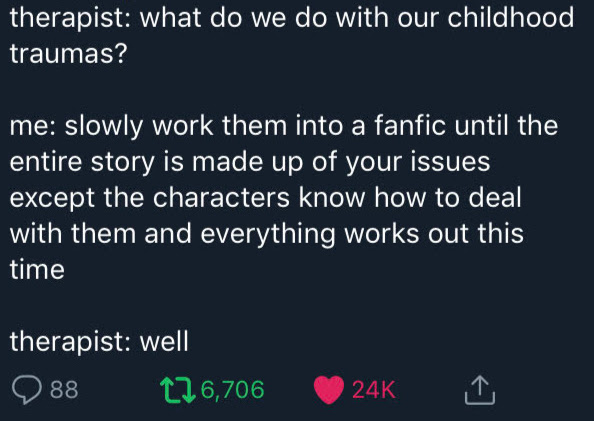
I also create comics and zines about aspects of my experiences.
Generally I use the personal sharing I do in such writing as an example: this is how you could do this kind of work, this is how you could understand how our experiences shape our habits, here’s a practice you might try. But sometimes I let the showing stand alone. Perhaps there’s not always the need to tell as well as show.
When is vulnerable too vulnerable?
This is complicated territory because writing from the vulnerable place is also risky. You could end up hurting yourself by trying to write about something which is still too raw and painful. The writing could stray into something over-sharing or self-focused in a way that doesn’t really connect with others. This is particularly likely if you’re still very caught up in the details of what happened in that particular situation. It could feel too vulnerable if people respond critically to it once you’ve put it out there.
There’s some kind of balance to be struck between the value of writing about what’s live when it’s live – the authenticity and sense of aliveness that kind of writing can have – and the wisdom of knowing when something needs more time before you approach it creatively – either in order to be safe enough for yourself, or for it to take a form that others can connect with.
On our podcast Justin and I often come up with ideas we’d love to cover but they feel too live for us – or for others in our lives – at the moment. We keep a list on our phones of topics that would be great to cover, but we want to come back to them when it feels like we have a bit more distance from them ourselves.
Another thing I do is to journal about the things that are really live initially in a format which is not for public consumption. I’ve filled hundreds of pages in the last year, going through major transitions in work, home, and relationships. Many of the ideas and practices that have come out of this writing will likely eventually find their way into my non-fiction and fiction writing, but it’s probably best that the writing I do for the initial processing is for my eyes only.
There’s an inner sense of ‘not ready’ and ‘ready’ which I’m beginning to trust in this – and other – aspects of life. For example, there will hopefully eventually be seven comics in this series, but this is the only one that’s felt complete enough to get down so far.
If something starts to take shape as a piece of writing for a reader beyond yourself you can always write it when live and return to it later. It’s a great idea anyway to separate the writing process and the editing process. This means that in the first drafting you can really sink into the flow and write it however it comes, knowing that you’ll be coming back to it before it goes out anywhere, so you can free yourself up to make mistakes and be imperfect. This is what Anne Lammot calls the ‘shitty first draft’ – something we’re allowed to do in writing and in life.
Personally I find it helpful to have a notepad or extra document open alongside my writing, where I write down the worried or critical thoughts I have about while I’m doing it: from information I need to check to issues around diverse representation. Then I know I can go back to those concerns during the editing process, but can park them and keep writing for now.
When I’ve written something and it has that feeling of potentially being too raw, or too vulnerable, to put out there at present, I leave it and return to it later: a month, a year, whatever.
I also have a sense of who my crew are for reading things that I’ve written which I’m not sure about sharing. If you know that the future version of yourself, plus several friends, will be reading the writing and feeding back about it before it sees the light of day, that can also help you to feel more free to write now.
Over time you can get a feel for what is just the right amount of vulnerable and what is over the line. Like if the exposure scale goes from 0-10 perhaps 5-6 is that sweet spot for things that are real and vulnerable in ways that stretch you a useful amount, and will likely connect with other people. But over a 7 is into the too-vulnerable zone and worth leaving till it feels less live. I’ve adapted this from an idea I got from Love Uncommon, that when our feelings are 0-7 the thing to do is to stay with them, but over 7 has tipped us into trauma/overwhelm and the thing to do there is to get back to a sense of being safe-enough before we try to stay with the feelings.
What if…
Here’s a few things people often worry about when writing about vulnerable stuff, plus my thoughts on them:
What if…people hate it?
I figure for everything I write there’s going to be a few folks who’ll really love it – the ones for whom it hits just the right point on the right day. Now that I have quite a lot of people who regularly engage with my stuff, there’ll probably be quite a few others who like it, which is great. Then there will be the vast, vast, vast majority of the world who have no idea who I am, no wish to read my stuff, and would feel pretty meh about it if they ever did. Then there’ll be a few people who – if they did read it – would totally hate it, either because they hate me – or people like me – or because it’s the opposite of what they think, or because they’re just having a bad day – or whatever.
In my case I’m generally writing for the people who find my stuff interesting, useful, or entertaining. Nobody else has to read it. If they do, and they don’t like it then that’s okay, they don’t have to read my stuff again.
What if…people are mean about me?
I think that people imagine that this will happen a lot if they put stuff out there, but it’s actually pretty rare. I write on some fairly controversial topics and I’ve very rarely have someone attack me or criticise my writing. It has happened, but to be honest it’s usually been something out of left field that I could never have predicted. I wouldn’t have avoided the experience by deciding not to write about the vulnerable stuff.
It’s definitely worth having some plans in place – if you write publicly – about what you’ll do if you do find yourself being criticised or attacked in a big way. Is there somebody who can take over your inbox and social media during the time it’s going on? Could you get away and do self-care till it’s died down a bit? Is there a holding message you can prepare in advance to put out while you take your time responding – if a response is required? Can you think advance of some kinds of filters to decide which kinds of critical feedback you’d like to take seriously and which you wouldn’t (around who gives it, in what form, what kind of issue it raises, etc.)?
What if…I change my mind later?
People worry that once you’ve written something it’s somehow set in stone and you could be judged for it FOREVER. I think it would be great if we could make a habit of returning to things we’ve written in the past and say how our views have shifted, or what we know now that we didn’t know then. We’re all in an ongoing process, and it’s not fair to judge a person now by who they were or what they knew 5, 10 or 20 years ago. Also culture is moving on and this makes it more possible to do better on many issues today than we might’ve done in the past. We could reflect on this process of change in our writing in useful ways – being accountable for the impact of our work – instead of being defensive and insisting that every word we’ve ever written was perfect.
What if…it’s vulnerable for other people I’m writing about?
This is where consent comes in (I said writing was like sex in more ways than one). If you’re writing about other people then it’s not okay to put something out there that could leave them vulnerable without their consent. There are several options here:
- Only write your story, not those of other people who might struggle to read themselves depicted, or to have themselves read about by others. Having had the experience of being reported about in the press twice without my consent I know very well how utterly traumatic, confusing, and powerless this experience can feel. I wouldn’t wish it on anybody.
- Keep things general rather than specific.
- Anonymise people (like I did when mentioning my clients earlier).
- Have consent conversations with people you would like to write about. Remember to acknowledge the power you have in the situation and any pressure they might feel under to agree to it: Ideally give them several options rather than just ‘go ahead’ or ‘don’t do it’. Take anything other than a definite ‘yes’ as a ‘no’. Remind them it’s fine to change their mind at any time (ongoing consent).
- Write collaboratively with the other people concerned so that you all have control over it together – this could be a useful process anyway.
- Write it as fiction rather than non-fiction, changing all identifying features, combining people together, or completely making up characters but keeping features of the experience true to life. This is what a lot of therapists do when they want to write about client work without breaking confidentiality. It’s what Alex and I do when we want to write a bunch of diverse experiences around an issue in our collaborative books.
There are complexities around all this of course when it comes to memoir writing particularly: what constitutes writing about somebody else versus telling your story? Again it can be useful to give yourself complete freedom to write what comes in the first draft, and then decide which strategies – or combinations of strategies – you’ll use to keep it ethical when you’re editing.
What if…I get something wrong?
You can go gradual. It’s not a binary of keeping something to yourself or putting it out there for all to see. You can have trusted friends read it first to give you a sense if it’s something worth sharing more widely. You can have sensitivity readers who you offer something to in return for reading it with an eye to particular aspects you want to be sure you’ve got right (e.g. axes of oppression you’re not personally familiar with but have written about, or science or history parts). If you have a publisher then you’ll have at least one editor who will read it before it goes out there. If it’s a blog then you can always share it only with a certain group of people, or put it out publicly but only share it with your social media friends or followers initially. And if you do get something wrong you can acknowledge that and change it immediately if it’s online, or in a later edition if it’s in print.
Writing vulnerable
Why would we write vulnerable stuff given all of these fears and potential pitfalls? I think that it does something very important for us personally, and for others reading our work.
Personally there is what Patrick Califia calls an antidote to shame in writing vulnerable stuff. This is often the stuff that we fear – deep down – might not be okay about us. Writing it and putting it out there is a way of saying ‘this is me, with all my inevitable frailties and failings and flaws, and I’m still okay.’ Under capitalism it could also be seen as a political act to challenge the success/failure and good/bad person binaries by speaking openly about our struggles, our mistakes, and our messes.
Related to this, writing vulnerable goes against the current pressure to curate and present a perfect image on social media and beyond (which brings with it a horror of being revealed as imperfect, which we inevitably are).
For me it’s always been about resisting the common depiction of the ‘self-help author’ or ‘expert’ who has it all together and doesn’t struggle in the way that ‘regular people’ do. Fuck that noise quite frankly. We hardly need another point of comparison to judge ourselves against and find ourselves wanting in the current climate. If we only put out our successes and triumphs and never our struggles and tragedies we’re feeding that culture of comparison. So we’d better get vulnerable.
Or we can sidestep the whole thing entirely as I do on Instagram and only share images of lovely nature/animals and food I’ve cooked (yes I am quite a good cook, but I’m rubbish at loads of other things I promise).
The post Showing Your Working: On Writing Vulnerable appeared first on Rewriting The Rules.
]]>The post Four things I’ve learnt about relationships for Poly Dallas Millenium appeared first on Rewriting The Rules.
]]>Why this means the world to me
Hi. Thank-you so much for having me here today. When Ruby approached me last year saying she would like to subtitle the conference this time after my book Rewriting the Rules I was blown away.

Partly this was because that book has been such a labour of love for me. It was the first self-help style book I wrote and I spent a decade longing to write it but unable to believe in myself enough to do so. When I finally did manage to battle through my inner critic I had to distill years of painfully finding my own way with relationships onto the page. The second edition – which just came out – was no less difficult. It felt like I was co-authoring it with an older version of myself and that was not an easy collaboration by any means.
Also it is a huge deal – as a European writer – to be welcomed to a US conference. A bunch of us have been studying and writing about polyamory in Europe for some decades now, but it often feels like the – often more recent – work coming out of US academia and activism eclipses what we’ve done, and are still doing. Of course this is even more the case for Europeans who sometimes or always write in languages other than English.
This is particularly challenging for me now that I’m working towards making my living as a writer. It’s extraordinarily hard to make any money from that line of work, and it can feel tough knowing that I am – I think – saying something new and important, but that few folk on this side of the pond will know about it. This recognition – and potential to speak to an American audience – means the world to me.
So it was already a huge deal to be invited to speak at this conference. And then I checked out the event online. It quickly became clear that here, finally, was an intersectional non-monogamy conference. For years I’ve been frustrated by the lack of coverage of power dynamics and social structures, privilege and oppression, in polyamory communities, and now I was being invited to an event where these were foregrounded.
It also felt intensely vulnerable. The main reason by far that I wanted to write a second edition of Rewriting the Rules was because when I wrote the first edition back in 2010 I had barely engaged with intersectional feminism. This has been something I’ve done my absolute best to address since then to the point that the vast majority of the thinkers I now engage with come from this approach, but I realise I still have a hell of a lot to catch up on. As a white British author to be invited to speak at a conference alongside the likes of Kevin Patterson, Dalychia Saah, J Mase and Feminista Jones is a huge honour and one I really hope I can do justice to.
This is why I haven’t taken the easy road with this presentation. I could’ve given you my standard hot take on non-monogamy talk that I’ve been giving the last couple of years, but you deserve more than that. So I’m going to heed the words of one of my heroes – Mollena Williams-Haas – from the incredible talk she gave at the Non-Monogamies and Contemporary Intimacies conference in Vienna last year (available here if you haven’t seen it – please do check it out). She said that the gift we need to give to the world is to go into the places we are most vulnerable and to work – whatever our work is – from that place.
I’ve been holding those words close ever since then. It is why I’m finally dropping my academic and therapy work to focus on writing. It is why my writing now includes memoir and erotic fiction as well as self-help: so that I can be transparent about where these ideas come from and why they mean so much to me. I guess it’s about showing my workings instead of just the polished advice that comes out of all that painful experience.
Because if I hide that part of it away I can be just another shitty self-help author holding themselves as a point of comparison to the rest of the world as somebody who has it all together and is going to lecture you on how to get it right just like them. This is one of the things I hate most about self-help and I’m committed to doing something different. A major theme through all my work is that relationships are extremely fucking hard and we all struggle in our relationships with ourselves, with our loved ones, and with the world. I’ve heard it said that your mess is your message. Perhaps the message is stronger if you also share the mess.
So I’m going to give you a short introduction to the key ideas of Rewriting the Rules, and then spend the rest of the talk telling you about what I’ve learnt about relationships since the first edition: by going into the mess.

Rewriting the Rules
Most relationship self-help books make a lot of assumptions about what a ‘successful’ relationship looks like, and how you go about having one. They sell the reader the dream of happy-ever-after, and put the blame on them if they can’t achieve it. That’s why I called Rewriting the Rules an anti-self-help book. Instead of locating blame in the individual it starts with the shitty cultural messages we all receive about relationships, suggesting that they are primarily responsible for the difficulties we come across. Messages like the idea that you have to find The One perfect person who will complete you, that you must hide any relationship conflicts from the rest of the world and pretend like everything is awesome all of the time, that you should have hot sex with this person for the rest of time, and that that must be in a monogamous relationship.
For each theme in the book – love, sex, gender, conflict, etc. – I asked four questions:
- What are the rules that we learn about this aspect of relationships?
- Why might we question them?
- If they don’t work for us, what might we put in their place? and
- What if we went beyond rules to embrace the uncertainty of this thing?
So, for example, in the monogamy chapter I look at the rules that suggest monogamy is the one true way of doing relationships, and how we can question that by looking at the statistics on non-monogamy globally, and on secret non-monogamy in countries like the UK and US. I explore the pressures that the monogamy ideal puts on relationships, and the diversity of monogamish and non-monogamous relationship styles that now offer alternatives to this. However, I also explore the tendency we have – when stepping away from mainstream cultural rules – to put new rules in their place and hold onto them just as rigidly. I suspect we’re all very familiar with varieties of poly-normativity and polier-than-thou tendencies to put forward the one true way of polyamory – or the poly grail, as I call it. Unicorn hunting, treating ‘secondaries’ as lesser human beings, and becoming so poly-saturated that you have no time for friends or self-care are three examples that spring to mind (not that me or anyone else in this room would ever do anything like that I’m sure!)
In Rewriting the Rules I try to steer clear of suggesting that any way of doing relationships is inherently better, more normal, or morally superior. It’s more about appreciating that different things work for different people, and in different relationships. We need to start by unpacking all the cultural rules that impact us all – whether we’re inside them or outside of them.

What I’ve learn about relationships since Rewriting the Rules
So that’s where I got to in the first edition of Rewriting the Rules, and I am still proud of that book because that cultural piece is missing from so much self-help around relationships – even polyamorous relationships.
However it could be argued that I went too far the other way. Focusing on wider cultural messages is also a good way of avoiding looking too carefully at closer-to-home reasons for your own relationship struggles.
Also, while I wrote a lot about the need to look at wider culture to inform our close relationships, I didn’t make enough connections in the other direction. How can going into the mess and vulnerability of our relationships help us make a better contribution to wider society? In the last five years this seems to me the most urgent question as we all try to make sense of a world of Trump and Brexit, to deal with the vital questions raised by – for example – #BlackLivesMatter, #MeToo, and the current moral panic around trans.
Here are four key ideas that I’ve woven into the new edition of Rewriting the Rules which I want to share. Obviously there’s only time to touch on them here – what they are and the implications they have for our relationships with our close people and the wider world. Hopefully they might be a jumping off point for more conversations and reflections though. There are free zines on my website covering most of these themes in a lot more detail if you find them useful.
-
Relationship patterns and intergenerational trauma
The first thing I wanted to include way more of in the second edition was relationship patterns: how they get formed, how they impact us and the people around us, and how we might be able to shift them. That involved taking a long, hard look at my own relationship patterns which have been something like this…
Did you see this show? It was one of my favs growing up. Every week this dog finds a new person and home, he helps them with whatever they’re struggling with, but once things are sorted he can’t stay and he has to head off down the road again. He’s basically a manic-pixie dream dog.
This was what I was doing in relationships of all kinds my whole life. I tried to figure out what people wanted me to be, and then I gave it to them. Initially that resulted in huge validation – I was good, and I was good for people. Once I was polyamorous I could be good for many people. What a good Littlest Hobo! But it’s unsustainable. And it hurt people and it hurt me, a lot. I’ve lost so many homes, people, companion animals. Too much loss. While I definitely don’t think the only relationships of value are the ones that last, I wouldn’t mind the chance at a relationship, home, family, or community that lasted longer than five years.
The cultural piece was part of this of course. The promise of being – and getting – The One definitely had a role to play in my struggles, as did the Hollywood promise that true love is the path to lasting happiness – whether in its monogamous or polyamorous form.
But – as with all of us I suspect – my history was also a big part of the picture. Perhaps the major piece of work I’ve been doing the last couple of years has been on this. Interestingly #MeToo was a huge part of it. My sisters and I started by sharing our experiences of sexual assault – growing up and in more recent years, including in polyamory communities. This opening up led us to sharing stories of our upbringing and identifying the impact of intergenerational trauma and how it had left all of us feeling that we were unacceptable unless we covered over our emotions and pretended to be something we were not. We now talk on Google hangouts between San Francisco, LA, and London every few weeks, committed to building a different way of relating, at least between the three of us.
-
Self and other consent
How can I challenge this pattern – which I suspect many others share – of trying to be what others want me to be? Self-consent is the key here. One of the main books that I drew on in the second edition of Rewriting the Rules was bell hooks’s All About Love.

My main takeaway from this was that love can’t happen – isn’t even love – unless we value ourselves and each other equally. That’s where you get to if you apply the same thought processes to social justice and to interpersonal relationships.
Learning self-consent is every bit as hard as learning how to – really – treat others consensually in a world of massive power imbalances and insidious social scripts, as Zach Budd highlighted at the Poly Dallas conference. It’s still a work in progress for me: a lifelong process I suspect. But it includes noticing when I let desire for approval, fear of failure, or a deep-down belief of my unacceptability override what I really feel. It requires cultivating kindness and practicing self-care: not the neoliberal capitalist bubble-bath kind of self-care but the Audre Lorde long-hard-look-at-yourself self-care that we all need to make a daily practice if we want to stop harming ourselves and others on an interpersonal – and a global – level.
-
The drama triangle
The other idea I brought into the new edition was Stephen Karpman’s drama triangle. If you’re not familiar with it it looks like this.

The idea is that, in relationships, we often get drawn into stuck dynamics where we go round and round this triangle. For example my Littlest Hobo dynamic easily puts me in the role of rescuer – coming in and making somebody’s life all better so that maybe – in the immortal words of Julia Roberts in Pretty Woman – they will ‘rescue me right back’. The problem is if you get invested in the role of rescuer you easily put the other person in a double-bind. They must get better so that you can feel you’ve been a good rescuer. Also they mustn’t get better because then you’ll be out of a job. It’s easy then to shift from rescuer to persecutor because you’re actually treating somebody pretty badly. And easy to shift again into victim because rescuers really don’t like people pointing out that they’re actually being persecutors.
Sound familiar? I think that this triangle has so much to offer what we’re grappling with in our wider communities. When #MeToo 2.0 hit some of the polyamory communities in the UK it took a familiar form. One individual abuser was highlighted, survivors shared their stories of his behaviour, and others aligned themselves with two different forms of rescuing: either becoming saviours for the ‘victims’, or bystander-apologists for the persecutor.
If we’re going to get to grips with the abusive dynamics that inevitably show up in our relationships and communities – in a culture founded on oppression and unequal valuing of different bodies and lives – then I think we have to stay with our capacity to occupy all three positions on this triangle. We need to get to know our inner victim, our inner persecutor, and our inner rescuer. That involves a whole heap of self-kindness, as well as the intensely vulnerable self-care work of staying with feelings.
-
Staying with all the feels in all the relationships
Learning our part in drama triangles – interpersonal and social – involves staying with how it feels to be in all of those places. For example, the work that my sisters and I are doing involves going back into our intensely vulnerable victim/survivor places: recognising that the various kinds of experiences we went through at young ages was not okay, and that the strategies that we developed to survive them made all kind of sense. It also involves recognising how much of that intergenerational trauma came out of us being on the receiving end of other people’s survival strategies, and how our own survival strategies have also now hurt other people.
Staying with our persecutor potential is hard as hell of course. It involves being with the guilt and shame and fear of our potential to harm others and to harm again. It involves going beyond the temptation to focus on obvious forms of abuse and non-consent – that we may not have engaged in – to the micro level emotional gaslighting, manipulation, and non-consensual pressure that we all take part in our day-to-day relationships, and the macro level dynamics of oppression that we all benefit from and are implicated in whether we like it or not.
Staying with our rescuer involves recognising our tendency to focus on obvious abusers and villains to avoid looking at the damage we do – for example by setting ourselves up as saviours, by not addressing our privilege and power, or by failing to acknowledge our limits and taking on too much only to let people down.

It’s hard fucking work, but we have to do it. And it involves developing our capacity to stay with all of the feelings in all of our relationships. So many of our survival strategies, relationship patterns, and non-consensual tendencies comes from endeavouring to avoid feeling the feelings that scare us: shame, anger, fear, sadness, loss. And of course, like a hamster on a wheel, most of these tendencies will fetch us right back where we most wanted to avoid. As Anita Cassidy puts it: ‘Feeling shit doesn’t kill you, but the shit you do to stop feeling shit might.’
An important caveat to this is, of course, with all these things (being present, staying with feelings, being vulnerable) they have to be done in a container of huge self-kindness, self-compassion, and self-care. Those things always have to come first and foremost. It’s easy to do these things because you think you should, and for them to end up being far too much. So taking it slowly, prioritising kindness over all else, and getting support with it, are all vital.
I think we all have to do this work, and I think that doing this work will look different for all of us. For me it has included a combination of journaling about the hard stuff, sitting with my feelings by the Thames, reading people who challenge me on social media, deliberately practising showing close people my vulnerability bit-by-painful-bit, and – perhaps unexpectedly – tuning into my erotic fantasies and writing erotic fiction.
Right now it involves the painful messy work of acknowledging my relationship patterns with existing – and new – partners, and how far I may – or may not – be able to shift them given how strongly entrenched and sneaky they are. I’m convinced though that this can be a joyful process as much as it is an excruciating one – often both of those things simultaneously. And if it’s going to make any difference it’s one we have to do together in our relationships, in our families, and in our communities.
Further Resources
- Rewriting the Rules.
- My zine on self-care.
- My zine on staying with feelings.
- Meg-John and Justin podcast on staying with other people’s feelings.
- Love Uncommon posts on how to do self-consent.
The post Four things I’ve learnt about relationships for Poly Dallas Millenium appeared first on Rewriting The Rules.
]]>