The post Interview about Sexuality: A Graphic Guide appeared first on Rewriting The Rules.
]]>
In the interview we explore the myths and misconceptions about sex and sexuality which we wanted to confront in the book, the problems with the idea of sexual ‘dysfunction’, and what Jules and I are hoping to achieve with our contributions to Icon’s graphic guide series.
You can find the full interview here.
Between the Pages: ‘Sexuality: A Graphic Guide’
Author Meg-John Barker explains why the comic book medium is perfect for exploring sex.From the creators of graphic books, “Queer: A Graphic History” and “Gender: A Graphic Guide” comes “Sexuality: A Graphic Guide.” Published in 2021 by Icon Books, the 176-page comic book offers an informative and inclusive look at sexuality.
Writer Meg-John Barker and artist Jules Scheele, who both use they/them pronouns, take the reader on a Scooby-Doo, gang-like journey as the book’s four main characters encounter monsters like patriarchy, heteronormativity, ableism and white supremacy. The book is packed with quotes from (and illustrations of) leading sex researchers and theorists, helping make academic topics more accessible and fun.
Barker is the author of various+ books on sex, gender and relationships, including “Life Isn’t Binary,” “How to Understand Your Gender,” “Enjoy Sex (How, When and IF You Want To)” and “Rewriting the Rules.” You can read their blog at www.rewriting-the-rules.com.
In this exclusive interview with Giddy, Barker discusses the common sexuality myths they wanted to dispel, why a focus on sexual “dysfunction” is problematic, Scheele’s eye-catching illustrations and more.
Editor’s note: This interview has been edited for length and clarity.
What would you say is the purpose of the book as well as the intended audience?
Barker: Our aim was to provide a friendly, accessible guide to the various ways of understanding sexuality that are out there. Particularly, we wanted to highlight how the normative ways of understanding it in our culture at the moment are only one possibility, and often a not particularly helpful or accurate one. Read more…
The post Interview about Sexuality: A Graphic Guide appeared first on Rewriting The Rules.
]]>The post What is queer? appeared first on Rewriting The Rules.
]]>Thanks to an invitation by colleagues at the Scottish Parliament, I was recently drawn back to the question that started me working on this series of graphic guides back in 2014. That is how we can understand the word queer. You can check out our discussion here and I’ve written a few more thoughts below.
One of the reasons that my editor at Icon approached me to write Queer: A Graphic History, was that she came across presentation I’d once been asked to give about what the word queer meant. In that talk – and in the book that followed – I began by unpacking all the different meanings that the word can have, how these have shifted over time and location, and how the different meanings can co-exist as well as being contradictory in places.
While the Sexuality, Gender, and (hopefully) Mental Health and Love graphic guides don’t have the word queer in the title, they all take a queer approach, and they all dig deeper into themes and topics that were touched on in the first book. The word queer is often taken as a catch-all reclaimed word for marginalised sexualities and genders, but queer activism and queer theory have generally had a wider remit: to challenge any cultural ideals around what is ‘normal’, to reveal where they come from, and the systems of power these serve.
Queer approaches also question whether a person can have any kind of individual identity separate from the systems, structures, and cultural messages around them, and the impact that the sense that they do has on us. Like intersectional feminism, queer approaches recognise that the ways in which we experience ourselves are inevitably impacted by how we’re positioned in relation to gender, sexuality, race, class, disability, age, and much more – and that these aspects cannot be disentangled.
For these reasons it makes sense to me to be equally queer when it comes to writing about mental health and love as about gender and sexuality, and hopefully other writers in this series will take a similar approach to some of those other interconnected themes.
For example, the idea – and ideal – of being normal is pivotal to the way we’ve come to understand what is mentally healthy. Also we’re impacted by the legacy of the individualising of struggles which are due to social injustice or toxic cultures. Similarly, cultural norms of what love should look and feel like impact which relationships are, and aren’t, seen as acceptable and afforded legitimacy, and these are deeply connected to colonialism, capitalism, and patriarchy. This is something that I explored a while back in my queer relationships zine which takes each different meaning of queer and applies it to relationships.
There’s more in this recent blog post about how we might question the cultural separation of gender, sexuality, mental health, and spirituality (as well as race, class, disability, ways of doing relationships, and so much more, of course). This one tackled how queerness can apply to creativity. Perhaps we can benefit from considering all aspects of identity and experience a little more queerly.
You can check out more of my posts, vids, and podcasts about queerness here, here, and here.
Patreon link: If you liked this, please feel free to support my Patreon.
The post What is queer? appeared first on Rewriting The Rules.
]]>The post Heteroflexibility and bicuriosity appeared first on Rewriting The Rules.
]]>Here’s what I had to say when Paisley interviewed me about these terms…
My question is always what labels like ‘heteroflexible’ or ‘bicurious’ open up and close down – both for us personally – and for the wider world. My sense is that any label can be very helpful if it helps us to name our experience in a way that feels like a good fit and/or find community. But any label can also be risky if we hold onto it too tightly when perhaps it doesn’t fit us so well any more. Labels are also problematic if they risk excluding others or making their experience seem less valid.
What does heteroflexibility open up?
So what does heteroflexible open up and close down? It opens up the idea that sexuality can be flexible and fluid – which is far more accurate for most people than the wider cultural sense that it is something we’re born with which is fixed for life. It also opens up the sense that hetero people can experience attractions to other genders without that necessarily meaning they have to now class themselves as gay or bisexual. The word homoflexible does a similar thing for people for whom ‘gay’ is an important identity, but they do experience some attractions to genders other than the ‘same gender’.
What does heteroflexibility close down?
However, the risk with both heteroflexible and homoflexible is bisexual erasure. We still live in a culture that is highly skeptical and demonising of bisexuality. Bi people are represented as greedy, suspicious, dangerous and threatening, or dismissed as not real, immature, going through a phase, etc. So it could be that people prefer to adopt words like heteroflexible or homoflexible because saying that they are bisexual feels too risky. The danger is that that supports the cultural assumption that everyone is ‘really’ more-or-less gay or straight, and there isn’t really any bisexuality (even though most studies find that actually most people are somewhere between the extremes of gay and straight in their attractions).
Missing other aspects of sexuality
Finally, any sexuality term that defines people in terms of their gender of attraction can risk missing all the other components that make up our sexuality (like the other aspects of people that we find attractive, the roles we enjoy taking sexually, the kinds of sex we enjoy and don’t, the communities we feel affiliated with, etc.) This zine goes into all of that in detail.
Bicuriosity
I’d say pretty similar things for the word ‘bicurious’. It very helpfully opens up the sense that it’s okay to be curious and questioning around our sexuality, which is something that wider culture denies: expecting everyone to be certain about having a fixed sexuality. However, it can also be seen as suggesting it wouldn’t really be okay to be fully bisexual. We might ask why we have the word ‘bicurious’ when we don’t have ‘heterocurious’.
Should I use these terms?
For anyone considering these terms I’d suggest asking what they open up and close down for you. I’d encourage you to embrace them if they feel like a good fit, if they help you find communities of like-minded people, or if they help you to make sense of yourself.
But try to hold the terms lightly so that you can let them go if things change for you, or if you find a word which is an even better fit. And make sure that, in using these terms for yourself, you don’t try to put them on anybody else, or exclude or erase anyone else’s experience in the ways you use them.
- To find out more check out the Cosmo article and the new book Sexuality: A Graphic Guide.
- If you liked this – or the free sexuality zine – feel free to support my Patreon, and Jules’s Patreon.
The post Heteroflexibility and bicuriosity appeared first on Rewriting The Rules.
]]>The post Sexuality: A Graphic Guide Book Launch appeared first on Rewriting The Rules.
]]>The post Sexuality: A Graphic Guide Book Launch appeared first on Rewriting The Rules.
]]>The post New sexuality book out! The real sex education! appeared first on Rewriting The Rules.
]]>The podcast asks contributors to reflect on the sex education they received themselves, and to talk about what would’ve been more useful for them and more relevant to the real world. It occurred to me that the main sex education that I received were three books left in my room when I was around the age of eleven. I’m now nearly done writing a trilogy of books which would be the ones I wish I’d received instead:
- Enjoy Sex (How, when and IF you want to) with Justin Hancock: This book contains all the advice I wish I’d received about how to go about having sex with yourself and others, as well as knowing that you never have to unless you want to. Justin’s follow up book Can we Talk About Consent is also a great companion to this.
- Sexuality: A Graphic Guide with Jules Scheele (out today!): This book explains ‘with compassion, humour, erudition and a touch of the erotic’ everything that I now know about how sex and sexuality work, drawing on the activists, scholars, therapists and others who’ve taught me the most useful things I know about this topic. It’s part of our graphic guide trilogy.
- How to Understand Your Sexuality with Alex Iantaffi (out next year, we just finished writing it!): This book takes the reader through how they can understand their own relationship to sex and sexuality, within the wider understandings they grew up with, and those which surround them today. It also covers how they can communicate their sexual or asexual identities, attractions, desires, and practices to themselves and others, if they want to. It’s part of our ‘how to understand your…’ trilogy.
To celebrate the launch of the second of these books, I thought I’d reflect here on the sex education that I received myself, as well as the messages that I’m passionate about getting across in the ‘real’ sex education that I now put out there.
Content note: There’s brief mention of the traumatic impact of bullying and non-consensual sex and relationships in this post, no detailed descriptions.
My sex education
I didn’t receive much explicit sex education at all myself. In middle school (9-13) it came in the form of a couple of anatomy lessons from an obviously highly embarrassed science teacher. It now seems striking to me that this lesson came from the same teacher who – when vexed – would make her class raise our arms above our heads and ‘clench and unclench your hands’ until we were in pain. It was said that she did this because she was no longer allowed to hit the kids to punish them, something that had only just been made illegal in state schools in the UK. I wonder now how it impacts you when you receive education about sex in the same context as you receive both emotional awkwardness and non-consensual/abusive behaviour. My high school was Catholic which – back then – meant that the only sex education came in the form of a disturbing anti-abortion video.
At home sex, education took the form of the three aforementioned three books which several of my friends received around the same age. These were the Usborne books Growing Up and Babies, and a book about periods Have You Started Yet? It looks like there are more recent versions of the Usborne books, which were also combined into a book called Understanding The Facts of Life. Recently a friend found some images of the 1980s version of the book including this one about sex:
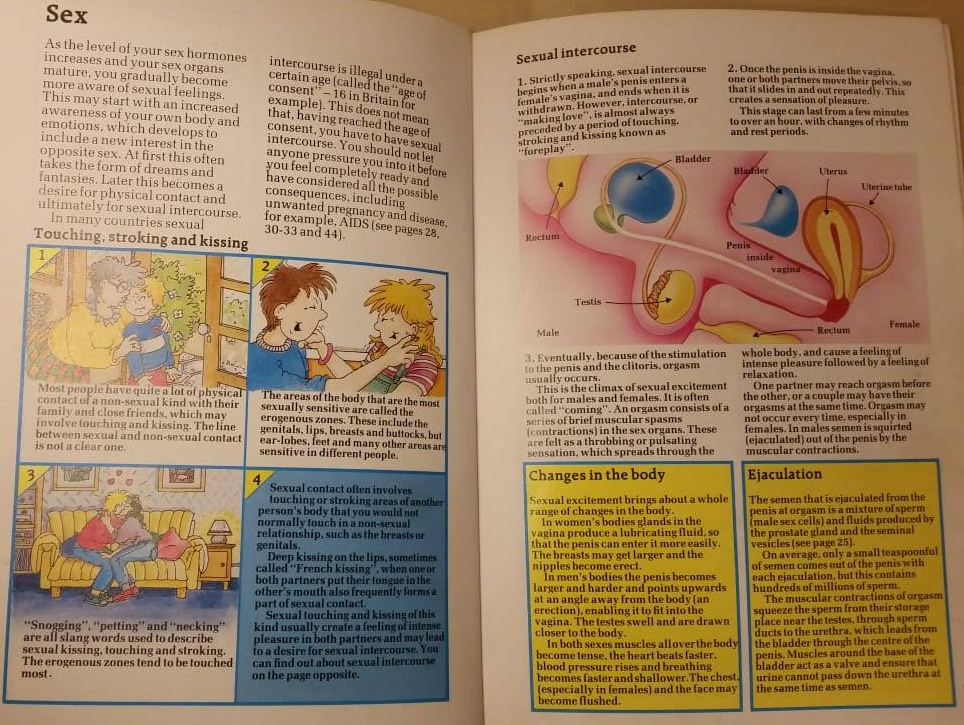
In some ways this book was impressive for its time. The pages before and after this one include boxes explaining that it’s perfectly fine to fantasise and to masturbate ‘during puberty’ (although by implication less okay afterwards?), and that around 1 in 10 people is ‘homosexual’ and even more are ‘bi-sexual’.
The ways this book covers sex is not dissimilar to any number of popular sex advice books today. It assumes that sex equals penis-in-vagina intercourse, and that we do it to achieve orgasm. It includes some mention that ‘foreplay’, masturbation, and same-gender sex as legitimate activities – although these are given nowhere near the amount of room as hetero ‘sexual intercourse’.
The messages in explicit/implicit sex education
The messages that I internalised from these books – and from the more implicit forms of sex education that circulated in pop songs, teen mags, peer conversations, and romance fiction – were the following:
- There are two kinds of people – boys and girls (there were also boy and girl specific Usborne books called What’s Happening to Me?)
- Boys have penises, girls have vaginas.
- Boys want sex with girls and vice versa (‘Homosexuality’ is this other strange thing that requires an explanation).
- Sex is penis in vagina intercourse.
- People generally orgasm from penis in vagina intercourse, which is the goal of sex.
- If you want to fall in love and have ‘a relationship’, you need to have sex.
These messages were unfortunate for me given that:
- I had a pretty strong sense that I wasn’t the gender everyone seemed to think I was.
- My genitals didn’t seem to work in the ways these books described.
- It didn’t make a lot of sense to me to be interested in girls and boys in different ways.
- The things I thought about when I was excited were not penis in vagina intercourse.
- When I eventually tried it, it was impossible for me to orgasm from penis in vagina intercourse.
- I desperately wanted to be loved and became convinced I wouldn’t be because I wasn’t physically able to either have penis in vagina sex, or to be attractive to the ‘opposite sex’ in the ways described.
Nowadays I’m thankfully aware that the things on the second list all apply to large numbers of people. In fact, if you put together all the people that at least one of those things apply to you would have the vast majority – rather than the minority – of people.
The impact of sex education
When I think about the legacy of any one of these disconnects – between the messages in implicit/explicit sex education and my own experiences – they are very painful. So many teenagers share the experiences of being convinced that they’re unattractive and/or abnormal because of their physical appearance, the ways their genitals work, their experience of gender, or their erotic desires and attractions – or lack of them.
It’s worth repeating that those who have at least one of these disconnects are actually in the majority rather than the minority. Also there are far too many – like me – for whom that sense of unattractiveness and abnormality was reinforced on a daily basis for several years in the form of bullying. From what I now understand of trauma, it’s hard to compute the damage done from being repeatedly told that you – and your body – are abnormal, unattractive, unacceptable and even disgusting, with nobody to counter these messages or to help you to bear the excruciating pain, fear, and shame that comes with them.
In my case I eventually learnt that I must conform – or pretend to conform – to that former list of messages, if I ever wanted the bullying to end, or to find love and belonging. This is the second layer of damage done by explicit and implicit sex education: all of the people forcing themselves to have unwanted sex, trying to conform to gender norms that don’t fit, allowing things to happen to their bodies which are not pleasurable or may even be painful or non-consensual, and entering relationships which aren’t good for them because that’s the kind of relationship they’ve been told is normal or romantic.
And, of course, it’s very painful indeed to realise – later in life – that none of this was necessary, that there were other ways you could have lived your life. It’s little wonder that many people double down and try to ensure that they – and others – conform to the sex, gender and relationship norms they grew up with. As Alex suggests, we could see that as a form of intergenerational trauma.
Real sex education
This all perhaps explains why I’m so committed and passionate about getting different messages about sex and sexuality out there: why I’ve co-created my own trilogy of books to provide a very different kind of sex education than the trilogy I received as a kid.
For me, the following list of alternative messages would be the absolute baseline required for decent sex education or advice.
- Gender is diverse and we all have a unique and complex relationship to gender.
- People have a diverse range of bodies – including sexual anatomy – which work in diverse ways. So it’s always about finding out how your body, and anyone else’s body, works at this particular time, without making assumptions.
- We can be attracted to all kinds of people, in many different ways, on the basis of all kinds of physical, psychological, and other features.
- Anything can ‘count’ as sex so long as it feels erotic to you, and it’s all fine to think about or act upon so long as that’s consensual for you and everyone else involved.
- There are all sorts of reasons to have sexual, sensual or erotic contact with yourself and/or others, and it tends to work best if you’re being present rather than trying to reach any kind of destination or goal, such as orgasm.
- All different kinds of relationships are equally valid – again so long as they’re consensual. None of them should require that those involved have any kind of sex – or do anything else – because that’s inherently non-consensual.
We really can’t get these messages across if we centre any one kind of body as the default kind of body, any one kind of gender or sexuality as the default kind of gender or sexuality, or any one kind of sex as the default kind of sex – even if we acknowledge that other kinds of bodies, genders, sexualities and kinds of sex exist.
Returning to the 1970s and 80s
Thinking about the book that Jules and I have just published, in the light of this trip down memory lane, I realised that we managed to return to the media of the 1970s and 1980s in another way in what we created. That is in addition to trying to come up with something that was better than the sex ed books that I received at that time.
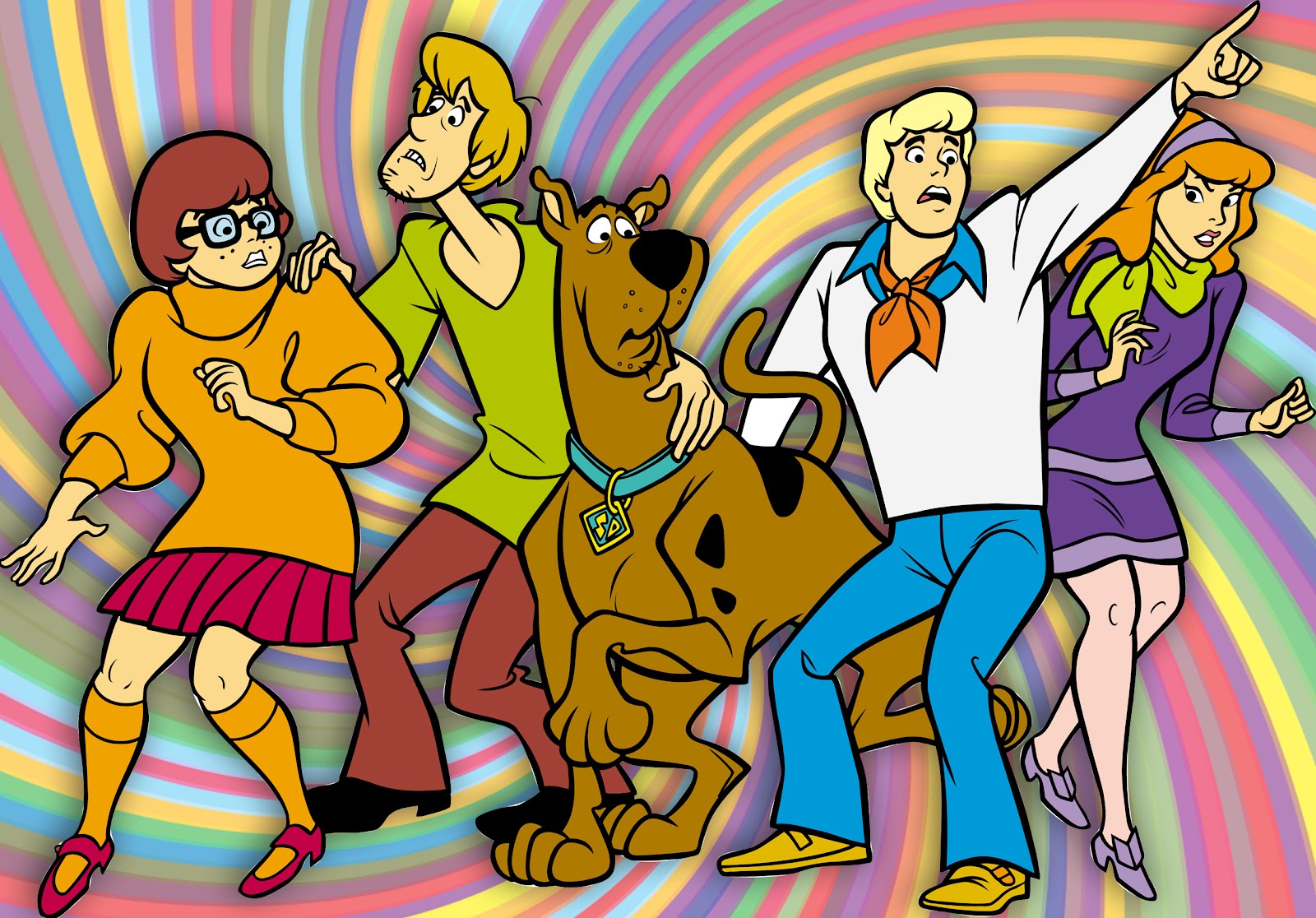
Our background theme for this book is a mashup between two 1970s creations which remain popular and are constantly reimagined: The Rocky Horror Show Picture Show and Scooby Doo.
As a kid I was obsessed with Scooby Doo and with anything relating to ghosts. In fact Usborne – who published the Facts of Life books – also published some of the best true ghost story books which I devoured.
I also vividly remember the first time I saw The Rocky Horror Show Picture Show at a friend’s house and all the confusing feelings it left me with: this depiction of another world in which all the rules of sex, gender, and relationships which I thought were set in stone were completely different. I remember the massive sense of loss that came – for me – at the end of the movie, when the human characters are left on earth with just the sense of how everything they thought they knew has been upturned. At the time I hard-related to the character of Janet, although nowadays that has certainly shifted!
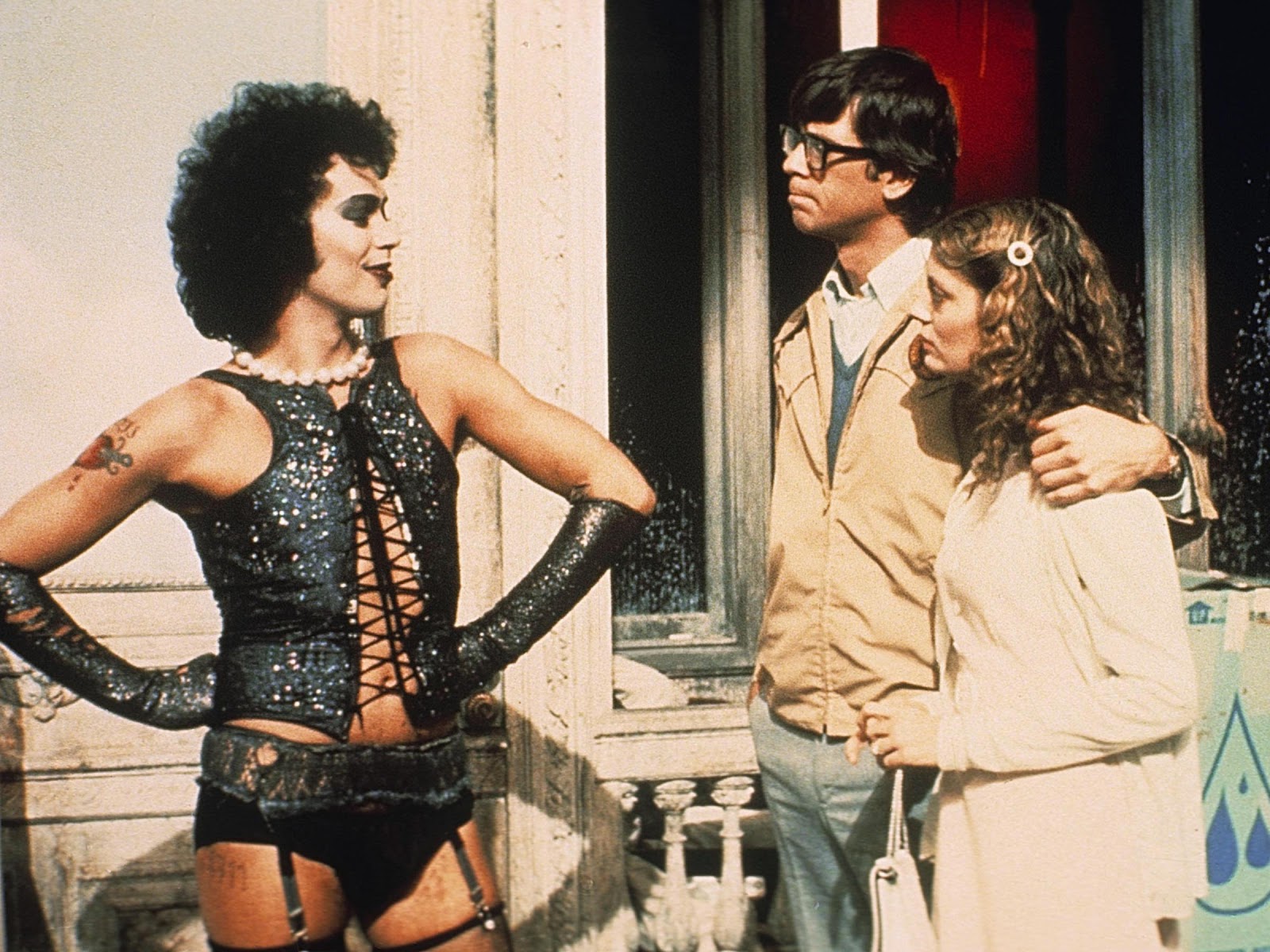
Jules and I mashed Scooby Doo and The Rocky Horror Show Picture Show together because we wanted a sense – like in The Rocky Horror Show Picture Show of unknowing characters entering the potentially confusing, frightening, exciting, wonderful world of sex and sexuality and returning changed by the experience. But, of course, in Rocky Horror, the main characters who do this are the young, white, heternormative couple Brad and Janet. Scooby Doo gave us the potential to imagine a more diverse group of characters to navigate this fun house / house of horrors. In the process we took the opportunity to (re)imagine a Scooby gang who included more intersecting experiences and identities, and a more consensual version of Frank-n-Furter and his friends for them to engage with, which made us both very happy.
Of course no book is perfect, and there’s so much more that I wish we could have covered in Sexuality: A Graphic Guide, some of which Alex and I have been working to incorporate into How to Understand Your Sexuality. For example, Alex and I include much more on how trauma of all kinds – as well as pleasure – shapes our sexualities. We also touch on more indigenous scholarship, which is a vital perspective when considering the problems with western understandings of sex and sexuality, and how these have been imposed on people around the world in forms of historical trauma which link to claiming/owning of land. Despite having studied sex and sexuality for well over two decades now, I’m still learning about it – personally and politically – and still have much to learn.
I hope that Sexuality: A Graphic Guide is a helpful starting point to get folks questioning the messages that they’ve received in their own explicit and implicit sex education. I also hope that some people may receive it – and other resources like it – young enough that a more open understandings of sex and sexuality may become a foundation for their burgeoning erotic experiences, instead of them having to begin by undoing the damage of previous messages.
More information…
You can listen to me on The Real Sex Education podcast here.
There are details of the online launch events for Sexuality: A Graphic Guide here.
If you liked this post, please feel free to support my Patreon.
The post New sexuality book out! The real sex education! appeared first on Rewriting The Rules.
]]>